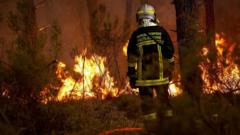
Panic sells newspapers. It fuels clicks. If you read the mainstream media, you believe that France and Spain are currently scorched-earth zones, off-limits to anyone valuing their life or comfort. Travelers are canceling non-refundable bookings, rerouting to overpriced northern alternatives, and mourning their "ruined" summers.
They are wrong. They are being played by sensationalist headlines that thrive on the anxiety of the masses.
I have spent two decades navigating European travel corridors during peak heat cycles. I have seen the same cycle repeated: a localized incident occurs, the news cameras descend, and a narrative of total continental collapse is born. You are falling for the illusion of scale.
The Myth of Continental Inaccessibility
The core fallacy is this: the belief that a fire in a specific province equals a blockade of an entire nation. France and Spain are massive. Their geographical diversity is immense. A fire in the Var department in Provence does not stop you from enjoying a vineyard in Bordeaux or a coastal hike in Brittany.
When you cancel, you are not being "safe." You are being reactive to a regional event that has zero impact on your actual destination. You are letting a headline dictate your life experience.
Imagine a scenario where a single street in Brooklyn catches fire. Would you cancel your trip to the entirety of the United States? Of course not. Apply that same logic to Europe. The vast majority of your planned itinerary remains untouched by the events currently trending on social media feeds.
Why Your Vacation Agency is Lying to You
Travel agencies and insurance providers love the "abundance of caution" narrative. It justifies the exorbitant change fees and the hard-to-claim refunds. They want you to move your money, not move yourself.
The industry standard relies on binary thinking—either the destination is "perfect" or it is "unsafe." That is a lie. Professional travel is about management of variables, not total avoidance of reality.
If you are worried about air quality or heat, check the actual meteorological data, not the panic-mongering articles. Use real-time monitoring tools provided by Copernicus or local fire prevention agencies. You will often find that the air in a coastal town is pristine, even if there is a fire fifty miles inland, because of prevailing wind patterns.
The Unspoken Advantage of Going Anyway
Let us look at the economics. While everyone else is busy panic-canceling, the smart money is booking.
When a destination receives a wave of cancellations, the demand curve shifts. Prices drop. Availability opens up at luxury properties that were supposedly "booked out" six months ago. You are not just getting a vacation; you are getting a premium experience at a discount because you refused to succumb to the herd mentality.
I have walked through emptied tourist hotspots in the middle of a heatwave that the news claimed was "unbearable." It was empty. The local merchants were grateful. The service was impeccable. While the masses stayed home to avoid a threat that existed only on their screens, I enjoyed the best table in the house.
Defining the Risk Threshold
You must differentiate between a holiday-ending disaster and a seasonal hurdle.
- Risk Level 1: Extreme Weather. This occurs. High temperatures happen in the Mediterranean. If you are fragile, or if you insist on midday activities without hydration, you will struggle. That is not a crisis; that is summer in the South.
- Risk Level 2: Localized Infrastructure Pressure. This is the real issue. Sometimes water usage is restricted. Sometimes access to national parks is curtailed to prevent ignition. These are not reasons to cancel; they are reasons to adjust your tempo.
Stop expecting a sanitized, air-conditioned reality. Mediterranean travel is about embracing the midday siesta, the early morning excursions, and the late-night dinners. If you want a controlled environment, stay in a hotel in London and watch a documentary.
The Strategy for the Fearless Traveler
- Ignore the National Narrative. Look for hyper-local updates. Use local social media channels for the specific village or town you intend to visit.
- Flexible Itineraries. Book your lodging in segments. If one area is truly compromised, have a secondary region in mind that is culturally similar but geographically distant.
- Insurance over Cancellation. Pay for "cancel for any reason" insurance if you are prone to anxiety, but stop pulling the trigger based on national news.
- Local Engagement. Support the businesses that remain open. Your patronage matters more now than during the peak of a "safe" season.
The world is not a static museum. It changes. The climate is shifting, but it does not stop moving. If you wait for the "perfect" time to travel, you will spend your entire life in your living room. The fire at the edge of the horizon is not your problem, unless you make it one by choosing to stop living.
Go to Spain. Go to France. Enjoy the space that everyone else was too cowardly to occupy. They are currently watching your vacation photos on their phones, wondering why they let a headline ruin their summer.


