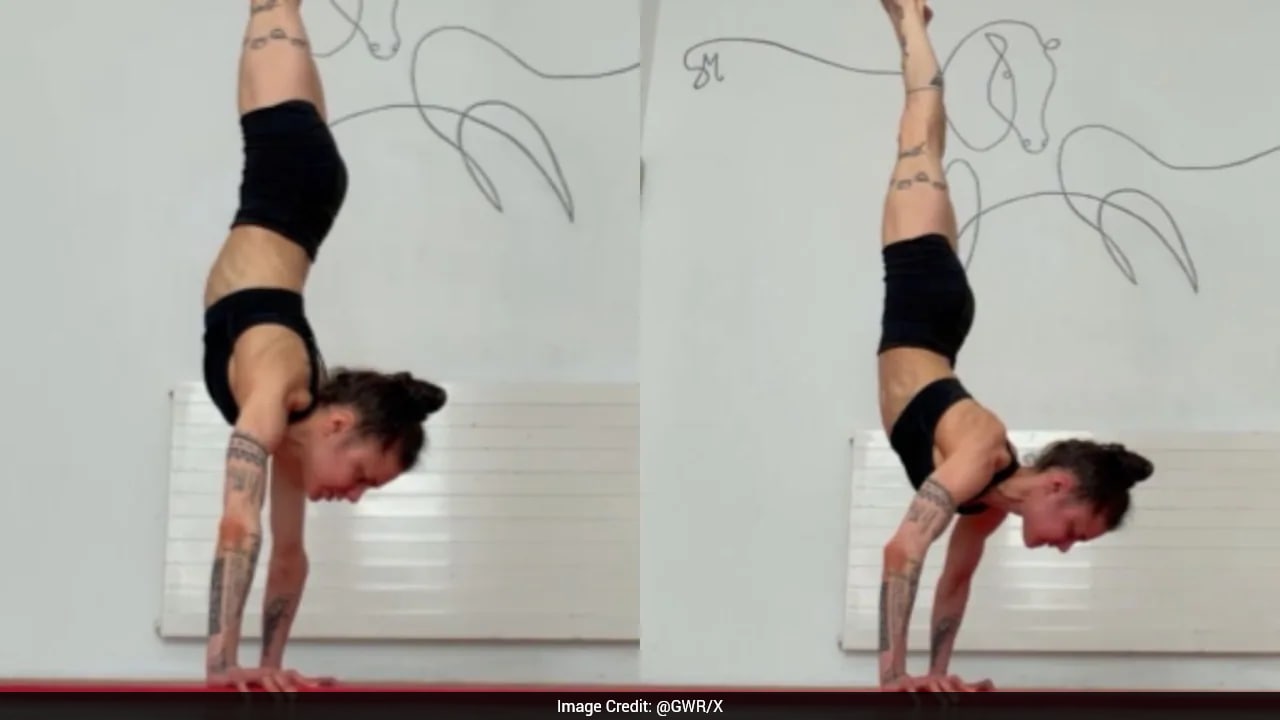
Achieving twelve consecutive nose-to-ground handstand push-ups in a sixty-second window requires an exceptional intersection of maximum strength-to-weight ratio, metabolic buffering capacity, and precise kinetic chain alignment. When an athlete lowers their body until physical contact is made between the nasal bridge and the support surface before pressing back to full elbow extension, the mechanical work per repetition reaches maximal limits. Standard handstand push-ups often rely on partial range of motion or kipping momentum. Eliminating momentum while forcing full depth transforms a traditional gymnastic strength display into an extreme test of human kinetic efficiency.
The Kinematic Cost Function of Deep Range Pressing
Every repetition of a nose-to-ground handstand push-up introduces a compounding structural deficit. The total vertical displacement is dictated by the anthropometry of the individual, specifically the distance from the metacarpal heads to the acromion process combined with cervical and skull dimensions.
During the eccentric phase, the center of mass must remain precisely aligned over a narrow base of support established by the hands. As the elbows flex past ninety degrees, the lever arms operating on the shoulder girdle lengthen significantly. The anterior deltoids, clavicular head of the pectoralis major, and the triceps brachii must absorb eccentric load while maintaining lateral stability of the scapulae.
[Start: Full Extension]
       │
       ▼ (Eccentric Phase: Precise vertical trajectory)
[Midpoint: 90-Degree Elbow Flexion / Peak Moment Arm]
       │
       ▼ (Terminal Eccentric: Nasal contact with floor)
[Isometric/Reversal: Zero-momentum transition]
       │
       ▼ (Concentric Phase: Triple extension of upper limb)
[Finish: Full Extension]
The primary mechanical failure point in this movement is not merely the concentric push, but the precise control of the transition zone. Reversing momentum from a dead stop at the bottom position—where the nose touches the floor—requires an immediate recruitment threshold of high-threshold motor units without the benefit of the stretch-shortening cycle operating at peak efficiency. The isometric pause required to confirm authentic contact with the ground eliminates elastic energy storage in the tendon-muscle complex, forcing pure muscular contraction to initiate the ascent.
Energy System Demands and Metabolic Bottlenecks
Performing twelve repetitions of this caliber within a single minute places distinct demands on human bioenergetics. While sixty seconds falls primarily within the glycolytic energy pathway, the instantaneous force production required for each repetition introduces a heavy reliance on the phosphagen system during the initial concentric drive.
- ATP-PC Resynthesis Constraints: Each single repetition demands maximal neural drive, depleting intramuscular adenosine triphosphate and phosphocreatine stores within the prime movers.
- Local Ischemia and Venous Occlusion: Inversion combined with sustained upper body isometric tension restricts venous return and capillary perfusion in the upper extremities. Blood pressure spikes dramatically to maintain cerebral and muscular perfusion against hydrostatic gradients, accelerating local metabolic acidosis.
- Hydrogen Ion Accumulation: As glycolysis ramps up to sustain the continuous output over the sixty-second interval, the accumulation of hydrogen ions interferes with calcium ion kinetics within the sarcoplasmic reticulum. This directly degrades contractile velocity and force output by the eighth and ninth repetitions.
Athletes attempting this volume under time constraints face a severe pacing paradox. Moving too quickly compromises the strict adherence to the depth standard, risking a red light or structural failure due to form breakdown. Moving too slowly extends the duration under tension, causing local muscular failure before the target repetition count is reached.
The Neuromuscular Coordination Matrix
Executing strict vertical pressing under inversion requires continuous sensory integration across the vestibular, visual, and proprioceptive systems. Unlike a standard overhead press where the base is fixed and the load moves, the inverted press requires the entire kinetic chain to function as a rigid cantilever while the upper limbs act as mobile columns.
Scapular upward rotation, posterior tilt, and protraction must be synchronized precisely with thoracic extension and pelvic neutrality. Any lateral deviation of the elbows greater than fifteen degrees from the sagittal plane alters the torque vector applied to the glenohumeral joint, transferring load away from the primary target musculature and onto vulnerable soft tissue structures like the anterior joint capsule and the rotator cuff tendons.
Furthermore, the core musculature—specifically the transverse abdominis and internal obliques—must maintain intra-abdominal pressure to prevent the lumbar spine from hyper-extending. Arching the lower back alters the center of mass, shifting the load outside the base of support and demanding corrective muscular adjustments that drain finite energy reserves.
Operational Constraints and Failure Modes
True elite performances in this discipline are bounded by immutable physical laws rather than motivational factors. The primary variables determining success or failure can be categorized into three strict operational constraints:
- Anthropometric Disadvantage: Athletes with longer limbs face greater torque requirements at the shoulder and elbow joints, necessitating disproportionately higher absolute strength to clear the same relative range of motion.
- Fatigue Induced Kinematic Drift: As localized muscular fatigue sets in, the trajectory of the descent often shifts forward, turning the vertical press into an inadvertent handstand push-up variant that utilizes the upper chest and anterior deltoids at an mechanically inefficient angle.
- Cardiovascular and Respiratory Limits: Inversion itself elevates heart rate independently of muscular work due to baroreceptor reflex adjustments. Superimposing maximal upper body isometric and dynamic loads creates a hypoxic micro-environment for the working tissues.
To push past historical ceilings in structural gymnastics endurance, training protocols must systematically target the specific isometric dead-stop transition at the bottom of the press while expanding localized capillary density to clear metabolic waste products under high-pressure inverted conditions. The limiting factor is no longer raw strength in isolation, but the capacity to express that strength repeatedly under severe ischemic and metabolic distress.