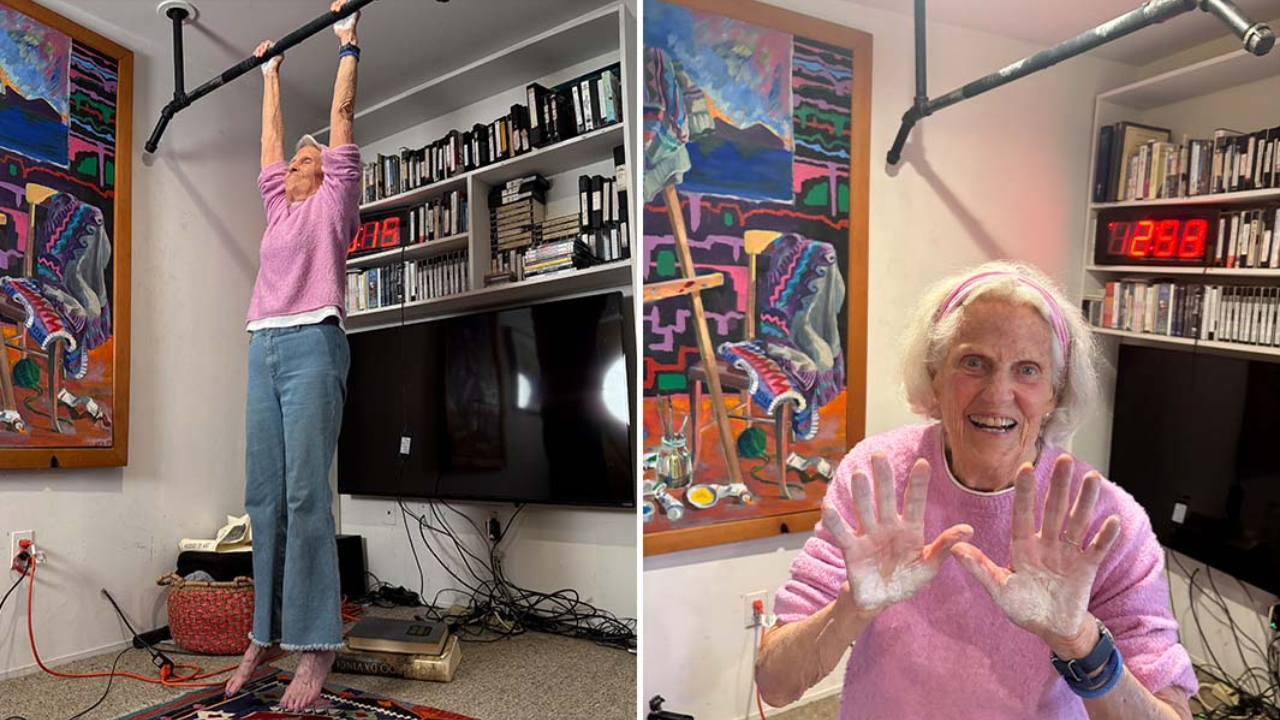
The attainment of a Guinness World Record for a dead hang by a 90-year-old individual represents more than a feat of endurance; it serves as a clinical outlier that challenges established models of sarcopenia and age-related neuromuscular degradation. While the general public views such events through the lens of inspiration, a structural analysis reveals a complex intersection of connective tissue integrity, motor unit recruitment, and the favorable physics of a high strength-to-weight ratio. To understand how a nonagenarian maintains a static hang for significant duration, one must deconstruct the mechanical load on the musculoskeletal system and the neurological drive required to prevent eccentric failure under constant tension.
The Tri-Pillar Framework of Static Endurance
The ability to maintain a dead hang is governed by three distinct physiological variables. When these variables are optimized, even an aging system can outperform younger cohorts who lack specific adaptation.
- Tensile Integrity of the Myofascial Chain: A dead hang does not merely test the finger flexors. It requires the seamless transfer of force from the distal phalanges through the carpal tunnel, the medial epicondyle of the humerus, the glenohumeral joint, and finally into the latissimus dorsi and core stabilizers. In older athletes, the preservation of collagen density within these tendons is a prerequisite for preventing Grade I or II strains during high-tension holds.
- Neurological Rate Coding: Muscle mass naturally declines with age—a process known as sarcopenia—but neurological efficiency can be maintained. The ability to send high-frequency electrical impulses to the motor units allows for maximum "stiffness" in the grip. This prevents the microscopic "slippage" that leads to rapid ATP depletion.
- The Mass-to-Friction Correlation: The physics of a dead hang favor individuals with lower total body mass. Gravity exerts a downward force ($F = mg$) that must be countered by the frictional force of the grip and the structural strength of the joints. A 90-year-old female often possesses a lower total body mass compared to younger athletes, reducing the absolute Newton-meters of torque applied to the shoulder girdle.
Mechanical Bottlenecks in the Aging Upper Body
The primary constraint on geriatric physical performance is the degradation of the "passive" structures. Unlike muscle, which can be hypertrophied via resistance training, cartilage and ligaments have limited vascularity and slower turnover rates.
Glenohumeral Stability and Subacromial Space
In a passive dead hang, the humerus is pulled superiorly toward the acromion. For an older individual, any existing osteoarthritis or rotator cuff thinning creates a bottleneck. Success in this record-breaking context implies a lack of significant impingement, allowing the individual to "hang on the bones" and ligaments rather than relying solely on active muscular contraction. This skeletal efficiency is a major differentiator between a sustainable hang and a rapid failure.
Forearm Compartment Endurance
The flexor digitorum profundus and flexor digitorum superficialis are the primary movers. In the context of a 90-year-old, the ratio of Type I (slow-twitch) to Type II (fast-twitch) muscle fibers often shifts toward Type I. While this results in a loss of explosive power, it creates a metabolic profile suited for low-intensity, long-duration static holds. The metabolic cost of the hang is managed through efficient oxidative phosphorylation, provided the individual has maintained adequate capillarization in the forearm tissues.
Psychophysiological Thresholds and Pain Tolerance
The "impossible" sentiment expressed by the record-holder refers to the cognitive barrier of perceived exertion. In clinical terms, this is the Central Governor Model, which suggests the brain terminates physical activity before physiological failure occurs to protect the body.
The record-breaker’s success is partially rooted in a high "nociceptive threshold." As the hang progresses, lactic acid accumulation and ischemia in the forearms trigger pain signals. If the prefrontal cortex can override the amygdala’s flight response, the athlete can push the muscles to the point of absolute mechanical failure (where the chemical bonds of the actin-mysterin cross-bridges literally cannot hold) rather than stopping due to discomfort. This psychological decoupling is often more prevalent in individuals with decades of habituated physical labor or disciplined movement.
Quantifying the Strength-to-Weight Advantage
To visualize why an older individual might excel at this specific task compared to a more muscular 40-year-old, consider the following variables:
- Total Body Mass (M): Often 20–30% lower in elderly females than in the average middle-aged male.
- Grip Surface Area (A): Remaining constant.
- Force Requirement ($F_r$): The specific tension required per square centimeter of skin/tendon.
A lower M means the $F_r$ is significantly reduced. This allows the individual to operate at a lower percentage of their Maximum Voluntary Contraction (MVC). If a hang requires only 40% of an individual's MVC, they can theoretically hold it for minutes; once the requirement crosses the 70% threshold, the intramuscular pressure occludes blood flow, leading to rapid anaerobic fatigue and failure. The 90-year-old record holder likely operates at a very low MVC percentage due to her weight, effectively turning a strength feat into a cardiovascular/aerobic feat.
The Role of Sarcopenic Resistance
While sarcopenia is considered universal, its rate is highly variable. The "mechanotransduction" process—where mechanical loading signals the body to repair and strengthen tissue—still functions in the tenth decade of life, albeit at a reduced velocity.
- Protein Synthesis Lag: An older system requires higher boluses of leucine and consistent tension to trigger the same muscle protein synthesis (MPS) as a younger system.
- Hormonal Baseline: Lower systemic levels of GH (Growth Hormone) and IGF-1 mean that the "safety margin" for injury is thinner.
The record suggests a lifetime of "loading" that created a high baseline of "functional reserve." This reserve acts as a buffer against the natural decline, ensuring that even after the 2–3% annual loss of strength common in the 80s, the remaining capacity is still above the threshold required to support the body’s weight.
Operationalizing Longevity via Grip Strength Metrics
Grip strength is frequently used in geriatric medicine as a proxy for "all-cause mortality." This is not because grip strength itself prevents death, but because it serves as a high-fidelity indicator of systemic vitality, neurological health, and muscle quality.
- Neural Integrity: Maintaining a strong grip requires a healthy peripheral nervous system. High grip strength correlates with lower rates of cognitive decline, as both rely on robust white matter integrity and efficient neural transmission.
- Metabolic Health: Higher muscle density in the extremities is associated with better insulin sensitivity and lower systemic inflammation (CRP levels).
- Connective Tissue Resilience: The ability to hang without joint luxation indicates high systemic collagen quality, which usually extends to the health of the vasculature and the heart valves.
The Strategic Path to Late-Life Physical Autonomy
The success of the 90-year-old Ohio woman provides a blueprint for "functional carryover." To replicate this level of structural resilience, the training interventions must be specific and progressive, moving away from "movement for the sake of movement" toward "structural loading."
- Time Under Tension (TUT): Prioritize isometric holds to build tendon stiffness without the joint shearing forces associated with high-repetition dynamic movements.
- Axial Loading: Incorporate movements that stress the skeletal system (e.g., loaded carries) to maintain bone mineral density via Wolff's Law.
- Grip-Specific Conditioning: Treat the hand and forearm as a primary system rather than an accessory. Use varied diameters (thick bar training) to stimulate different motor unit recruitment patterns.
The record is not a fluke of "spirit" but a victory of biological maintenance. It demonstrates that the slope of physical decline is not fixed; it can be flattened through the strategic application of mechanical stress. The ultimate limitation is not the age of the tissue, but the cessation of the stimuli required to keep that tissue viable.
The focus for those seeking to emulate this longevity should be on maintaining the strength-to-weight ratio and the neurological recruitment of the posterior chain. In the absence of acute pathology, the human frame is capable of sustaining its own weight well into the tenth decade, provided the metabolic cost of the hold remains below the threshold of ischemic failure. The most effective strategy for late-stage physical independence is the continuous, low-level provocation of the body’s adaptive mechanisms, ensuring that the "cost of gravity" never exceeds the "price of strength."