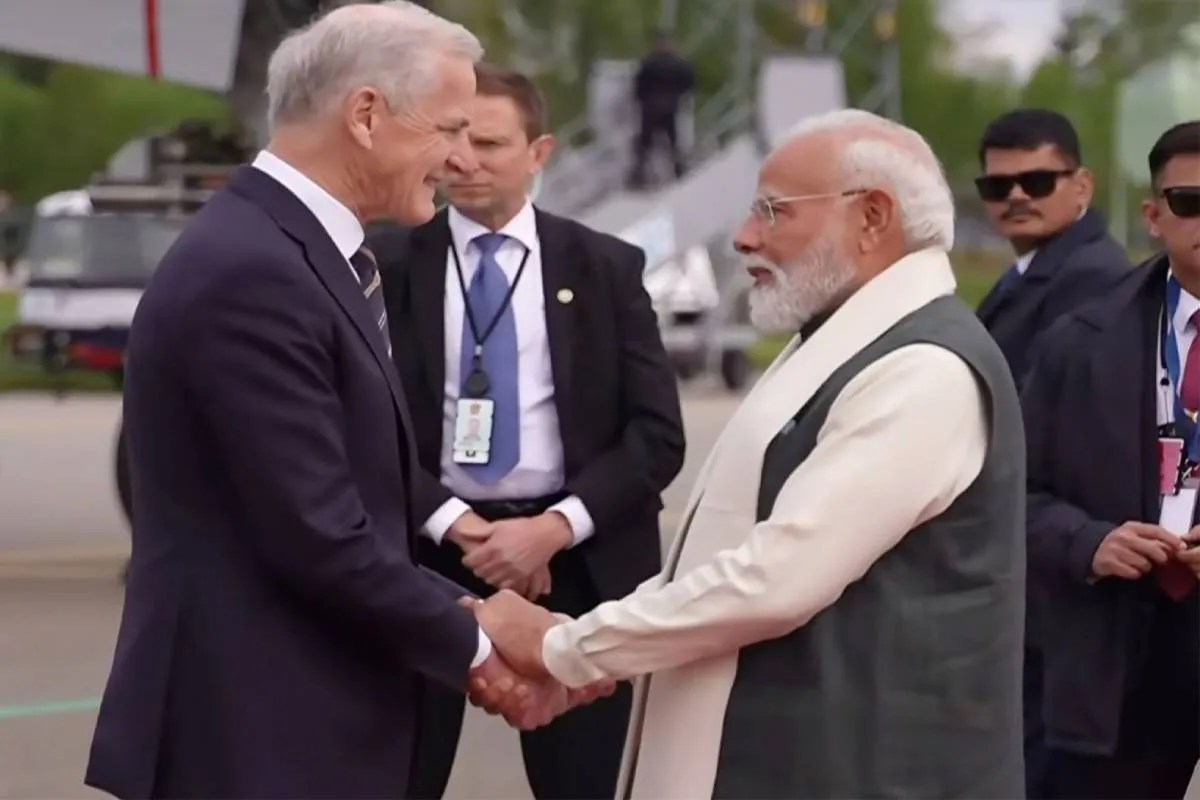
A bitter, sub-zero wind sweeps across the Norwegian archipelago of Svalbard. It rattles the steel frames of satellite dishes that point silently toward a gray sky. Here, deep within the Arctic Circle, the air is so cold it burns the lungs. It feels entirely disconnected from the sweltering heat of New Delhi or the crowded diplomatic corridors of Islamabad and Beijing.
But distance is an illusion.
Every few minutes, satellites whiz overhead. They capture data that dictates global shipping, weather forecasting, and military surveillance. This frozen expanse is no longer just a landscape of ice and polar bears. It has become the world’s quietest superpower node. When a prime minister travels from the tropical heart of South Asia to the icy edge of northern Europe, it isn't a routine diplomatic photo-op. It is a calculated move on a global chessboard where the ice is melting, shipping lanes are opening, and the balance of electronic power is shifting forever.
For decades, Indian foreign policy looked firmly toward the global south, the Middle East, and the immediate neighborhood. The Nordic region—Norway, Sweden, Denmark, Finland, and Iceland—was viewed through a lens of idyllic isolation. They were the peaceful, prosperous nations that topped happiness indexes. They were the countries that gave out Nobel prizes.
That old perspective is dead.
The modern world runs on data, green energy, and rare minerals. As the Arctic ice recedes due to rising global temperatures, it exposes something beneath the frost. Trillions of dollars in untapped natural gas, oil, and deep-sea minerals are becoming accessible. Simultaneously, the Northern Sea Route is transforming from a frozen myth into a viable maritime highway. A ship traveling from Tokyo to Hamburg through the Arctic cuts transit time by nearly two weeks compared to the traditional route through the Suez Canal.
Imagine standing on the docks of Mumbai, watching a cargo vessel load containers destined for Europe. Under the old rules, that ship faces the bottlenecks of the Malacca Strait and the geopolitical tensions of the Red Sea. Under the new reality, that ship could head north.
India understands this shift. More importantly, India knows that its two most formidable neighbors are already trying to build the infrastructure to control it.
Beijing has long declared itself a "Near-Arctic State," a geographical stretch that raises eyebrows in Oslo and Reykjavik. China has poured billions into Greenland’s mining sector, funded research stations in Svalbard, and constructed heavy icebreakers. The goal is clear: a "Polar Silk Road" that bypasses Western-controlled waters entirely. Islamabad watches these developments with keen interest, eager to tie its own economic destiny to China’s expanding maritime footprint.
This is the invisible pressure cooking beneath the surface of the Nordic Summit. When India steps into this arena, it disrupts a script that Beijing spent a decade writing.
But how does a nation from the Indian Ocean establish a legitimate presence in the Arctic without triggering a military standoff? The answer lies in the deep, quiet language of technology and environmental science.
Consider the concept of green hydrogen. Everyone talks about the transition away from fossil fuels, but the execution is messy. India has set massive targets for renewable energy, yet storing and transporting that energy across a subcontinent requires technology that is still in its infancy. Norway, conversely, is a nation built on hydro-power wealth. They have mastered the art of extracting energy from harsh environments and managing vast sovereign wealth funds to bankroll the next generation of clean tech.
The synergy isn't about buying and selling goods. It is about survival. India needs the deep-tech architecture that the Nordic countries have spent half a century perfecting. The Nordic nations, with their small populations, need the staggering scale, digital infrastructure, and engineering brainpower that India commands.
Step away from the grand speeches and look at the real-world friction. Why does this alliance cause sleepless nights in Islamabad and Beijing?
For Pakistan, the anxiety is deeply tied to international standing. Every time India secures a seat at a high-level table where critical global assets are managed, the strategic gap between the two South Asian neighbors widens. It becomes harder to frame India merely as a regional actor locked in a perpetual border dispute. India emerges instead as a global manager of the commons.
For China, the sting is sharper. Beijing’s strategy relies on being the indispensable partner for both the developing world and technologically advanced European sectors. A direct pipeline of cooperation between New Delhi and the Nordic capitals breaks that monopoly. It proves that democratic nations can build their own tech corridors without relying on Chinese supply chains or state-backed tech conglomerates.
The real battleground, however, is hidden under the ocean and high above the atmosphere.
Norway’s coastline is a maze of deep fjords and underwater cables that handle a massive percentage of Europe’s internet traffic. In an era of hybrid warfare, these cables are incredibly vulnerable. India’s expertise in software security and satellite deployment offers a natural counterweight to threats targeting this infrastructure.
The cooperation extends to the skies. India's space program is famous for its cost-efficiency and reliability. By syncing Indian launch capabilities with Nordic ground tracking stations in the polar regions, the alliance creates a data loop that is virtually impossible for adversaries to block or blind.
This isn't about traditional military alliances. No one is planning to station Indian naval frigates in the Baltic Sea. This is a new breed of statecraft. It is an alliance built on data parity, environmental intelligence, and resource security.
The true test of this diplomatic pivot won't be measured by the joint statements issued at the end of a summit. It will be seen years from now, when the first commercial fleets navigate the clear waters of a melted north. It will be felt when the smart grids of Bengaluru run on algorithms co-developed in Oslo, and when the satellite arrays in the Arctic circle transmit early warnings of monsoon shifts directly to farmers in Bihar.
The ice of the far north is melting, and as it liquefies, it reshapes the contours of global power. The tropical and the frozen worlds are merging. Those who thought the Arctic was too cold, too distant, or too isolated to matter to the future of South Asia simply weren't looking at the map correctly. The game has expanded, the stakes are global, and the quiet moves made in the chill of Scandinavia are sending shockwaves through the warmest corridors of Asia.