The air inside the Philadelphia Mint always smells of hot grease, copper, and industrial scale. It is a deafening, ceaseless grind where massive presses slam thousands of tons of pressure into blank metal discs, turning raw copper-nickel alloys into the physical representations of American promise.
But this week, the heavy air in the minting rooms carries a different kind of tension.
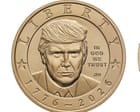
Treasury Secretary Scott Bessent stood before the digital public on Wednesday to unveil the rendering of a new, gold-hued $1 coin. Its front face features a sharply etched profile of Donald J. Trump. Below his chin, the dual dates read "1776–2026," anchoring the piece to the nation’s upcoming Semiquincentennial—our 250th anniversary of independence.
To his supporters, the coin is a glittering, pocket-sized monument to a presidency that redefined the populist right, a tangible token of a second term that continues to challenge institutional norms. To his detractors, it represents something far more unsettling: the creeping personalization of the state, an ego cast in metal, and a blunt-force violation of a century-old democratic custom.
At its core, this is not a story about spare change. It is a battle over who gets to write American history on the very canvas we carry in our pockets.
The Law, the Loophole, and the Living Legend
For generations, the rules of American currency were simple, quiet, and designed to keep the egos of the living far away from the printing presses.
Since the mid-19th century, federal law has held a firm line: you have to be dead to be on the money. The 1866 statute barred living individuals from paper bills, and subsequent legislation, including the 2005 law governing presidential dollar coins, explicitly stated that a president must be deceased for at least two years before their likeness can grace a coin.
The logic was rooted in a deep-seated American allergy to monarchy. Kings and autocrats stamp their faces on coins while they still draw breath. Republics wait until history has had its say.
But the law is an ecosystem of words, and where there are words, there are loopholes.
Enter the Circulating Collectible Coin Redesign Act of 2020. Signed during the twilight of Trump’s first term, this bipartisan act gave the Treasury broad authority to design special commemorative coins for the nation's 250th anniversary. The legal team at the Treasury Department and the U.S. Mint began digging into the text. They found that while the law prohibited any person—living or dead—from appearing on the reverse (tails) side of the commemorative coins, it left a curious, silent void regarding the obverse (heads) side.
In that silence, an administration saw an opportunity.
To justify the move, Treasury officials pointed backward, looking for a historical anchor. They found it in 1926. During the nation's Sesquicentennial, the U.S. Mint struck a commemorative half-dollar. If you look closely at that vintage silver coin, you can see the profile of George Washington—and right behind him, the distinct, living silhouette of President Calvin Coolidge.
"During the 150th, there was a Calvin Coolidge coin," Secretary Bessent argued during a recent media appearance. "So we can put living presidents' images on a coin."
One century later, Coolidge’s quiet precedent has been resurrected to clear the path for a far louder successor.
The Quiet Rebellion on the Coin Advisory Board
But laws are not just parsed by cabinet secretaries. They are guarded by committees, and inside those committee rooms, the response to the Trump dollar has been anything but smooth.
Imagine Donald Scarinci. He is a seasoned numismatist, a Democrat, and a man who has spent more than twenty years serving on the Citizens Coinage Advisory Committee (CCAC)—the eleven-member bipartisan body established by Congress to review and advise on all U.S. coin designs. For Scarinci and several of his colleagues, the rollout of this coin felt less like a standard bureaucratic process and more like a tactical end-run.
"We've never seen any design with the portrait of Donald Trump on it," Scarinci revealed, his frustration clear.
According to committee members, the Mint made a sudden, late-December attempt to present the designs. But because of the holiday rush and short notice, the committee couldn't assemble a quorum. The meeting never happened. By the time the committee gathered in February, the train had already left the station. The Commission of Fine Arts had approved a version of the design in March, and the Treasury Department moved forward without the advisory board's formal blessing.
The Mint’s leadership maintains they made a good-faith effort to consult the board, suggesting the committee chose not to meet. But to critics on the committee, the maneuver felt deliberate.
"The concept that the secretary of the Treasury can create his own coin—it's illegal," Scarinci said bluntly, warning that the fight might eventually spill onto the floor of Congress, where lawmakers could theoretically try to strip the coin of its legal tender status.
Already, some members of Congress are reacting with fierce resistance. Oregon Senator Jeff Merkley and Nevada Senator Catherine Cortez Masto previously introduced legislation aiming to block the coin's production.
"While monarchs put their faces on coins, America has never had and never will have a king," Cortez Masto declared.
From "Fight" to Formality
The coin that is currently being struck in the Mint looks vastly different from the raw, aggressive drafts that first leaked from the Treasury Department last year.
Early design concepts from late 2025 were deeply personal, reflecting the raw, combative nature of Trump's political identity. One early iteration showed the president on both sides of the coin. On the back, he was depicted raising a defiant, clenched fist against the backdrop of an American flag—an explicit artistic nod to the July 2024 assassination attempt in Butler, Pennsylvania, complete with the word "FIGHT" emblazoned on the metal.
It was a design that felt less like state currency and more like a campaign poster.
But as the designs moved through the cold filters of the Commission of Fine Arts and the Treasury's final review, the sharpest edges were ground away. The fist is gone. The double-sided portrait has been abandoned.
The final version, scheduled for release this fall, opt for a traditional, formal profile on the front. The reverse features a classic, stately Great Seal of the United States with a bald eagle and the number "250".
Yet even in its watered-down form, the coin represents a monumental shift. It is a gold-hued token made of non-precious metals—clad in the same manganese-brass alloy used for standard dollar coins—meaning it will look and feel like gold without carrying the prohibitive price tag of the 24-karat collector version also in development. It will not enter general circulation to be handed out as change at grocery stores. Instead, it will be sold directly to the public in rolls and bags, destined for the velvet-lined display boxes of collectors and the mantlepieces of loyal supporters.
A Reflection in the Metal
To look at a coin is to look at what a nation values at a specific point in time.
For decades, our pocket change has been a museum of consensus. We agreed on Washington, on Lincoln, on Jefferson, and on Roosevelt because time had smoothed over the jagged edges of their eras. We accepted them as part of a shared, quiet heritage.
But we no longer live in an era of consensus.
The Trump $1 coin is the physical manifestation of our polarized present. It is a piece of metal designed to provoke a reaction, an object that forces you to take a side the moment you look at it. To those who purchase the rolls this fall, it will be a treasured keepsake of a political revolution. To others, it will be a historical anomaly, a curious footnote from an era when the traditional boundaries of American presidency were tested, stretched, and ultimately redrawn in brass.
When the presses finish their run and the dust settles, these coins will disperse across the country. They will sit in desk drawers, change hands at coin shows, and be passed down to children who will look at them with a mix of curiosity and confusion.
We shape our money, and then, our money shapes how we are remembered.