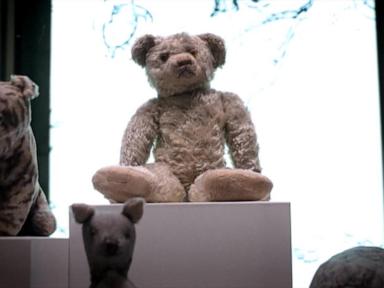
In 1921, a father walked into Harrods department store in London and bought a plush, mohair teddy bear for his one-year-old son. The boy named the bear Edward. Over time, after visits to a local zoo and a nearby pond, Edward became Winnie-the-Pooh.
A century later, that same stuffed bear sits inside a bulletproof glass display case in Midtown Manhattan. He doesn't move. His threadbare fur is faded. His left ear sags slightly from decades of toddler hugs given before World War II. Beside him sit his original companions: Tigger, Eeyore, Piglet, and Kanga.
They look fragile. Yet, they sit at the absolute center of an international diplomatic tug-of-war that has resurfaced between London and New York.
It sounds absurd on its face. Grown politicians, museum curators, and cultural ministers bickering over eighty-year-old toys stuffed with sawdust. But when you step back, the fight over Christopher Robin’s original nursery toys isn't about cloth or cotton. It is about memory, home, and who gets to claim ownership over the collective childhood of the English-speaking world.
The Gift That Left the Kingdom
The story of how Pooh ended up across the Atlantic begins in 1947. A.A. Milne, the author who turned his son’s playtime into literary immortality, sent the physical toys to his American publisher, E.P. Dutton, on a promotional tour. They were meant to stay for a brief visit.
They never went back.
In 1987, the publisher donated the original stuffed crew to the New York Public Library. Since then, millions of visitors have walked past the Main Branch on 42nd Street, press their noses against the glass, and marvel at the tiny, worn artifacts that launched an empire.
In Great Britain, however, a quiet resentment simmered for decades.
To the British, Pooh is an indelible icon of Sussex. He represents Ashdown Forest, afternoon tea, and the gentle, melancholic nostalgia of an interwar England that no longer exists. Seeing him permanently housed under the harsh fluorescent lights of Manhattan feels, to many across the pond, like a cultural theft.
British politicians have repeatedly raised the issue, demanding the return of the bear to his ancestral home. Every few years, rumors circulate that a deal is being brokered to send the toys back. Every few years, New York digs in its heels.
When diplomatic rumors swelled recently about a royal-backed push to bring Pooh home, local leaders in Manhattan responded with swift defiance.
"You come at the bear, you best not miss," declared Manhattan Borough President Brad Hoylman-Sigal. Shortly after, the British Embassy issued an official statement stepping back from the brink, confirming the bear would remain in New York.
The Invisible Weight of Stuffed Animals
Why do we care so deeply about where a worn toy sleeps at night?
Because objects store human emotion long after their creators pass away.
Consider Christopher Robin Milne himself. In his adult memoirs, Christopher spoke with deep complexity about the shadow his fictional counterpart cast over his life. He felt his father had built a billion-dollar empire on the back of his real childhood, leaving him with little more than a famous name he spent decades trying to escape.
When the real Christopher Robin let those toys leave his house, he wasn't just shipping stuffed animals across the Atlantic. He was releasing the physical evidence of a childhood that had been dissected and consumed by the global public.
To New York, these toys represent the ultimate immigrant story. They arrived from abroad, worn out and searching for a permanent place to rest, only to become a cherished piece of the city's civic fabric. They belong to everyone who steps through the library doors for free.
To Britain, they are exiled royalty.
Neither side is wrong. That is what makes the debate so impossible to resolve.
The Real Power of the Hundred Acre Wood
We live in an era where cultural icons are rapidly bought, sold, and rebooted by giant corporations. Disney bought the rights, turned Pooh into a yellow-and-red marketing juggernaut, and transformed a quiet English woodland into a multi-billion-dollar brand.
Yet, standing in front of that glass case in the New York Public Library, none of that corporate gloss exists.
You don't see a brand. You see a frayed seam on a small pig's foot. You see missing button eyes replaced by hand. You see the physical remnants of love, worn away by the fingers of a real child almost a century ago.
The controversy will eventually flare up again. A British minister will make a speech. A New York mayor will issue a cheeky counter-statement. Photos will be taken, and news anchors will report on the "custody battle" with a lighthearted chuckle.
Inside the glass case, the small bear of very little brain will keep sitting quietly on his shelf, unaware of the oceans crossed or the arguments made in his name. He will do what he has always done: offer a quiet, motionless reminder of what it felt like when the world was small, simple, and safe.