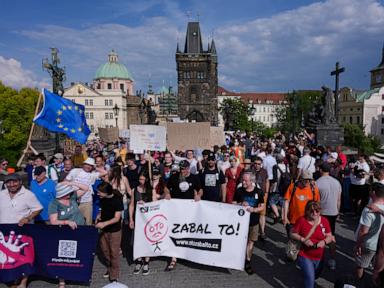
Prague is boiling, and it isn't just the summer heatwave. Thousands of people packed the streets on Sunday to fight for something most people take for granted: the independence of their evening news.
Prime Minister Andrej Babiš and his populist ANO-led coalition recently approved a plan to completely strip Czech Television (ČT) and Czech Radio (ČRo) of their independent funding. The government wants to kill the traditional public broadcasting license fee. Instead, they plan to fund these networks straight from the state budget starting next year.
It sounds like a boring administrative tweak. It isn't. It's a blatant power grab masquerading as taxpayer relief, and it follows a dangerous blueprint already active in Central Europe.
The Illusion of Free Media
The government claims households and businesses don't want to pay the monthly license fee anymore. Right now, it costs about $10 a month per household. Babiš frames this move as putting money back into your pocket.
Don't buy it.
When a public broadcaster relies on direct citizen fees, politicians can't easily choke off its money just because they disliked a hard-hitting investigative report. The moment you move that funding to the state budget, the government holds the purse strings. If a network uncovers a government corruption scandal, the ruling party can simply slash the budget during the next parliamentary session.
This isn't an abstract theory. We've seen this exact movie before in Hungary under Viktor Orbán and in neighboring Slovakia under Robert Fico. First, you change how the money flows. Then, you force out the independent management. Finally, you turn the public broadcaster into a state-run megaphone.
A Crushing Fifteen Percent Cut
The financial reality of this bill is brutal. Shifting to the state budget means an immediate 15% drop in financing for public media.
According to the heads of the networks, Czech Television stands to lose a billion crowns annually. Czech Radio will lose around 350 million crowns. This rolls funding levels back to where they were nearly two decades ago.
This isn't about finding efficiencies. It forces structural damage. Hynek Chudárek, the chief of Czech Television, warned that a cut this massive means firing between 300 and 500 staffers out of a workforce of 2,900. Operations will shrink. Regional bureaus—often the only news outlets covering life outside the capital—will face the chopping block.
The International Federation of Journalists explicitly stated that this bill violates the European Media Freedom Act. The law deliberately fails to provide predictable or sustainable funding. That lack of predictability is a feature of the bill, not a bug.
Workers Fight Back With a Strike
The public isn't taking this sitting down, and neither are the journalists. Following the mass weekend rallies organized by the Million Moments for Democracy group, public media employees are walking out.
A major warning strike by staff at Czech Television and Czech Radio is set to disrupt regular programming. The stations will stay on the air, but the regular broadcast schedule is getting tossed out.
Even President Petr Pavel has broken ranks to criticize the government's approach. While Pavel noted that budget-based funding isn't inherently evil in every single global context, he hammered the cabinet for rushing the bill through without creating any legal safeguards for editorial independence. The government put the cart before the horse, and they did it on purpose.
What Happens Next
This isn't just a local political squabble in Central Europe. It's a test case for how easily populist leaders can dismantle democratic guardrails under the guise of economic populism.
If you want to support independent journalism, watch how this strike plays out. European media watchdogs are already lobbying the EU to intervene using the European Media Freedom Act. Keep an eye on local independent journalism funds and international press freedom organizations like the Syndicate of Journalists of the Czech Republic. Public pressure is currently the only thing keeping the lights on for independent Czech media.