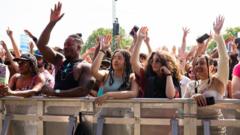
The High Court has spoken, and the music will play on. By dismissing a legal challenge from local residents aimed at blocking large-scale festivals in Brockwell Park, the judiciary has effectively rubber-stamped a controversial status quo. For the organizers of events like Wide Awake, Cross the Tracks, and Mighty Hoopla, it is a green light for profit. For the locals who feel the heartbeat of their neighborhood is being traded for a balance sheet, it is a bitter pill. But this dispute is about much more than decibel levels or trampling grass. It is a flashpoint in a growing national crisis over how we fund public assets and who truly owns the "commons" in an era of austerity.
Lambeth Council, like many cash-strapped local authorities, views its green spaces as revenue streams. They are no longer just places for a Sunday stroll; they are high-yield event spaces. The High Court’s refusal to grant a judicial review to the Brockwell Park Community Partners (BPCP) validates this commercial pivot. The residents argued that the sheer scale and frequency of these events—occupying the park for weeks during the peak of summer—breached the trust under which public land is managed. The court disagreed.
The High Cost of Cheap Revenue
To understand the friction in Herne Hill and Brixton, you have to look at the numbers. Lambeth Council maintains that the income from these festivals is vital. It flows back into the park’s upkeep and supports wider borough services that have been gutted by over a decade of central government funding cuts. It is a seductive argument. If the choice is between a locked gate at a youth center or a three-day pop festival, most politicians will choose the music every time.
However, the "profit" is rarely as clean as the brochures suggest. When a major festival moves in, the park isn't just "used." It is occupied. Heavy machinery rolls over sensitive root systems. Heras fencing carves up the landscape, creating "no-go zones" for those who rely on the park for mental health, exercise, or a rare escape from cramped urban housing. The remediation period—the time it takes for the mud to turn back into grass—can stretch deep into the autumn.
The community isn't just losing a weekend; they are losing a season. We are seeing a slow-motion privatization of the public realm. By allowing private promoters to fence off huge swaths of common land, councils are essentially charging residents for the right to breathe in their own neighborhood.
A Legal Shield for Commercialization
The High Court’s decision centered on the legality of the council’s decision-making process, not the "fairness" of the noise. In the UK, the bar for a judicial review is notoriously high. To win, the BPCP had to prove that Lambeth Council acted irrationally or failed to follow its own statutory duties. The court found that the council had stayed within the broad lines of its discretionary power.
This highlights a massive loophole in how we protect urban nature. Current legislation gives local authorities enormous leeway to "manage" land. If a council decides that managing a park includes renting it out to a global events corporation for a month, the law rarely finds a reason to stop them. The residents’ frustration stems from this disconnect. They feel the spirit of the law is being bypassed by the letter of the law.
The Myth of Minimal Impact
Promoters often point to their "robust" (one of the few times that word feels appropriate in a negative sense) environmental plans. They promise to protect the veteran trees and leave the site as they found it. Anyone who has walked across Brockwell Park in the wake of a rain-soaked Mighty Hoopla knows this is a fantasy.
Compacted soil is a silent killer for trees. It starves the roots of oxygen. While the festival might be gone in a week, the damage to the park’s ecology can take years to manifest. By the time a tree dies, the festival promoter has moved on to a different borough, and the council is eyeing the next year’s permit fee. We are trading long-term ecological health for short-term fiscal patches.
The Gentrification of the Festival Circuit
There is also a social element that the court room ignored. The festivals in Brockwell Park are not local community fairs. They are high-ticket, international-grade events. A weekend pass can cost more than many local families spend on groceries in a month.
When the fences go up, the message to the local community is clear: this space is for those who can pay. The park is transformed from a democratic equalizer—where the wealthy homeowner and the social housing tenant share the same sun—into a tiered experience. This creates a psychological distance between the residents and their land. Once you start viewing a park as a commodity, it is very hard to go back to viewing it as a right.
The Broken Model of Park Funding
If we want to stop the "festivalization" of our parks, we have to address the "why." Local authorities are broke. Since 2010, real-terms funding for councils has plummeted. Parks, unlike social care or bin collection, are not a statutory service. This means councils are not legally required to provide them or maintain them to a specific standard.
In this environment, park managers are forced to become entrepreneurs. They are told to find "self-sustaining" models. This inevitably leads to:
- Corporate takeovers of public events.
- Charging for facilities that used to be free, like tennis courts or toilets.
- The proliferation of advertising within green spaces.
The Brockwell Park case is a symptom of a systemic failure to value public goods. We have decided, as a society, that we won't pay for parks through general taxation, so we ask the parks to pay for themselves. It is a cannibalistic strategy.
Beyond the Courtroom
The legal battle might be over for this season, but the social conflict is only beginning. The BPCP and other groups like them across London—from Finsbury Park to Victoria Park—are forming a loose coalition. They are realizing that the courts are a blunt instrument for a nuanced problem.
The real fight is in the planning committees and the council chambers. It requires a fundamental shift in how we define "value." If we only value a park by the revenue it generates in June, we have already lost. We need to measure the value of the cooling effect trees have on a city, the reduction in NHS costs due to improved mental health, and the social cohesion provided by truly open space.
The Path to Reclaiming the Commons
The High Court ruling should be a wake-up call. It proves that the law, as it currently stands, favors the landlord over the inhabitant. To change the outcome, the community must change the rules of engagement.
Transparency is the first weapon. Residents need to demand a clear, unvarnished look at where festival money actually goes. Does every penny from a Brockwell Park permit go back into that specific park? Often, the money disappears into a general fund, used to plug holes in other departments. If the park is taking the pain, the park must see the gain.
Capacity limits are the second. There must be a hard cap on the number of "major event days" allowed per year. This shouldn't be a flexible target; it should be a binding constraint. A park needs time to breathe, and a community needs time to exist without the constant hum of generators and the sight of security guards.
Alternative funding must be explored. Whether it's through local "green levies" on luxury developments or a national statutory requirement for park funding, we have to find a way to decouple green space from commercial exploitation.
The Brockwell Park festivals will go ahead this year. The trucks will arrive, the bass will thud, and the grass will be churned into a brown slurry. The High Court has confirmed that, for now, the council has the right to sell the summer to the highest bidder. But a legal right is not a moral mandate. The residents of Herne Hill haven't just lost a court case; they have identified a flaw in the very heart of how we treat our cities. The music might be loud, but it isn't enough to drown out the growing demand for a different kind of urban life—one where a walk in the park doesn't come with a ticket price or a fence.