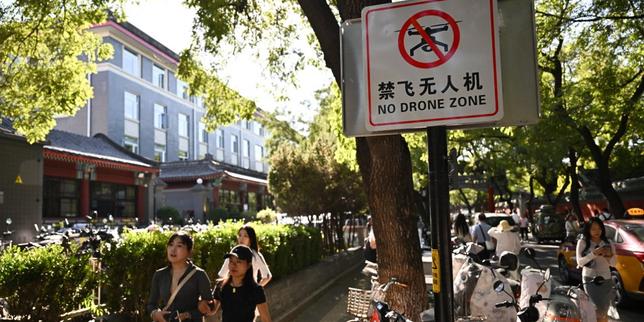
Everybody loves a good panic about urban skies. The mainstream narrative surrounding the supposed mid-November drone ban in Beijing treats consumer hardware like an airborne invasion force that finally met its match. Headlines wring their hands over residents bidding farewell to their flying cameras, framing the restriction as a triumph of public safety and airspace security.
It is a lazy, superficial read of a much deeper institutional failure.
Focusing on the retail ban misses the fundamental architectural shift happening beneath the surface. I have spent years watching municipal authorities panic every time a hobbyist quadcopter drifts anywhere near a sensitive perimeter, and the reflex is always the same: reach for the sledgehammer. Ban the gear, clear the skyline, and pretend the underlying coordination problem has been solved.
Except it has not. The regulatory machinery in Beijing did not outlaw drones because hobbyists suddenly became an existential threat. They did it because the existing airspace management framework is too brittle, too antiquated, and too terrified of decentralization to handle an integrated low-altitude economy.
The Myth of the Rogue Hobbyist
Let us dismantle the core premise circulating across the tech press. The standard line is that Beijing residents are weeping over their grounded DJI phantoms because reckless pilots ruined a good thing. That argument assumes the primary bottleneck is consumer behavior.
It is not. The real bottleneck is bureaucratic imagination.
Modern commercial logistics, emergency response, and localized delivery networks require low-altitude infrastructure. Companies pouring billions into urban aerial mobility do not care about weekend aerial photography. They care about automated corridors. When a city enforces a blanket prohibition under the guise of mid-November safety sweeps, it creates a massive vacuum.
Instead of building dynamic, software-defined geofencing and real-time transponder integration—technologies that already exist and function in dense test zones—regulators chose the administrative equivalent of shutting down the highway because a few people were speeding.
I have seen enterprises blow millions on custom drone fleets designed for urban inspection, only to watch bureaucrats freeze permits because they lack the technical competence to monitor vector data alongside commercial aviation lanes. Blaming the consumer hardware is simply an easier PR strategy than admitting that municipal infrastructure is stuck in the twentieth century.
The Counter-Intuitive Reality of Sky Restrictions
Here is the uncomfortable truth that neither the regulators nor the nostalgic hobbyists want to admit: prohibition never eliminates the activity; it merely drives it into the black market and starves the legitimate industry of iterative feedback.
When you ban consumer devices outright, you do not stop low-altitude innovation. You simply ensure that only bad actors and underground operators retain the operational capability. Legitimate manufacturers stop pushing the envelope on safety redundancies, fail-safe protocols, and collision avoidance algorithms because the domestic consumer market has been legally sterilized.
Look at what happens when you substitute heavy-handed bans with open, programmatic airspace management. In markets where regulators actually embrace UTM (Unmanned Traffic Management) protocols, incident rates plummet while commercial utility skyrockets. Beijing has the technological muscle to build the most sophisticated urban drone grid on the planet. Choosing a blanket ban instead is a stunning admission of administrative bankruptcy.
What the Coverage Misses About the Low Altitude Economy
The mainstream commentary treats drones as toys. That is a fatal error in perspective. Drones are edge-computing nodes with propellers. They are IoT devices that happen to occupy the third dimension.
When authorities restrict them based on calendar dates and blanket geographic sweeps, they are cutting off the sensory nervous system of the smart city. Traffic monitoring, structural integrity assessments, micro-logistics, and rapid medical transport all rely on dense, high-frequency low-altitude data capture.
By forcing residents to pack away their hardware, the city is not securing its airspace; it is blinding itself.
Imagine a scenario where municipal authorities spent half the energy on building automated, cloud-connected flight corridors that they spend on writing punitive restriction notices. The congestion on the ground would ease, emergency response times would drop by double-digit percentages, and local tech ecosystems would thrive on building localized aerial utilities.
Instead, we get a theatrical farewell to consumer quadcopters while systemic inefficiencies remain entirely untouched.
Where This Leaves Us
The November crackdown in Beijing will not protect the capital's airspace for long. It will merely push the friction underground until the economic pressure of the low-altitude commercial sector becomes too loud to ignore.
Stop mourning the loss of weekend hobbyist flights as if it were the end of an era. Start recognizing it for what it is: a temporary, panic-driven patch on a system that refuses to evolve. When the economic cost of being left behind in the aerial logistics race finally outweighs the institutional comfort of total control, the bans will quietly vanish.
Until then, enjoy the empty skies. You paid for them with innovation.


