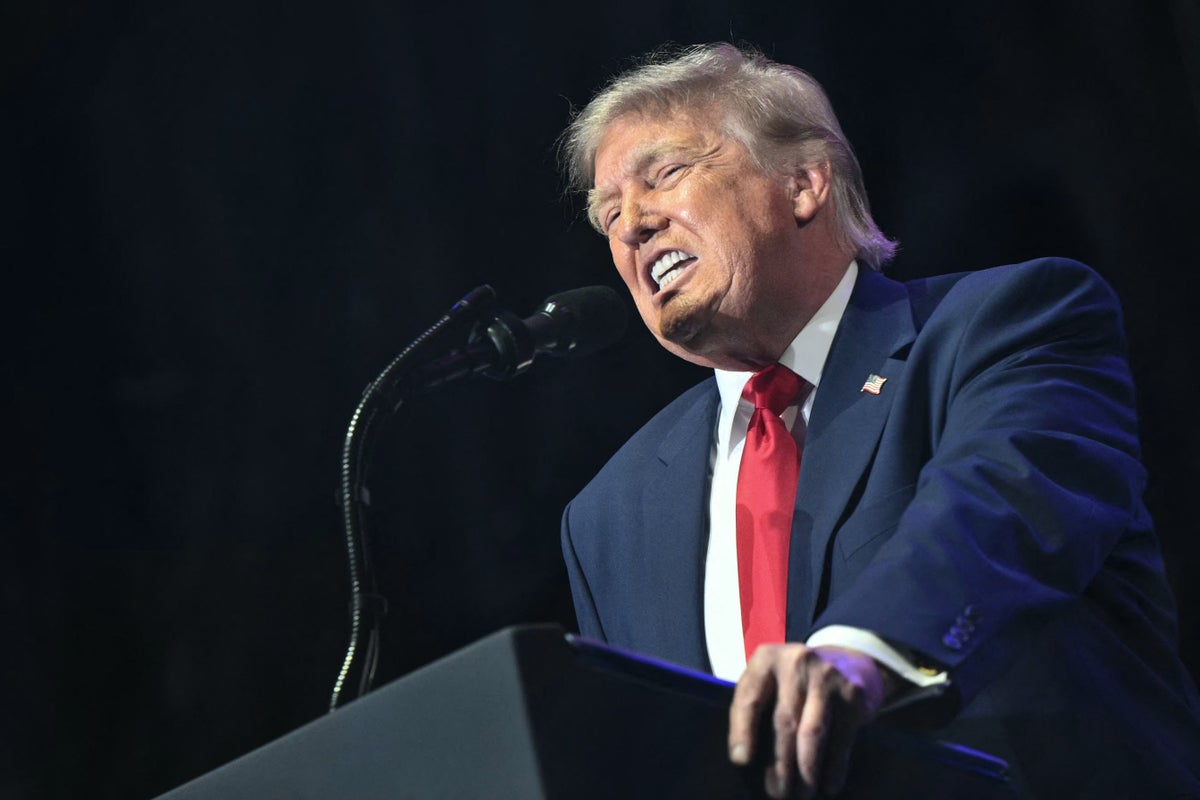
The air inside the Washington Hilton ballroom felt heavy, smelling faintly of carpet cleaner and stale coffee. Outside, tactical teams with rifles kept watch. Inside, private security guards lined the walls, their eyes scanning the rows of velvet-backed chairs. This was the same venue where a gunman had tried to assassinate Donald Trump just months earlier at the White House Correspondents’ Dinner. The physical tension in the room was palpable. It was a space defined by the memory of survival.
When Trump stepped to the microphone at the Faith & Freedom Coalition’s annual summit, the energy shifted. The delivery was not the roaring, stadium-shaking performance of his massive outdoor rallies. It was quieter. Subdued. Almost intimate. He spoke to a crowd of Christian conservatives who have long felt like an endangered species in an increasingly secular nation.
He did not offer policy proposals or economic metrics. He offered a dark, visceral narrative designed to frame the upcoming midterm elections as a battle for existence itself.
The Geography of Panic
Consider how a political message travels. It starts with local facts and transforms into universal anxiety. Just days prior, three progressive candidates backed by New York City’s democratic socialist mayor, Zohran Mamdani, swept their Democratic primaries. To a casual observer, it was a localized shift in urban municipal politics.
But on this stage, those local victories were reframed as an approaching storm.
Trump looked out at the audience and drew a straight, jagged line from the voting booths of New York to the sanctuary doors of America’s heartland. He bypassed terms like "social democrat" entirely. Instead, he reached for a word heavy with historical dread.
Hardcore, godless communists.
The narrative logic was simple and terrifying. The radical left, he warned, wanted to completely destroy the traditional American way of life. He argued that the political establishment was either too weak or too frightened to stand in the way. He watched prominent Democrats and saw fear. They were afraid of losing their elections to what he called a new breed of sick people.
The Invisible Stakes
To understand why this message resonates, one must understand the psychology of the audience. For decades, the religious right has viewed modern cultural shifts not as progress, but as a systematic campaign of erasure. When Trump spoke of a "war on Christians," he was tapping into a deep-seated vulnerability.
He went further, connecting the ideology of his domestic opponents to global violence. He spoke of Nigeria, where Christian populations have faced brutal persecution by militant groups. The geopolitical reality is complex—international observers note that the conflict there is driven by extremist groups rather than Marxist ideology, and the victims include thousands of Muslims. But in the prose of the speech, nuance was stripped away.
The message became stark: They will close your churches in this country. They will kill your people.
By linking local political losses to global religious violence, the abstract concept of a primary election became a matter of physical survival. The ideology, he argued, cannot tolerate a strong, faithful population. It has to end religion because the system fails if people love God more than the state.
The Banal and the Extreme
The rhetoric swung like a pendulum between apocalyptic warnings and dark, observational humor. At one point, Trump joked with the crowd that he could have been the greatest communist in history because the ideology is remarkably easy to sell.
The crowd offered polite, scattered laughter as he adopted a sarcastic persona, telling them that from now on, no one had to pay rent. Anyone who wanted a house could just pick one out. Free food for everyone.
Then came the drop.
It destroys everything, he warned. After two or three years of free promises, the country fails. Everyone suffers or dies. He compared the spread of these political ideas to an uncontrollable form of cancer moving across the map, threatening to turn the nation into a Third World reality.
The room grew quietest when the topic turned back to violence. Trump, who has survived three assassination attempts over the past two years, spoke darkly about the methods of his opponents. He stated that the assassination of those who oppose them is a central element of their ideology. He called them animals.
The Echo Chambers of History
This is not a new script, but rather a classic American archetype adapted for a modern, anxious moment. A child of the original Cold War era, Trump’s rhetoric echoes the mid-century Red Scare, pulling old anxieties into the digital age.
The strategy relies on a specific emotional sequence:
- Identify a localized cultural or political shift.
- Link that shift to an ancient, easily recognized enemy.
- Elevate the stakes from a political disagreement to a battle over life, faith, and survival.
By the time the speech concluded, the baseline of American political debate had been discarded. The upcoming midterm election was no longer presented as a choice between competing economic strategies or judicial philosophies. It was framed as a defensive line against an existential plague.
The audience left the ballroom moving out into the Washington humidity past the armed security guards. They carried with them a narrative that transformed ordinary political opponents into an existential threat, leaving behind a lingering question: when politics is framed as a matter of literal life and death, how does a nation find its way back to common ground?