The physical destruction caused by Cyclone Maila in the Solomon Islands is not a random byproduct of weather but a direct function of atmospheric pressure gradients and the failure of localized civil engineering. When a tropical system sustains winds of 115mph, it crosses a critical threshold where aerodynamic drag on residential structures transitions from manageable stress to catastrophic mechanical failure. The impact of Maila is best understood through a tri-part framework: the physics of wind-load intensification, the hydrological saturation of volcanic soil, and the logistical friction inherent in archipelago-based disaster response.
The Physics of Wind-Load and Structural Failure
The reported 115mph sustained winds categorize Cyclone Maila as a high-end Category 3 or low-end Category 4 equivalent on the Saffir-Simpson scale. However, the raw wind speed is a deceptive metric. The actual force exerted on a building—the dynamic pressure—increases with the square of the velocity.
$q = \frac{1}{2} \rho v^2$
In this equation, $q$ represents the dynamic pressure, $\rho$ is the air density, and $v$ is the wind velocity. A jump from a 75mph (Category 1) storm to Maila’s 115mph peak represents more than a 130% increase in the physical force applied to every square meter of vertical surface. Most residential infrastructure in the Solomon Islands is designed for lower-frequency, lower-intensity events. Once the wind exceeds the structural design envelope, several specific failure sequences occur:
- Envelope Penetration: High-velocity debris compromises windows or doors. This causes a sudden internal pressurization that, when combined with the external low pressure created by the wind rushing over the roof (the Bernoulli effect), creates a net upward force that literally peels roofs from their moorings.
- Vortex Shedding: As the 115mph winds hit sharp-edged buildings, they create alternating low-pressure swirls. If the frequency of these vortices matches the natural vibration frequency of the structure, it induces resonance, leading to rapid fatigue of timber joints and metal fasteners.
- The Projectile Variable: At 115mph, unanchored objects like corrugated iron sheets transform into high-velocity kinetic energy penetrators, causing secondary damage to structures that might have otherwise survived the initial wind load.
Hydrological Saturation and Geological Displacement
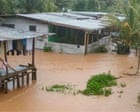
While the wind captures the headlines, the secondary driver of the Maila disaster is the volumetric flow rate of precipitation. The Solomon Islands’ topography—defined by steep volcanic slopes and high-clay-content soil—reacts poorly to the extreme rainfall rates associated with slow-moving cyclonic systems.
The mechanism of failure here is the loss of shear strength in the soil. As water infiltrates the ground, it increases pore-water pressure. In a simplified Mohr-Coulomb failure criterion, the increase in water pressure reduces the effective stress between soil particles, essentially lubricating the plane between the topsoil and the underlying bedrock.
- Mass Wasting Events: Once the rainfall surpasses the infiltration capacity of the soil, surface runoff triggers debris flows. These are not merely floods; they are non-Newtonian fluids with high density, capable of moving boulders and obliterating foundations.
- Riparian Overflow: The short, steep river catchments of the Solomon Islands have a very low "Time of Concentration"—the time it takes for rain falling on the furthest point of the watershed to reach the outlet. This leads to flash flooding with almost zero lead time, bypassing traditional early-warning systems.
- Saline Inundation: The cyclonic low pressure (the "eye") allows the sea level to rise locally, while the 115mph winds push a massive volume of water toward the shore—the storm surge. In low-lying coastal villages, this creates a dual-threat environment where fresh-water flooding from the mountains meets salt-water inundation from the coast.
Logistical Friction in Archipelago Geography
The Solomon Islands pose a unique challenge for post-event analysis and recovery due to the "Archipelago Bottleneck." Distributing aid across nearly 1,000 islands requires a hub-and-spoke logistics model that Cyclone Maila has effectively severed.
The first constraint is the Maritime Access Barrier. High sea states following a 115mph wind event persist for 48 to 72 hours, preventing small-vessel transit between Honiara and the outlying provinces like Malaita or Makira. The second constraint is the Aviation Infrastructure Gap. Most airstrips in the provinces are grass or gravel; saturation from the storm renders them unusable for heavy cargo aircraft, restricting the initial response to helicopters, which have significantly higher operating costs and lower payload-to-fuel ratios.
The telecommunications failure observed during Maila is another predictable component of this friction. High winds frequently misalign microwave backhaul links or destroy cellular towers. Without real-time situational awareness, the central government is forced to allocate resources based on historical vulnerability maps rather than current empirical need, a strategy that inevitably leads to misallocation and "shadow zones" of unaddressed suffering.
Economic Resilience and The Cost of Informal Infrastructure
The Solomon Islands economy is heavily reliant on subsistence agriculture and the export of raw materials like timber and fish. Maila has disrupted the capital stock of these industries in ways that traditional GDP metrics fail to capture.
- Tree Crop Mortality: Coconut and cocoa plantations, which provide the primary cash income for rural households, suffer from "crown snap" or total uprooting at 115mph. Unlike seasonal crops, these take 5 to 7 years to reach productivity again, creating a long-term debt trap for local farmers.
- The Subsistence Deficit: The destruction of root crops (taro, sweet potato) by soil saturation leads to immediate food insecurity. Because these are largely non-marketed goods, the loss doesn't appear in national trade balances, but it triggers a humanitarian requirement for imported grain, which strains the country’s foreign exchange reserves.
Strategic Realignment for Cyclonic Defense
The frequency of high-intensity storms in the South Pacific necessitates a shift from reactive disaster management to proactive structural hardening. The current model of "build-back-same" ensures that every future 110mph+ event will result in identical economic losses.
A superior strategy involves the implementation of a Hardened Core architectural mandate. Rather than attempting to storm-proof an entire traditional dwelling—which is often economically unfeasible—investment should be directed toward constructing a single, small, reinforced concrete room within or adjacent to every home. This room serves as a life-safety bunker during the event and a dry-storage node for seeds, tools, and communications equipment afterward.
Furthermore, the decentralization of critical supplies is the only viable solution to the Archipelago Bottleneck. Pre-positioning "Crisis Pods"—shipping containers converted into solar-powered hubs with water purification systems and satellite linkups—on each major island group eliminates the reliance on Honiara-based logistics in the immediate 96-hour post-impact window. Maila has proven that centralized response models are fundamentally incompatible with the physics of 115mph winds and the geography of the Solomon Islands.