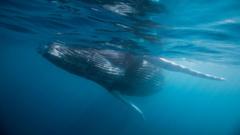
A construction project expanding the Pan-American Highway through the Atacama Desert of Chile stumbled upon one of the most baffling paleontological mysteries of the modern era. More than 40 marine mammal skeletons, predominantly baleen whales, lay packed into a roadside site called Cerro Ballena. They were five million years old. What puzzled scientists wasn't just the sheer volume of bones, but their pristine condition. Entire families of whales lay preserved in the middle of the world's driest desert, hundreds of yards from the modern coastline.
The immediate assumption was a sudden catastrophic event. A massive storm, a shifting tide, or a sudden beaching. But the truth revealed by a team of Smithsonian researchers and Chilean scientists proved far more complex and terrifying. The whales didn't die from a single sudden accident. They were killed by a recurring toxic weapon that still threatens marine life today. For an alternative view, consider: this related article.
Four Distinct Waves of Death
The secret to uncovering the mystery lay in how the fossils were arranged.
Scientists noted that the skeletons were spread across four distinct layers of sediment. This meant the site was not a single, massive graveyard created in an afternoon. Instead, it was a recurring crime scene. Over a period of roughly 10,000 to 16,000 years, the exact same tragedy repeated itself four separate times. Further coverage on this matter has been provided by The New York Times.
The orientation of the skeletons provided the next clue. Nearly all the whales were found lying belly-up. When a whale dies at sea, its carcass bloats with gas and flips over. These animals did not die on land. They died out in the open ocean, floated on the surface for a brief period, and were then washed into a shallow tidal flat by heavy waves.
The diversity of the species found at Cerro Ballena eliminated the possibility of a simple virus or social beaching event. Social beachings usually involve a single species of deeply connected whales, like pilot whales. At Cerro Ballena, the dead included rorqual whales, an extinct species of sperm whale, a bizarre walrus-whale that had previously only been found in Peru, aquatic sloths, and ancient seals.
Something had poisoned the entire ecosystem from the top down.
The Mechanics of Toxic Algae
The culprit was Harmful Algal Blooms. Today, we know them as red tides.
In the late Miocene epoch, the geographic layout of the South American coast created the perfect conditions for these toxic blooms. The iron-rich runoff from the Andes mountains poured into the Pacific Ocean. When combined with specific upwelling currents that brought cold, nutrient-dense water from the deep sea to the surface, the ocean essentially became a hyper-fertilized greenhouse.
Algae multiplied at an explosive rate.
Certain species of dinoflagellates and diatoms produce incredibly potent neurotoxins. When marine animals inhale water heavy with these organisms, or consume prey that has ingested the algae, the toxins target the nervous system. Respiratory paralysis follows swiftly.
For a massive mammal like a baleen whale, a heavy dose of these toxins means sudden drowning. They would have lost the ability to swim or breathe within hours of exposure, dying in the open water before the tides carried their buoyant bodies into the protected lagoon that eventually became Cerro Ballena.
The Preservation Miracle
Normally, a dead whale on a beach is stripped to the bone by scavengers within weeks. Yet, the Cerro Ballena fossils show virtually no signs of scavenger damage. Large sharks and ancient killer-sperm whales left these carcasses completely untouched.
The toxicity of the flesh likely kept large scavengers away. A shark that fed on a poisoned whale would suffer the same fate.
Furthermore, the physical environment acted as a natural tomb. The lagoon was protected from the harsh waves of the open ocean. Once the bloated carcasses settled into the shallow mud, they were rapidly covered by a layer of fine, windblown sand from the surrounding desert and tidal silt. This rapid burial sealed the bones away from oxygen and smaller crabs or seabirds, freezing the animals in time before decomposition could scatter the skeletons.
A Modern Warning in Ancient Bones
The discovery at Cerro Ballena is more than an interesting historical footnote. It serves as a stark warning about the current trajectory of our oceans.
The exact mechanisms that killed the whales five million years ago are accelerating today. Runoff from industrial agriculture has replaced the natural iron runoff of the ancient Andes. We are dumping millions of tons of nitrogen and phosphorus into coastal waters, artificially creating the exact hyper-fertilized conditions that triggered the ancient red tides.
We are already seeing the consequences. In recent years, massive die-offs of manatees in Florida, sea lions in California, and whales in the Pacific Northwest have been directly linked to domoic acid and paralytic shellfish poisoning.
Mapping the Modern Threat
| Region | Primary Toxin | Affected Species | Catalyst |
|---|---|---|---|
| Gulf of Mexico | Brevetoxin | Manatees, Dolphins, Sea Turtles | Agricultural fertilizer runoff via Mississippi River |
| California Coast | Domoic Acid | Sea Lions, Sea Otters | Ocean warming and coastal development |
| Atacama Coast (Ancient) | Unknown Dinoflagellate | Whales, Aquatic Sloths, Seals | Natural Andean iron runoff and ocean upwelling |
The scale of the ancient events at Cerro Ballena shows what happens when these blooms become unchecked. It wasn't a localized problem; it was an entire coastal corridor transformed into a dead zone for millennia.
Digital Tools Salvaged the Site
The story of how this site was analyzed is a triumph of modern digital archeology.
When the highway construction crew found the bones, the Chilean government gave scientists a brutal deadline. They had just a few weeks to document the site before the road-building machines would pave over the area. Traditional paleontology, which relies on painstakingly mapping grids with string and measuring tapes before slowly encasing bones in plaster, would have taken years.
The Smithsonian team deployed 3D laser scanners and high-resolution photography rigs.
They captured the precise spatial coordinates of every bone, shell, and sediment layer in a matter of days. This allowed the construction of the highway to proceed while preserving a perfect, millimeter-accurate digital replica of the graveyard. Scientists around the world can still study the exact orientation of those five-million-year-old skeletons in virtual reality, long after the physical site was covered by asphalt.
This technology proved that the whales didn't die of a sudden climate shift or a catastrophic meteor strike. They died because the ocean's natural balance tipped into toxicity.
As modern sea temperatures rise and coastal pollution increases, we are actively rebuilding the ancient machinery that carpeted the Atacama Desert with the bones of giants.