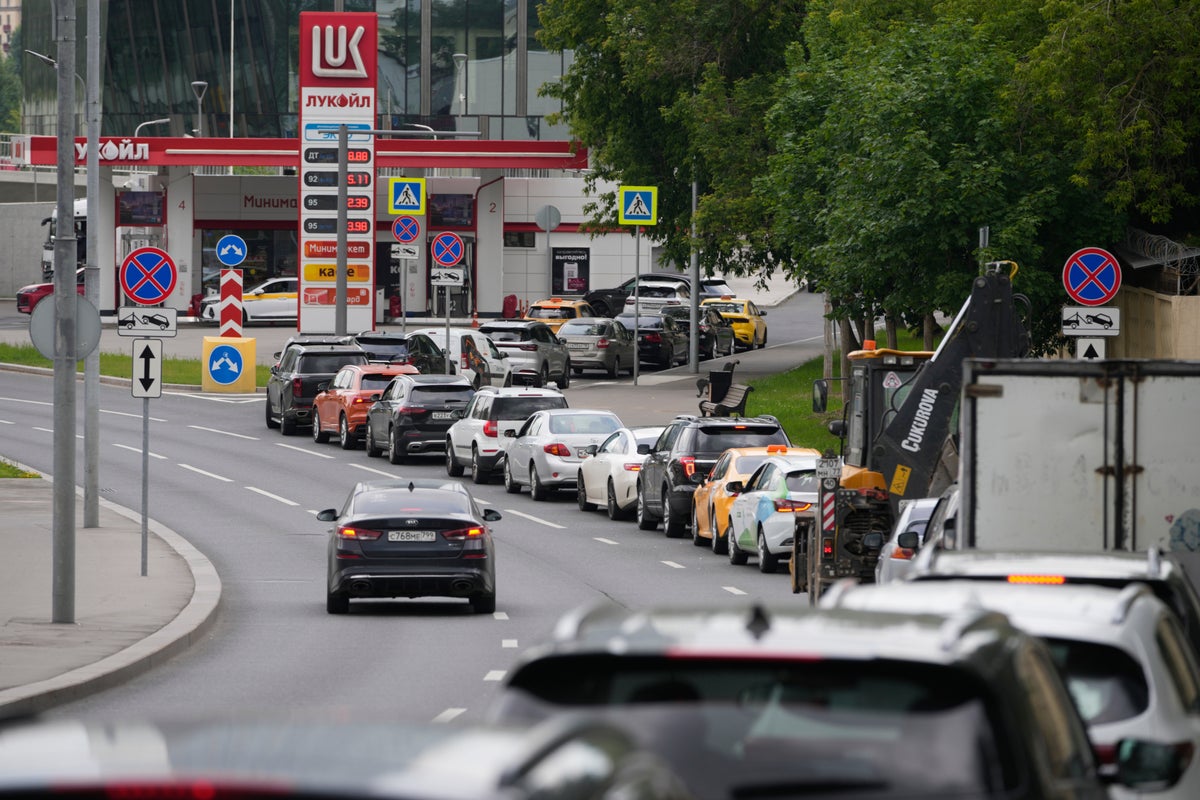
Ukraine's long-range drone campaign has decoupled Russia's status as a top-tier crude oil extractor from its capacity to function as a refined domestic fuel economy. By targeting the primary distillation units of major refining clusters—including recent strikes extending up to 1,400 kilometers into the Ufa refining hub, Yaroslavl, and the Slavyansk-na-Kubani facility—the asymmetric strategy has forced an estimated 25% to 33% of Russia's total domestic refining capacity offline. This structural disruption has triggered a 17% contraction in domestic gasoline production, dropping from 1.03 million barrels per day to approximately 850,000 barrels per day. The resulting 15% domestic supply deficit has exposed a fundamental vulnerability: Russia cannot easily substitute sophisticated domestic refining capacity with crude exports due to infrastructure constraints, Western sanctions on specialized components, and the mathematical reality of regional demand inelasticity.
To evaluate the strategic and economic toll of this campaign, the crisis must be analyzed through the mechanics of refining disruption, geographic supply mismatches, and the compounding costs of infrastructure defense.
The Fractional Distillation Bottleneck: Mechanics of Target Selection
The primary vulnerability of any petroleum refinery lies not in its storage tanks or peripheral pipelines, but in its atmospheric and vacuum distillation units (AVUs). These massive, highly specialized components execute the initial separation of crude oil into basic fractions such as naphtha, kerosene, diesel, and heavy fuel oil.
Ukraine's strike methodology prioritizes these units for two structural reasons:
- Linear Production Dependency: Every downstream process—including catalytic cracking, hydrotreating, and reforming—depends entirely on the continuous output of the primary AVU. Disruption at this single node paralyzes the entire facility's refined output, regardless of whether downstream units remain intact.
- Inelastic Capital Replacement: Modern AVUs rely heavily on Western-designed, automated control systems and precision metallurgical components. Under the current global sanctions regime, the procurement lead times for these specialized parts do not follow standard industrial schedules. Repairs cannot be completed with generic domestic substitutes without severely downgrading the facility's efficiency and safety parameters.
The operational reality is dictated by a race between Ukrainian drone delivery cadences and the maximum velocity of Russian engineering repair teams. When a facility like the Kapotnya refinery—the primary fuel supplier to the Moscow metropolitan area—is struck multiple times within a single quarter, the repair cycle is completely reset. This accumulation of structural damage transforms a series of isolated tactical events into a permanent reduction in aggregate national refining capacity.
The Spatial and Economic Mismatch of Russian Energy
Russia's energy economy operates under a sharp geographic divide. Crude extraction occurs predominantly in Western Siberia and the Volga-Urals, while the highest concentration of high-complexity refining assets sits in the European portion of the country, close to major population centers and historical export terminals.
[Crude Extraction: Siberia / Urals]
               │
               ▼ (Pipeline Infrastructure)
[Refining Clusters: European Russia / Ufa / Krasnodar] <── [Targeted by Long-Range UAVs]
               │
               ▼ (Refined Products: Gasoline / Diesel)
[Domestic Demand Hotspots & Agricultural Belts]
This structural configuration creates an acute logistics bottleneck when European-side refineries are knocked offline:
The Crude Substitution Fallacy
An unrefined barrel of Urals crude cannot be put directly into an agricultural tractor, a military logistics truck, or a civilian vehicle. When refining capacity falls by a third, Russia is forced to export more unrefined crude to international markets. However, this excess crude faces strict Western price caps and steep discounts from major Asian buyers, which severely limits the net financial compensation for the lost value-add of domestic refining.
Regional Inelasticity and Rationing
Refined petroleum products are highly sensitive to transport distances. Transporting gasoline from functional refineries deep in Siberia to the western border regions or the agricultural belts of southern Russia places an unsustainable burden on the national rail network, which is already heavily congested with military supply lines.
The consequences of this spatial breakdown are visible across multiple economic layers:
- The Agricultural Harvest Bottleneck: The supply crunch directly coincides with the peak of the summer agricultural harvest, a period characterized by highly inelastic demand for diesel and gasoline.
- Local Demand Containment: Municipal and regional authorities have been forced to implement localized consumption caps. For example, in the Siberian Irkutsk region, state-run Rosneft stations have restricted civilian purchases to a maximum of 50 liters per vehicle per day, while non-state operators have introduced even lower thresholds.
- The Crimean Logistics Crisis: The crisis is most acute in occupied Crimea, where recent deep strikes have successfully severed major overland fuel supply lines, forcing a total suspension of civilian petrol sales to prevent a complete paralysis of localized military movements.
The Air-Defense Dilemma: Calculating Overstretch
From a strategic perspective, the drone campaign functions as an economic force multiplier by imposing a severe structural optimization problem on Russian military command. Russia possesses a finite inventory of advanced air defense systems, such as the S-400 and Pantsir-S1 architectures.
The expanding geographic reach of Ukrainian UAVs—now regularly exceeding 1,000 kilometers from the border—creates an unsustainable defense radius. Russian planners face a trilemma: they must choose between protecting forward military installations along the frontline, shielding high-value political and civilian targets like Moscow and Saint Petersburg, or deploying point-defense systems around dozens of sprawling industrial energy facilities.
Every Pantsir system anchored to an oil refinery in Ufa or Yaroslavl represents a critical gap in air defense along active combat zones. Conversely, prioritizing the frontline leaves billions of dollars of energy infrastructure exposed to relatively low-cost, domestically produced long-range drones. This dynamic shifts the cost curve entirely in Ukraine's favor.
Strategic Playbook: The Near-Term Energy Vector
To stabilize its domestic fuel market and prevent a compounding economic shock, the Russian state is forced to pivot from an export-focused energy strategy to an aggressive deficit-management posture. Expect Moscow to deploy a three-pronged emergency playbook over the coming quarters:
- Sourcing Finished Products via Belarus and Kazakhstan: Russia will increasingly rely on importing refined gasoline and diesel from regional allies. This turns Russia from a historical net exporter of refined products into a dependent importer, a shift that will quickly consume liquid currency reserves.
- Permanent Implementation of Export Bans: Existing temporary bans on gasoline exports will likely be extended indefinitely and expanded to include specific grades of diesel and intermediate distillates, prioritizing domestic price controls over foreign currency generation.
- Industrial Cannibalization: Repair teams will likely begin cannibalizing offline or lower-efficiency refineries in the eastern territories to harvest specialized valves, pumps, and control systems for high-priority facilities in western Russia.
The long-term trajectory of this economic bottleneck depends entirely on whether Ukraine can maintain its current launch frequency. If Kyiv sustains this targeting cadence, the rate of structural depreciation across Russia's downstream sector will outpace its repair capabilities, locking in structural fuel deficits that will continuously degrade both domestic economic stability and military logistics.