The Scent of Charred Pine
Walk down Renfrew Street on a damp afternoon in Glasgow, and if the wind catches the rain just right, you can almost swear you still smell it. It isn't the familiar Scottish mist or the exhaust from passing taxis. It is the acrid, lingering ghost of burnt pitch pine, aged timber, and shattered stone.
For over a century, the Mackintosh building of the Glasgow School of Art stood not just as a place of higher learning, but as a living creature. Charles Rennie Mackintosh poured his soul into every wrought-iron window frame, every soaring wooden beam, and every stained-glass panel. It was a masterpiece of Art Nouveau, a sanctuary where thousands of students learned to see the world differently.
Then came May 2014. A projector sparked in the basement. Flames tore through the timber-frame interior, devouring the famous library—a room crafted like a timber cathedral—just as students were putting the finishing touches on their final degree shows.
Glasgow wept. But Glasgow also resolved to rebuild.
Money poured in from around the globe. Artisans were hired. Rare woods were sourced. The restoration was a painstakingly slow labor of love, a testament to the belief that human brilliance could triumph over misfortune.
Then came June 2018.
Twice Burned
Lightning, they say, rarely strikes the same place twice. Fire, apparently, is far less scrupulous.
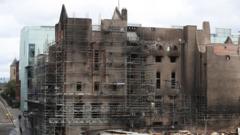
Four years after the first blaze, with the restoration nearly complete and the building months away from reopening, fire struck again. This time, it was absolute. The 2018 blaze was a monstrous inferno that lit the night sky over Scotland’s largest city, reaching temperatures so high that steel beams bent like wax and stone walls cracked under the thermal shock. By sunrise, the Mackintosh was an empty shell—a hollowed-out skull of blackened masonry held together by temporary steel scaffolding.
When the smoke cleared, the initial emotional response was clear: we must rebuild again. No matter what.
Because to give up on the "Mac" felt like giving up on Glasgow's spirit. It felt like admitting that destruction had won over art.
Yet emotional resolve eventually meets the icy shore of ledger sheets. And right now, the Glasgow School of Art is staring into a financial abyss that no amount of sentimentality can bridge.
The Cold Reality of the Ledger
Rebuilding a historic icon once is an act of defiance. Attempting to rebuild it twice, from absolute zero, is a financial catastrophe.
Consider the sheer mechanics of the situation. The original estimated cost to restore the building after the 2018 fire hovered around £100 million. But in the years since, the world changed. Global supply chains buckled. Inflation surged. The specialized labor required to recreate 19th-century craft techniques—blacksmiths who can forge bespoke ironwork, stonemasons who understand historical mortar mixes, carpenters who work with century-old pine—became astronomically expensive.
Today, realistic estimates for a faithful faithful reconstruction stretch well beyond £200 million, with some experts quietly whispering figures closer to a quarter of a billion pounds.
Where does that money come from?
Insurance policies cover only a fraction of a loss this total. Public arts funding across the United Kingdom faces severe austerity cuts. Universities and arts institutions are battling declining real-term funding, rising energy costs, and shifting student demographics.
The harsh truth is simple. The Glasgow School of Art cannot afford to rebuild the Mackintosh building. Not under its current budget, not with its current backing, and perhaps not ever in the way people dream.
Imagine holding a bank account with enough money to buy a modest family house, but you are handed a bill to restore a royal palace. That is the exact mathematical reality facing the school's leadership today.
The Human Cost of an Empty Shell
It is easy to get lost in numbers, but behind the financial standstill lies a human tragedy that hits current students every single morning.
Think of a hypothetical nineteen-year-old student—let us call her Maya—who arrived in Glasgow three years ago, drawn by the legend of the Mackintosh. She expected to walk through light-drenched studios designed by a genius, surrounded by history. Instead, she attends lectures in converted office spaces and works in prefabricated accommodation blocks nearby.
The empty hull of the Mackintosh looms over her campus like a massive, iron-caged monument to what used to be. Every pound spent maintaining the stabilization scaffolding—millions of pounds every few years just to keep the remaining stone walls from collapsing into the street—is a pound that cannot go toward modern equipment, staff salaries, or student scholarships.
This is the invisible tax of heritage. When an institution becomes the custodian of a national treasure, it must decide where its primary loyalty lies: to the preservation of dead stone, or to the education of living human beings.
The Myth of the Replica
A deeper, more uncomfortable question is quietly making the rounds through architectural circles and museum corridors.
If you rebuild the Mackintosh today, what are you actually building?
The original structure was crafted by Mackintosh’s own hand and the hands of craftsmen working in his era. It carried the patina of time, the scratches of generations of art students, the faint aroma of turpentine soaked into ancient floors.
If we spend £250 million to construct an exact replica using modern materials, laser-guided cutting tools, and modern fire-retardant coatings, we do not get Charles Rennie Mackintosh's building back. We get a full-scale model. A ghost in a brand-new suit.
Architectural historian William Morris famously argued in the 19th century that trying to restore a ruined ancient building is a lie. You cannot recreate the spirit of an age that has passed; you only create a feeble imitation.
Is it better to leave the ruins as a poignant memorial, or to construct a modern replacement that serves the living, breathing art community of today?
A Choice Nobody Wants to Make
The board of the Glasgow School of Art sits at a table where every decision leads to heartbreak.
Option one: Pursue the full historic reconstruction. This path risks dragging the institution into decades of crippling debt, begging for public handouts during a national economic crunch, and starving the actual academic program of vital resources.
Option two: Build a modern, functional facility within or behind the preserved stone facade. This path saves tens of millions, provides cutting-edge facilities for students, but draws the eternal wrath of heritage purists and traditionalists worldwide.
Option three: Leave the structure stabilized as a permanent ruin or open-air memorial, shifting all operational growth elsewhere.
None of these options feel like a victory. Every single one feels like a compromise with tragedy.
The Shadow on Renfrew Street
Late in the evening, when the traffic dies down and the art studios nearby go dark, the giant steel cage surrounding the Mackintosh building glows faint under the yellow streetlights.
It stands as a testament to human ambition, to artistic genius, and ultimately, to our fragile attempt to hold onto physical things in an impermanent world. We want to believe that culture is priceless—that no cost is too high to protect our heritage.
But culture exists in the minds of the living, not just in the stones of the past. As Glasgow debates how to pay for a dream it can no longer afford, the scaffolding remains, rust creeping slowly down the steel joints, waiting for a decision that money alone cannot make.