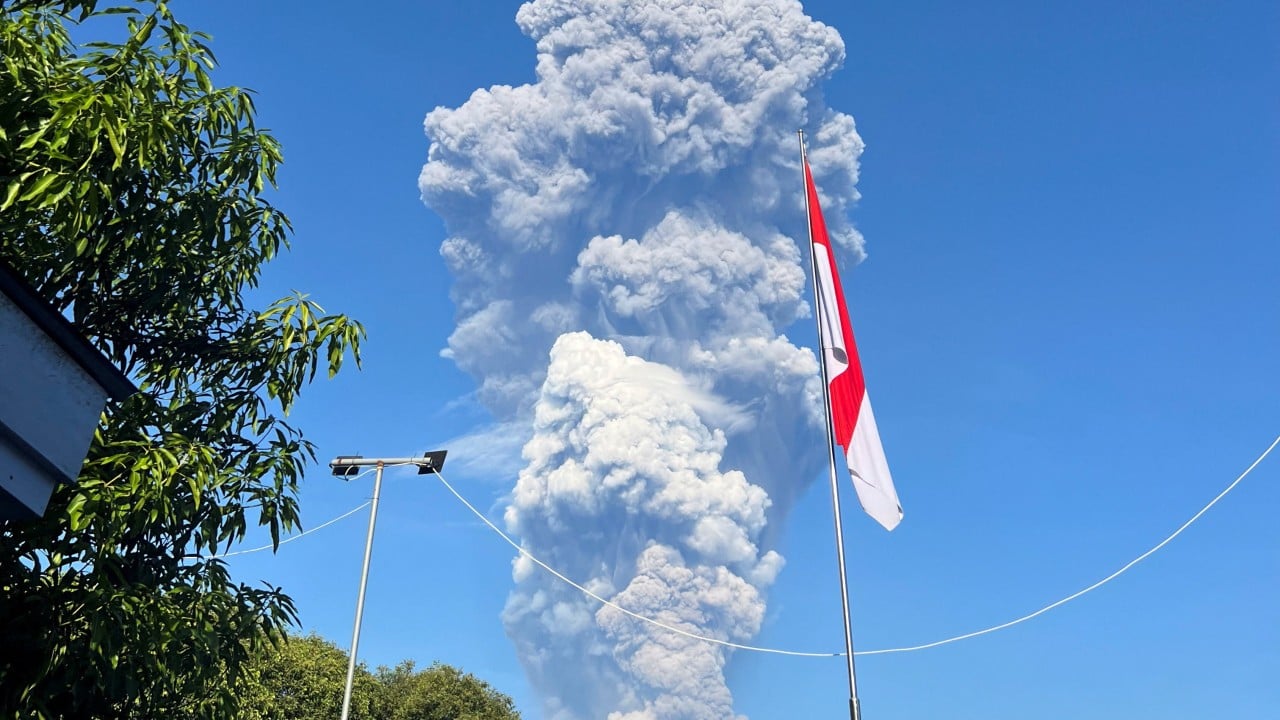
The air on Mount Dukono doesn't just smell like sulfur. It tastes like the end of the world. It is a thick, gritty bitterness that coats the back of your throat and settles in your lungs, a constant reminder that the earth beneath your boots is alive, restless, and entirely indifferent to your presence. On a clear day, the view from the summit of this North Maluku giant is a breathtaking panorama of the Halmahera coastline. On a bad day, the mountain decides to breathe.
That breath is a plume of volcanic ash that can rise miles into the stratosphere. It is a gray, suffocating curtain.
Three families—two in Singapore and one in Indonesia—are currently living in the agonizing silence that follows such a breath. The headlines tell a clinical story: two Singaporeans and one Indonesian national are missing following a sudden eruptive event. But the headlines don't capture the frantic vibration of a smartphone left on a bedside table in a Jurong flat, buzzing with unanswered WhatsApp messages. They don't describe the way the humidity in Halmahera feels heavier when you are staring at a trail head that has been swallowed by a river of gray silt.
The Allure of the Forbidden Peak
Mount Dukono is not like the manicured hiking trails of Bukit Timah. It is one of Indonesia's most active volcanoes, a place where the geological clock ticks faster than anywhere else on the planet. For a specific breed of traveler, that is the draw. There is a primal magnetism in standing on the edge of a crater that is actively reshaping the map.
Consider the mindset of the modern explorer. We spend our lives behind glass—smartphone screens, office windows, windshields. We crave the tactile. We want to feel the heat of the earth radiating through the soles of our hiking boots. We want to see the "fire" that the travel brochures promise.
But the mountain doesn't care about your bucket list.
When the eruption began, it wasn't a cinematic explosion with a slow-motion countdown. It was a sudden, violent displacement of reality. For the three hikers now lost to the slopes, the transition from an adventurous Saturday to a fight for survival likely happened in the span of a single heartbeat. One moment, the sun was a bright coin in the sky; the next, the world turned the color of a bruised lung.
The Anatomy of a Disappearance
To understand why people go missing on Dukono, you have to understand the terrain. This isn't just forest. It’s a labyrinth of hardened lava flows, deep ravines, and shifting ash deposits that can act like quicksand. When an eruption occurs, the primary threat isn't always the lava. It is the tephra—the rock fragments and particles ejected into the air.
Imagine trying to navigate a steep, rocky descent while wearing a blindfold. Now, imagine that blindfold is made of hot, acidic dust that stings your eyes and turns your sweat into a muddy paste. Your GPS loses signal. Your compass spins. The landmarks you used to find your way up—a specific jagged rock, a cluster of hardy ferns—are buried under six inches of fresh gray powder.
The geography becomes a shapeshifter.
Search and rescue teams in Indonesia are among the most hardened in the world. They deal with the whims of the Ring of Fire daily. Yet, even for them, Dukono is a nightmare. The volcanic activity hasn't stopped just because people are missing. The mountain continues to pulse. Ash clouds continue to collapse, sending pyroclastic flows—avalanches of hot gas and rock—tumbling down the flanks at speeds that outrun any human.
The rescuers are not just looking for people; they are playing a high-stakes game of chess with a grandmaster made of magma.
The Invisible Stakes of the Search
While the physical search happens on the slopes of Halmahera, a psychological search is happening back in Singapore.
In a quiet neighborhood, a mother sits at a kitchen table. She isn't reading the news reports. She knows them by heart. She is looking at a photo on her phone, taken just forty-eight hours ago. It shows a smiling face, a backpack strapped tight, a thumb up. The caption probably said something about "conquering the peak."
This is the hidden cost of our global mobility. We can be on a remote Indonesian volcano on Saturday and expect to be back at our desks on Monday. We have collapsed the distance between the mundane and the magnificent, but we haven't collapsed the danger.
The tragedy of the missing trio isn't just a "travel mishap." It is a reminder of the thinness of the veil. We walk through life assuming the ground is solid. We assume that if we follow the path, the path will lead us home. But on the Ring of Fire, the ground is a liquid waiting to happen.
A Silence Louder Than the Eruption
The search has been hampered by the very thing that caused the disappearance: the mountain's refusal to settle. Heavy rain has turned the ash into lahars—volcanic mudslides that have the consistency of wet concrete and the power to sweep away trees. Every time a helicopter prepares to lift off, the sky darkens again.
Nature is not cruel. Cruelty requires intent. Nature is simply massive.
The Indonesian authorities have cordoned off a three-kilometer radius around the crater, a "no-go zone" that is now a theater of shadows. Inside that circle, time has stopped for three people. Outside that circle, the world is demanding answers. Why were they there? Was the guide experienced? Did they ignore the warnings?
These questions are a form of defense. If we can find a mistake they made, we can convince ourselves that it wouldn't happen to us. We blame the victim to insulate ourselves from the terrifying truth: that sometimes, you can do everything right and still be in the wrong place when the earth decides to move.
The Singapore Ministry of Foreign Affairs is working with local Indonesian counterparts, a diplomatic dance of logistics and hope. They are coordinating with the National Search and Rescue Agency (Basarnas). They are checking flight manifests and trail logs. They are doing the heavy, necessary work of bureaucracy in the face of catastrophe.
But for the families, the diplomacy is white noise. They are waiting for a crackle on a radio. They are waiting for a muddy boot to emerge from the treeline.
The Weight of the Wait
There is a specific kind of exhaustion that comes from waiting for news of a loved one missing in the wild. It is a physical weight. It makes your limbs feel like lead and your mind move in circles. You find yourself bargaining with a God you haven't spoken to in years. You find yourself staring at maps of North Maluku until the contour lines look like veins.
The Indonesian hiker among the missing likely knew these slopes better than the visitors. Perhaps he was the one leading the way, the one who saw the cloud first and shouted a warning that was swallowed by the roar of the vent. In these moments, nationality dissolves. There are no Singaporeans or Indonesians in a volcanic ash cloud. There are only humans, small and fragile, huddled against the heat.
The story of the Mount Dukono eruption will eventually fade from the front pages. The ash will settle and eventually become fertile soil. New ferns will grow. Another group of hikers, lured by the "unspoiled" beauty of the Maluku Islands, will sign the ledger at the base of the mountain.
But for three families, the mountain will never be just a landmark again. It will be the place where the world went quiet.
The rescue teams are still out there. They are moving through the gray, ghost-like landscape, calling out names into the wind. They are looking for a flash of color—a red jacket, a blue tent—in a world that has been bleached of everything but ash. They carry oxygen tanks and hope, two things that are in short supply on the slopes of Dukono.
The mountain continues to smoke. It stands as it has for millennia, a monument to the volatile beauty of our planet. It doesn't offer apologies. It doesn't offer closures. It only offers the cold, hard reality of the earth’s internal fire, and the echoing silence of those who dared to stand too close when it finally exhaled.