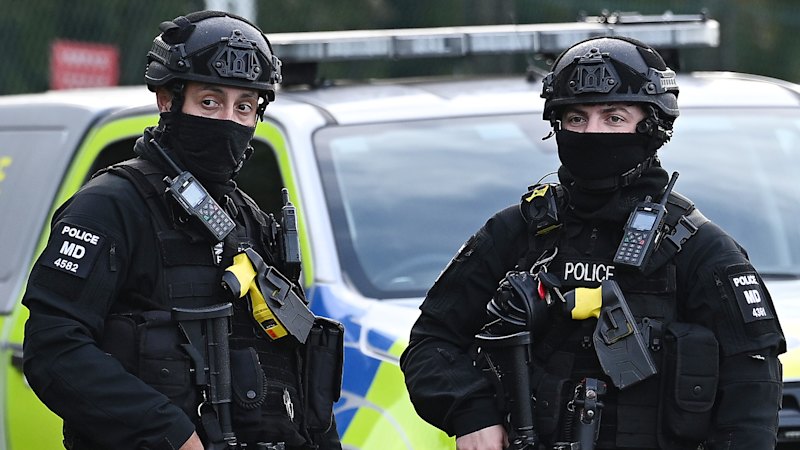
The unsealing of federal indictments in New York alongside counterterrorism operations in Gloucestershire exposes structural vulnerabilities in how proxy networks operate beneath conventional thresholds of war. When British authorities arrested multiple suspects near RAF Fairford—a strategic installation utilized by United States strategic bombers—and subsequently released them on bail before executing targeted National Security Act charges against key individuals, the sequence laid bare the operational friction between legal standards of proof and immediate military risk mitigation.
Intelligence architecture in transnational proxy operations relies on decentralized cell structures. According to federal prosecutors, coordination of attacks against European targets and military staging posts persisted despite high-value detentions. The mechanism utilized—transmitting directives via coded prison communications routed through family intermediaries—demonstrates the resilience of network nodes even when primary handlers are neutralized or incarcerated. Inmates isolated in correctional facilities maintain channels through ambient socio-familial vectors, bypassing electronic monitoring countermeasures designed to sever command-and-control loops.
The kinetic response by the United States Air Force, which involved redeploying strategic assets away from British installations, illustrates a calculated risk-management calculus. Military planners treat proximity threats through a framework of asset preservation. Even absent verified explosive materials recovered at immediate checkpoints, the presence of coordinated surveillance and intelligence-gathering indicators directed against a base housing nuclear-capable or long-range platforms elevates the threat matrix beyond local policing thresholds.
State denial strategies function as predictable variables in this calculus. Iranian officials formally rejected involvement in the Fairford surveillance plot, adhering to the doctrine of plausible deniability that characterizes asymmetric warfare. State-backed proxy networks allow sovereign actors to project tactical disruption while retaining diplomatic exit ramps. By employing non-state militia commanders, such as figures tied to Kata'ib Hizballah, alongside regional operatives across multiple jurisdictions, state sponsors insulate formal military command hierarchies from direct attribution.
The judicial handling of suspects within the United Kingdom highlights the operational gap between intelligence collection and criminal prosecution. Initial bail releases reflect the evidentiary standards required under British criminal procedure, where suspicion and operational disruption do not automatically clear the high bar required for indefinite pretrial detention without specific statutory upgrades. Subsequent rearrests under the National Security Act indicate a transition from localized security vetting to specialized counter-espionage charges, aligning domestic statutory frameworks with modern state-threat activities.
Securing strategic installations against asynchronous proxy probes requires shifting from perimeter defense to continuous threat vector mapping. Intelligence agencies must anticipate that incarceration of mid-level commanders does not terminate operational momentum if communication redundancies remain unmitigated. The primary strategic response demands complete disruption of auxiliary family-conduit channels and tighter surveillance of cross-border financial flows supporting localized operatives.

