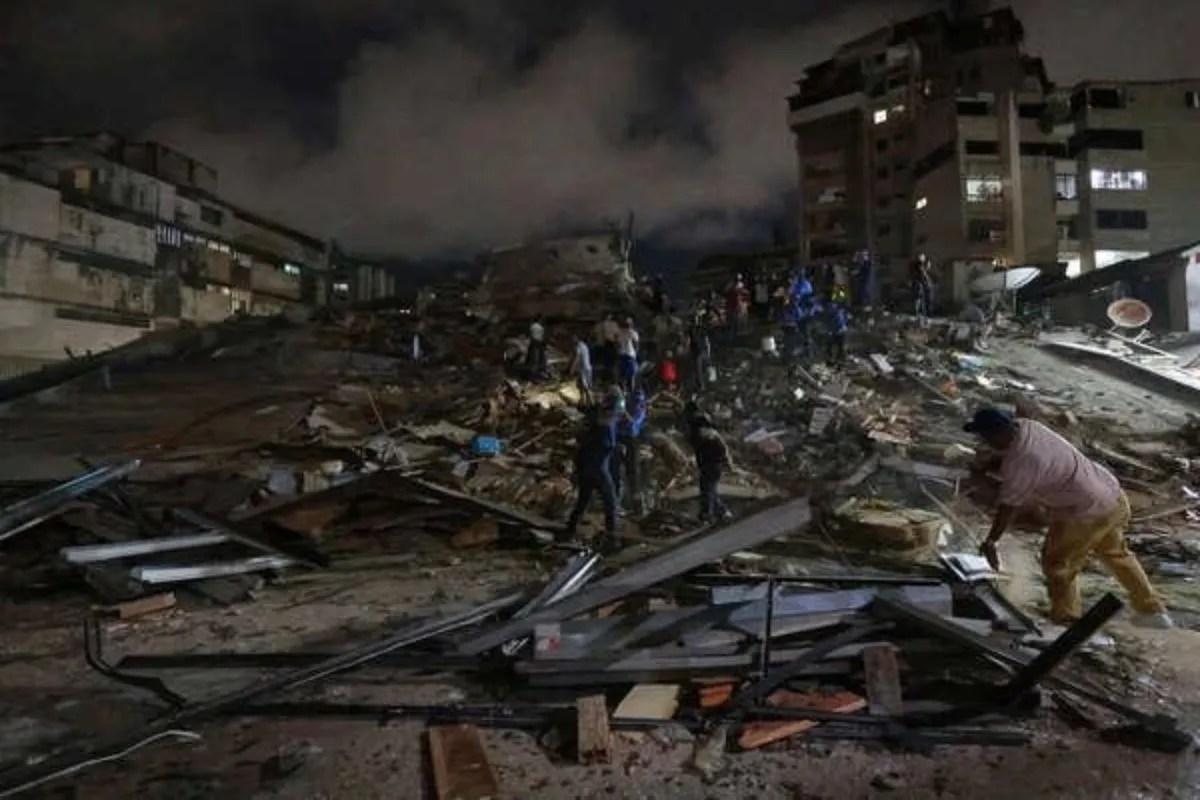
The catastrophic failure of urban infrastructure in northern Venezuela following the seismic events of June 24, 2026, exposes a critical vulnerability in structural resilience and mass casualty management. A shallow doublet earthquake sequence—a magnitude 7.2 foreshock followed 39 seconds later by a magnitude 7.5 mainshock—generated violent ground shaking across north-central regions, resulting in an officially confirmed death toll of 1,430 as of June 27. The destruction is not merely a product of tectonic magnitude; it is the direct consequence of systemic engineering deficits, compromised structural integrity, and acute logistical bottlenecks in emergency resource deployment. Evaluating this disaster requires an objective structural framework that links seismic physics to the collapse of urban systems and subsequent humanitarian strains.
The Mechanics of Doublet Shaking Accumulation
Standard disaster analysis frequently treats seismic events as isolated, single-impulse stresses. The June 24 event defied this model by operating as a doublet sequence, which functions as a compounding stress multiplier on built environments.
- Structural Fatigue Acceleration: The magnitude 7.2 foreshock compromised the structural integrity of residential and commercial buildings, initiating micro-fractures, shearing load-bearing walls, and destabilizing foundations.
- The 39-Second Window: Before any civic response or evacuation could execute, the 39-second delay meant structures already operating at or near plastic deformation limits were immediately subjected to a more severe magnitude 7.5 mainshock. Buildings that could have survived either tremor individually experienced catastrophic structural failure due to this continuous accumulation of kinetic stress.
- Shallow Focal Depth: The hypocenters ranged between 10 to 22 kilometers deep. This proximity to the surface minimized the attenuation of seismic waves, directing maximum kinetic energy directly upward into high-density municipal centers including La Guaira, Yaracuy, and Greater Caracas.
This sequence exposed approximately 3.9 million people to severe shaking, with over 712,000 residents situated in areas experiencing extreme destructive intensity.
The Cascade of Critical Infrastructure Failures
The secondary effects of the doublet earthquake illustrate a predictable cascade where the failure of one system triggers immediate, compounding bottlenecks across adjacent networks.
Transportation and Air Logistics Severance
The primary logistical bottleneck originated at Simón Bolívar International Airport in La Guaira. Structural damage to key runways and terminal buildings instantly restricted international aid access. While one runway remains operational for restricted military transport, the reduction in cargo throughput capacity delayed the deployment of heavy excavation machinery and specialized search units during the critical 72-hour survival window.
Power and Communications Blind Spots
The immediate loss of grid power across the Capital District neutralized local telecommunications networks. This severed connection points between centralized emergency operations and local search-and-rescue teams. The absence of cellular and digital signals forced civilian populations to rely on independent digital databases to report missing relatives. This structural breakdown created a massive information asymmetry: as of June 27, reported missing persons stood at 68,900, a figure inflated by duplicate reports and unconfirmed statuses caused by the ongoing communication blackout.
Specialized Mass Casualty Healthcare Deficits
The Pan American Health Organization reported that 91 emergency hospitals were located within zones experiencing high intensity shaking. Twenty of these facilities operated in areas of severe structural threat. Instead of serving as processing hubs for the 3,238 confirmed injured citizens, these healthcare facilities faced localized disruptions to power, water, and oxygen supplies, impairing trauma triage and surgical operations.
The Logistics Gap in Search and Rescue Lifecycle
Survival probability in concrete structural collapses follows an exponential decay curve. The first 48 to 72 hours represent the peak probability for extracting live victims. Beyond this window, dehydration, internal trauma, and environmental exposure cause mortality rates to spike.
Survival Probability (%)
100 |-------------------
    |     \
 50 |       \
    |         \
  0 |___________\_______
    0     24    48    72   (Hours Post-Collapse)
The Venezuelan civil defense apparatus demonstrated severe preparation gaps that effectively shifted the burden of physical rescue onto untrained civilian populations. Non-specialized personnel utilizing primitive manual tools or bare hands lack the capability to stabilize heavy concrete voids.
The introduction of state-enforced regulatory barriers further slowed the operational cadence. The mandate requiring civilian volunteers and international teams to secure safe-entry passes at centralized hubs created administrative queues, stalling transit into the hardest-hit zones of La Guaira precisely as the 72-hour survival window closed.
Economic Quantifications and Structural Attrition
The United Nations estimates physical infrastructure asset destruction at $6.7 billion, representing approximately six percent of Venezuela’s gross domestic product. This valuation reflects direct asset loss but fails to capture the long-term operational friction introduced to the macroeconomy.
The region affected represents a vital logistical corridor for the nation. The physical destruction of transport routes linking the coast to Caracas permanently escalates supply-chain costs for essential goods. Concurrently, the displacement of millions of citizens—including an estimated 2 million affected individuals in Caracas alone—creates immediate macroeconomic demands for emergency shelter, systemic reconstruction, and public health stabilization that will divert capital from existing industrial development sectors.
Strategic Allocation of International Aid
Managing the transition from active search-and-rescue to long-term regional stabilization requires a reallotment of international capital and logistics. The initial $150 million allocation from external entities must shift from general humanitarian liquidity to specific engineering and public health interventions.
Immediate priority must be given to deploying heavy, mechanized structural lifting equipment directly to coastal zones via maritime transport, bypassing the bottleneck at the damaged primary airport. Simultaneously, the deployment of modular field hospitals equipped with independent power and water filtration units is required to offload the strain on compromised local clinical infrastructure.
Long-term survival and recovery depend on updating municipal building codes to enforce strict seismic damping standards. Future reconstruction programs must legally mandate ductile detailing in concrete frames and restrict high-density residential development on unstable coastal slopes to mitigate the risk of future doublet sequences.