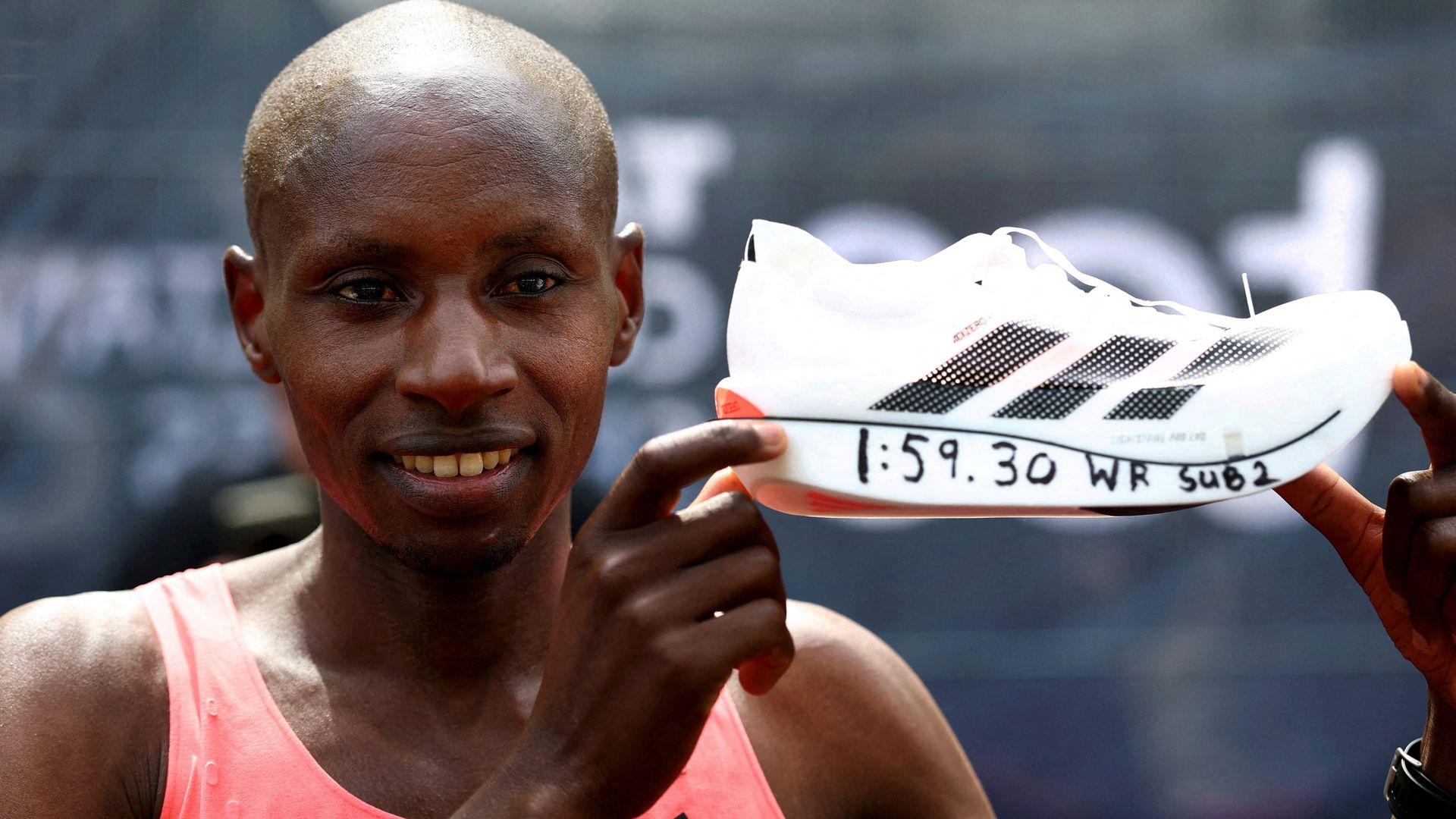
The air in London on marathon morning doesn’t just sit; it vibrates. It’s a thick, humid soup of adrenaline, deep heat rub, and the collective anxiety of fifty thousand people about to find out exactly who they are when their lungs start to scream. But amidst the sea of neon polyester and trembling knees, one man stood with a slice of bread. It was smeared with honey. Simple. Ordinary. Almost offensive in its domesticity when compared to the high-stakes theater about to unfold on the pavement.
That man was Alexander Mutiso Munyao.
To the casual observer, the honey was a snack. To the initiate, it was high-octane fuel for a machine refined to a degree that defies biological logic. We often view the marathon as a test of will, a romantic struggle of the human spirit against the road. We are wrong. The modern marathon is a cold, calculated war of attrition fought with carbon plates, proprietary foams, and the precise timing of glucose absorption.
The Ghost in the Machine
Consider the sheer audacity of the pace. To win the London Marathon, you aren't just running; you are falling forward at a speed that would leave most weekend joggers gasping for air within four hundred meters. Munyao wasn't just racing the elite field; he was racing the ghost of Kelvin Kiptum, the titan who had rewritten the record books before his life was cut short.
The pressure of that legacy is a physical weight. It sits on the shoulders like lead. When Munyao broke away from Kenenisa Bekele—a man whose lungs seem to hold the capacity of an industrial bellows—the shift wasn't loud. It didn't involve a theatrical surge. It was a subtle tightening of the screws. A slight lean. A fraction of an inch added to the stride.
This is where the "super shoe" enters the narrative. Critics love to point at the thick, bouncy soles of modern racing flats as if they are cheating. They call them mechanical doping. But a shoe, no matter how much Pebax foam or carbon fiber you cram into it, does not run the race. What it does is more psychological than mechanical: it preserves the legs. It allows a human being to reach mile twenty-two without their calves feeling like they’ve been beaten with a cricket bat.
In the old days, the marathon was about who could survive the pain. Now, thanks to the engineering underfoot, it is about who can maintain the highest level of efficiency for the longest duration. The shoes shifted the finish line.
The Chemistry of the Honey Slice
While the shoes handle the impact, the honey handles the collapse.
When you run at Munyao’s intensity, your body becomes a furnace. It burns through glycogen with terrifying speed. Hit the wall, and the world turns gray; your brain starts sending "stop" signals so loud they drown out your heartbeat. That bread and honey wasn't a breakfast. It was a tactical reserve.
Think of the body as a high-performance engine. If you put low-grade fuel in a Formula 1 car, it knocks and pings before the first turn. Simple sugars, delivered in a form the gut can handle under extreme stress, are the difference between a podium finish and a collapse on the Mall. Munyao’s choice of honey is a nod to the old ways—a natural, rapid-release energy source that bypasses the complex digestion that would sit like a stone in the stomach at four-minute-per-mile pace.
But there is a darker side to this efficiency. The more we optimize the gear and the nutrition, the closer we push the human heart to its absolute ceiling. We are tinkering with the redline.
The Loneliness of the Break
At thirty-five kilometers, the crowd noise becomes a blurred roar, a wall of sound that the mind can no longer process into individual cheers. This is the "Dead Zone." Your vision narrows. The world becomes the three feet of tarmac directly in front of your toes.
Munyao found himself alone.
Bekele, the elder statesman, the man who had seen a thousand such battles, began to fade. It wasn't a sudden drop-off. It was a slow-motion unraveling. One second he was there, a shadow on Munyao’s shoulder, and the next, the gap was a yard. Then five. Then twenty.
That gap is the most terrifying place in sports. When you are behind, you have a target. When you are in front, you have nothing but the wind and the haunting possibility that you have moved too soon. The invisible stakes here aren't just about the prize money or the trophy. They are about the terrifying silence of your own mind. Without a competitor to pace off, you have to listen to your own breathing. You hear every ragged inhalation. You feel every minor twitch in your hamstring.
We often ask why these men and women do it. Is it the glory? Perhaps. But watching Munyao’s face as he turned onto the final stretch, there was no joy. There was only a grim, focused intensity. It was the look of a man completing a complex mathematical equation under the threat of execution.
The Myth of the Natural Athlete
We love the story of the "natural." We want to believe that Munyao simply woke up with the ability to glide over the earth. It makes us feel better about our own struggles to jog around the block. But the truth is far more grueling and, frankly, far more inspiring.
The victory in London was built in the thin air of the Kenyan highlands. It was built in the thousands of miles of red dust, in the pre-dawn runs when the frost is still on the grass and the lungs burn with the cold. The "super shoe" and the "bread with honey" are just the final flourishes on a masterpiece of human suffering and dedication.
The marathon isn't a race against others. It's a race against the part of yourself that wants to be comfortable. Every mile is a question: Are you still willing to pay the price?
Munyao’s answer was written in the way his feet kissed the ground—barely touching, moving with a circular fluidity that made the pavement look like a moving walkway. He wasn't fighting the road; he was cooperating with it.
The Final Turn
As the red tarmac of the Mall opened up, the gravity of the moment finally seemed to hit. The clock was ticking toward a time that would have been unthinkable a generation ago.
We are living in an era where the two-hour barrier isn't just a dream; it’s a looming inevitability. Every time a runner like Munyao crosses that line, they are chipping away at the psychological granite that tells us what is possible. They are the explorers of our physical limits.
But forget the carbon fiber. Forget the specialized sports drinks and the biomechanical analysis.
When Munyao crossed the line, he didn't look like a machine. He looked like a man who had finally been allowed to stop holding his breath. He looked human. He looked exhausted. He looked like someone who had spent everything he had and found, at the very bottom of his soul, there was just enough left to win.
The shoes are back in the bag. The honey is gone. What remains is the silence of the Mall after the crowds have dispersed, and the knowledge that for one morning in London, a human being ran as close to the edge of the world as any of us are ever likely to see.
The road doesn't care about your technology. It only cares about your heartbeat.