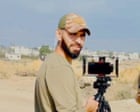
The modern combat zone operates on a dual-front paradigm: physical kinetic destruction and systemic information control. When a state military conducts a kinetic strike on a media operative, it is rarely an isolated tactical error; it is an intersection of intelligence collection, asymmetric rules of engagement, and strategic narrative positioning. The strike by the Israel Defense Forces (IDF) in the Bureij refugee camp in central Gaza, which killed Al Jazeera Mubasher cameraman Ahmed Wishah, serves as a primary case study for understanding how modern militaries manage the operational risks of battlefield visibility.
To analyze this event with rigorous structural logic, one must dissect the three core vectors that define targeted strikes on media personnel in asymmetric urban environments: the intelligence-attribution mechanism, the conflict-attrition rate, and the operational doctrine of information denial.
The Intelligence Attribution Mechanism
Militaries operating in dense urban environments rely on specific categorization metrics to justify kinetic actions against targets that wear civilian press identification. The friction between the IDF's categorization of Wishah as a "Hamas terrorist" and Al Jazeera’s designation of him as a civilian journalist highlights a structural bottleneck in contemporary international humanitarian law: the classification of dual-use actors.
The military operational framework for targeting rests on a definitive data-state challenge. When a state entity executes what it describes as a "precise strike," the action implies a pre-existing intelligence profile. The verification matrix generally relies on three inputs:
- Signals Intelligence (SIGINT): Geolocation data derived from mobile devices, network transitions, or electronic transmissions within a specific grid sector.
- Human Intelligence (HUMINT): Ground-level reporting identifying associations, logistical footprints, or command-structure integration.
- Imagery Intelligence (IMINT): Persistent drone surveillance tracking physical movements between civilian infrastructure and known military nodes.
The structural failure in this intelligence mechanism occurs during the attribution phase. In an environment where political authorities also manage civilian infrastructure—such as the media, medical, and administrative sectors in Gaza—the line between functional employment and combatant status becomes blurred. The IDF’s operational doctrine frequently classifies individuals holding employment within state-adjacent or partisan media organizations as operational extensions of the adversary's command structure. Conversely, international legal bodies require distinct, unambiguous proof of direct participation in hostilities to strip an individual of civilian protection. The systematic lack of immediate evidentiary disclosure following such strikes creates an informational asymmetry, allowing the striking party to control the immediate strategic narrative while delaying legal scrutiny until the tactical relevance of the event has faded.
The Kinematics of Attrition
The deaths of Ahmed Wishah and his brother, Mohammed Wishah—an Al Jazeera Mubasher correspondent killed in a separate strike on April 8—are indicators of an exceptionally high attrition rate among local media operatives. According to tracking data compiled by the Committee to Protect Journalists (CPJ), at least 260 Palestinian journalists have been killed since October 2023. This volume of casualties cannot be accurately explained by standard collateral damage models. Instead, it must be understood through the lens of specific urban combat variables.
The first variable is the localized proximity function. Local camera operators and field correspondents must maintain physical proximity to kinetic flashpoints to secure high-fidelity visual data. In a highly dense, non-contiguous urban theater like the Gaza Strip, this necessity places the operative within the immediate blast radius of unguided or low-yield precision munitions targeting adjacent structures.
The second variable is the degradation of established geographic safe zones. The strike on Wishah occurred within a residential structure inside the Bureij refugee camp. Under conventional warfare doctrines, residential zones, medical facilities, and refugee nodes carry high thresholds for legal proportional clearance. In asymmetric operations, the threshold lowers because the adversary frequently integrates tactical assets within civilian infrastructure. This structural reality effectively converts the entire geographic theater into a high-probability strike zone, nullifying the visual protection traditionally offered by "Press" markings on vests and vehicles.
The Operational Doctrine of Information Denial
From a strategic consulting perspective, the targeting of high-profile network personnel functions as an unacknowledged tool of information deprecation. Media networks serve as the primary conduits for transferring ground-level kinetic outcomes to the international diplomatic arena. By altering the risk-reward calculation for field journalists, targeted strikes achieve specific operational outcomes without requiring formal censorship laws.
[Kinetic Strike on Operative]
       │
       ▼
[Increased Risk Coefficient for Local Staff]
       │
       ▼
[Reduction in Frontline Visual Verification]
       │
       ▼
[Degradation of External Strategic Oversight]
This structural progression creates a direct chilling effect. When the survival probability of ground-level camera operators drops below a manageable threshold, international and regional news organizations face severe operational constraints. They must either withdraw personnel, rely on unverified user-generated content, or accept a significant reduction in the fidelity of their reporting. This reduction in primary documentation directly benefits the state actor by decreasing the volume of independent data points available to international legal bodies, non-governmental organizations, and hostile diplomatic coalitions.
Furthermore, the secondary narrative battle relies on immediate delegitimization. By branding a killed media worker as a combatant immediately post-strike, the military entity introduces a state of analytical paralysis. International media outlets must balance the imperative to defend press freedom against the risk of defending an active insurgent asset. The resulting delay in institutional condemnation reduces the political cost of the strike, normalizing high-attrition rates among media structures in ongoing and future urban campaigns.
The tactical execution of Ahmed Wishah confirms that the modern urban battlespace no longer accommodates the traditional conceptual detachment of the press. Media infrastructure is actively treated as a specialized sector of the adversary's broader asymmetric framework, ensuring that field operatives remain primary targets within the calculation of total information control. The long-term strategic play for international news agencies requires the deployment of remote, automated, and decoupled imagery collection systems to mitigate the unsustainable human capital attrition currently experienced in high-intensity urban theaters.