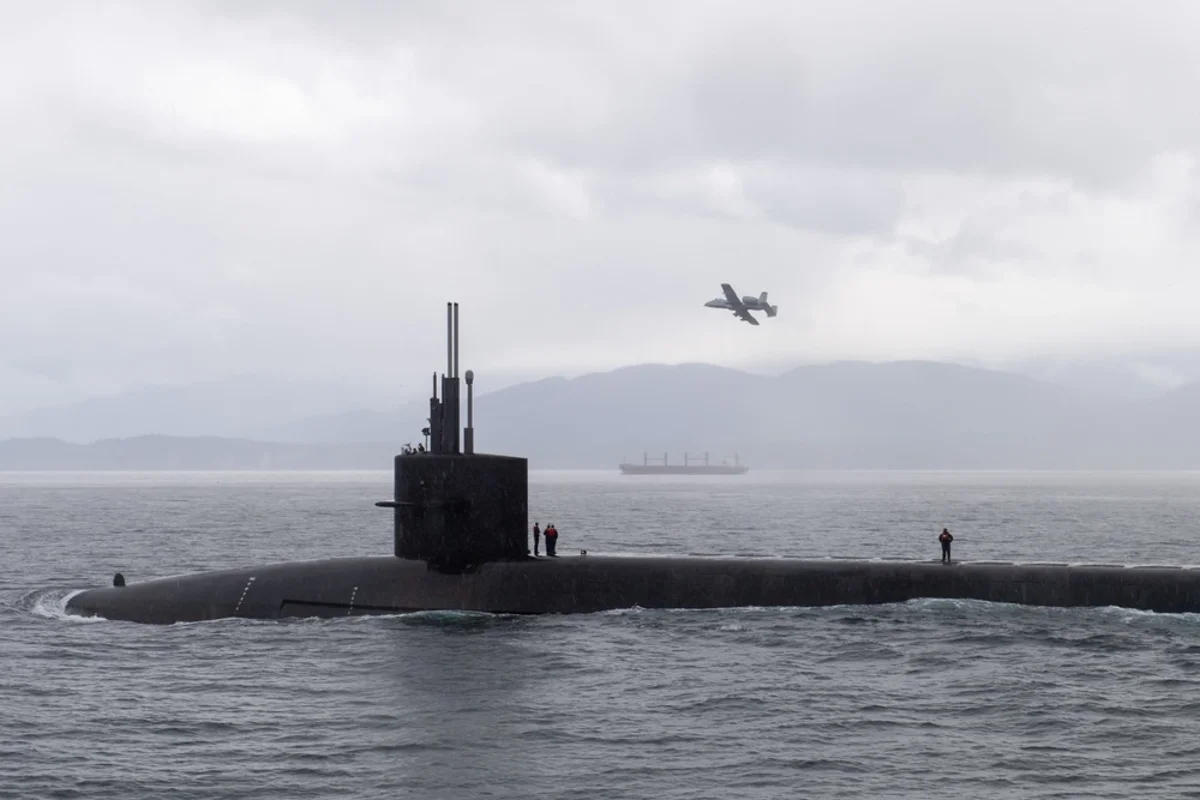
Industrial-scale toxic exposure inside a nuclear-powered hull reveals a critical vulnerability in the integration of secondary mechanical systems and environmental controls. When 64 U.S. Navy service members were sickened onboard the Ohio-class ballistic missile submarine USS Nebraska (SSBN-739) at Naval Base Kitsap-Bangor, the immediate point of failure was identified as a backup diesel generator malfunction during a routine pier shift. However, a rigorous engineering breakdown demonstrates that the casualty was not merely a mechanical "glitch," but an atmospheric management breakdown driven by fluid dynamics, pressure differentials, and system isolation protocols.
To understand how a routine auxiliary operation compromised the breathing air of dozens of crew members, the incident must be deconstructed through the explicit mechanics of submarine propulsion, secondary power generation, and environmental safety vectors.
The Dual-Propulsion Atmospheric Paradox
A nuclear submarine operates as a closed environmental loop when submerged, relying on sophisticated life support equipment to scrub carbon dioxide and generate oxygen. Yet, when moored or transitioning during port operations, the vessel interacts directly with the external atmosphere. The engineering architecture of an Ohio-class submarine features an inherently risky intersection between its primary power plant and its secondary auxiliary system.
The Primary Vector: Nuclear Isolation
The USS Nebraska relies on a pressurized water reactor (S8G) for primary propulsion and electrical power. During the June 22 event, the nuclear reactor remained completely undisturbed and isolated. This separation is achieved through independent thermal and radiological boundaries. The secondary loop steam generation systems that drive the main propulsion turbines do not interface with the auxiliary combustion systems.
The Secondary Vector: Auxiliary Diesel Architecture
Nuclear vessels carry a large auxiliary diesel generator to provide emergency electrical power in the event of a reactor scram or during specific in-port maintenance windows where the reactor is offline or transitioning. The integration of a combustion engine within a sealed hull relies on a highly rigid operational sequence known as a diesel lineup.
The mechanics of this system introduce a fundamental risk profile defined by two primary variables:
- The Induction Path: The engine requires a massive volume of ambient air for combustion, drawn down through specialized induction valves in the sail structure.
- The Exhaust Path: High-temperature combustion byproducts must be aggressively expelled outside the pressure hull through dedicated exhaust piping, typically discharging near the sail or the stern depending on the operational configuration.
The Mechanics of Atmospheric Inversion
The exposure of 64 sailors to acute concentrations of diesel exhaust—manifesting as coughing, headaches, dizziness, and nausea—points to an atmospheric inversion casualty. In naval engineering, this occurs when an exhaust plume is re-ingested into the ship's internal ventilation envelope or fails to clear the pressure hull entirely.
+-----------------------------------------------------------+
|                   EXTERNAL ATMOSPHERE                     |
+-----------------------------------------------------------+
       |                                             ^
       | [A] Air Intake                              | [B] Failed Exhaust
       v                                             |     Dissipation
+-----------------------------------------------------------+
|                      SUBMARINE SAIL                       |
+-----------------------------------------------------------+
       |                                             |
       | Vent Duct                                   | Re-ingestion
       v                                             v Path
+-----------------------------------------------------------+
|                    INTERNAL VENTILATION                   |
|                   [C] Toxic Accumulation                  |
+-----------------------------------------------------------+
Three distinct mechanical and operational hypotheses explain this failure mode:
1. The Proximity Re-Ingestion Loop
During a routine pier shift, the submarine is stationary or moving at dead slow speed relative to the water and surrounding structures. If the auxiliary diesel is running under load, it expels a dense stream of particulate matter, carbon monoxide, nitrogen oxides ($NO_x$), and sulfur dioxide.
Without a sufficient relative wind or vessel velocity to dissipate the thermal plume, a localized micro-climate of toxic exhaust forms directly above the hull. If the main hull ventilation system remains configured to draw in topside air via an open operations compartment hatch or low-pressure blower, the vessel establishes a feedback loop: drawing its own toxic exhaust straight back into the living and working spaces.
2. Valve Lineup Configuration Failure
Operating an auxiliary diesel requires an absolute coordination of mechanical linkages. The hull supply and exhaust valves must open in precise synchronization with engine startup. If a mechanical component in the exhaust valve assembly fails to actuate completely, or if the crew executes an incorrect valve lineup, the exhaust backpressure can force toxic gases through unsealed gaskets or bypass lines directly into the auxiliary machinery room, rapidly migrating throughout the interconnected compartments of the 560-foot hull.
3. Atmospheric Entrainment via the Sail
The structural design of the Ohio-class sail acts as a aerodynamic shroud. When the auxiliary diesel exhausts through or near the sail structures, low-pressure eddies can trap exhaust gases along the trailing edge of the sail. If the crew is conducting a routine pier shift with open access hatches immediately aft of the sail, the physical path of least resistance for the expanding, hot diesel gas is downward through the hatch into the operations and berthing spaces.
Quantifying the Toxicological Impact
The rapid onset of symptoms among a significant portion of the watchstanders underscores the concentration velocity of diesel exhaust in confined areas. The primary chemical culprits operate via distinct physiological mechanisms:
- Carbon Monoxide ($CO$): Competes directly with oxygen for hemoglobin binding sites, forming carboxyhemoglobin. This halts cellular respiration, causing immediate dizziness and lightheadedness.
- Nitrogen Dioxide ($NO_2$) and Sulfur Dioxide ($SO_2$): These gases react instantly with the moisture in the eyes, nose, and respiratory tract to form mild acids, triggering the acute coughing and mucosal irritation reported by the Navy.
- Ultra-fine Carbon Particulates: Act as systemic irritants that saturate the alveolar sacs, causing rapid respiratory distress.
The fact that six sailors required hospitalization indicates that localized concentrations within specific compartments reached thresholds exceeding standard permissible exposure limits (PEL). The rapid discharge of those six individuals confirms that the exposure duration was brief enough to prevent deep systemic chemical asphyxiation, indicating swift execution of emergency ventilation protocols by the crew.
Systemic Isolation Vulnerabilities
The core limitation of human-managed safety systems on a strategic asset like an SSBN is the latency between casualty detection and atmospheric isolation. When an atmospheric contamination event begins, the ship's internal layout can either mitigate or accelerate the hazard.
The internal volume of an Ohio-class submarine is partitioned into distinct watertight and atmospheric zones. However, the centralized heating, ventilation, and air conditioning (HVAC) system can act as a force multiplier for toxic gas redistribution if the "recirculate" and "emergency ventilation" dampers are not instantly reconfigured.
The transition from standard pier-side breathing configurations to emergency recirculating mode requires the mechanical isolation of external air intakes and the activation of carbon scrubbers. If the initial detection of diesel fumes is delayed by watchstanders attributing the scent to normal port operations, the toxic plume can achieve complete saturation of the multi-level operations compartment within minutes.
Defensive Reconfigurations for Auxiliary Operations
To eliminate the recurrence of localized atmospheric poisoning during stationary and near-shore maneuvers, naval protocols must shift from manual checklist verification to automated, sensor-driven interlocks.
The implementation of continuous electrochemical gas monitoring arrays within the main induction trunks provides an immediate, digital line of defense. These sensors must be hardwired into the ship's central control monitoring station. If $CO$ or $NO_x$ levels at the fresh air intake exceed 5 parts per million (ppm), the system must trigger an automated command to drop the main low-pressure blowers and actuate the isolation dampers, cutting off the path of contamination before the gas enters the common ventilation loop.
Furthermore, operational guidelines for pier shifts must mandate a strict correlation between local meteorological conditions and auxiliary propulsion usage. If the relative wind speed across the deck is lower than five knots, or if the wind vector matches the exact orientation of the exhaust-to-intake axis, the use of auxiliary diesel systems must be restricted unless absolute airtight isolation of the internal atmosphere is established beforehand, forcing the ship to rely entirely on shore power or its primary reactor plant.