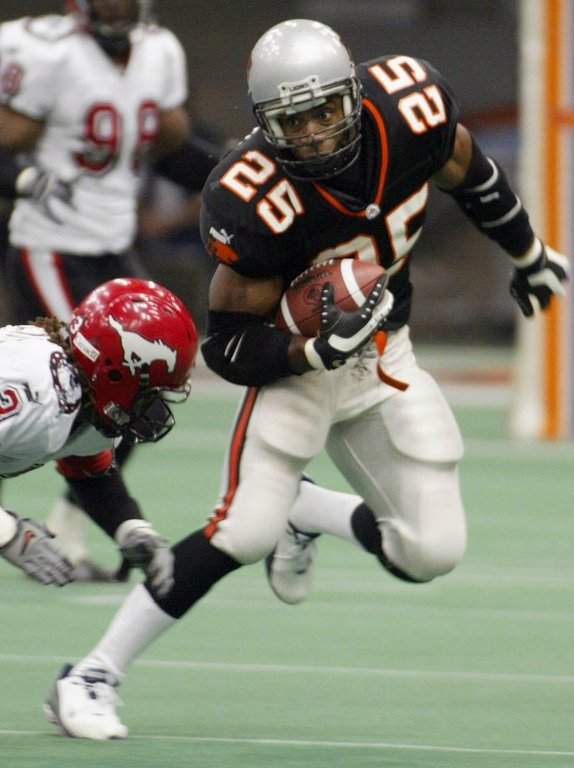
Evaluating elite athletic careers requires moving past nostalgic retrospectives to analyze the structural mechanics of positional value, workload distribution, and physical durability. The induction of Sean Millington into the Canadian Football Hall of Fame provides an empirical window into the economic and tactical realities of running back production within three-down professional football. A thirteen-season career spanning 194 games is an statistical outlier in a sport where high-impact collisions usually truncate a ball-carrier's lifespan to a fraction of that duration. Assessing how Millington achieved this longevity requires examining the underlying operational variables that separated his output from his contemporaries.
The Production Function of the Modern Fullback
In conventional offensive architectures, the running back position functions as a primary mechanism for yardage acquisition, short-yardage conversion, and pass protection. Millington operated primarily as a fullback, a role that traditionally demands an asymmetrical trade-off between blocking duties and rushing efficiency. The positional economic model dictates that fullbacks absorb high-frequency, high-velocity collisions while receiving fewer total touches than halfbacks, depressing their aggregate offensive statistics relative to their physical expenditure.
Millington subverted this efficiency curve by maximizing yards from scrimmage across 13 seasons, accumulating 6,086 rushing yards and 9,322 total yards alongside 87 touchdowns. His productivity was driven by a high yards-per-carry average—peaking at 5.4 yards per rush over his career baseline—combined with rare durability. The operational mechanics of sustaining a 237-pound frame through 194 regular-season contests demand an analysis of structural contact absorption. Unlike smaller, shiftier open-field runners who rely on elusive maneuvers that stress lateral knee ligaments, power-profile runners minimize angular shear forces by lowering center-of-gravity vectors into direct vertical impacts. This minimizes non-contact joint trauma, trading acute high-energy collisions for distributed muscular loads.
Special Teams as a Longevity Stabilizer
A critical variable often overlooked in career duration analysis is contribution magnitude outside the primary offensive unit. Millington recorded 176 special-teams tackles, anchoring a defensive-specialist output that ranks fourth all-time in league history.
From a strategic perspective, maintaining roster stability across a decade-plus career often relies on positional versatility. When offensive snap counts fluctuate due to scheme modifications or coaching changes, elite athletes who maintain high baseline value on kick coverage units insulate themselves from roster churn. Special teams deployment introduces distinct biomechanical stressors, yet it also diversifies the physical tax of the game. Rather than absorbing repetitive interior line deformation on every offensive play, special-teams coverage assignments leverage linear acceleration and open-field tackling techniques, validating the athlete's utility across multiple organizational cost-benefit analyses.
Divisional Dominance and Championship Efficiency
The distribution of performance metrics across different franchises highlights the environmental impact on athletic output. Millington spent the majority of his career with the BC Lions—accounting for 148 of his appearances—while also logging service time with Edmonton, Winnipeg, and Toronto. His acquisition as the first overall selection in the 1990 CFL Canadian Draft established an immediate baseline expectation of organizational dependency.
Evaluating his two Grey Cup titles (1994 and 2000) alongside his two Most Outstanding Canadian awards (1997 and 2000) reveals a high correlation between peak operational months and championship contention. In the 2000 Grey Cup victory, his 99 rushing yards and subsequent Dick Suderman Trophy underscore clutch production scaling under high-leverage defensive schemes. Championship environments tighten defensive gaps, reduce yards-per-carry variances, and punish predictable play-calling. Sustaining high efficiency against postseason defensive fronts requires a low failure rate on first-down conversions, a metric where physical power profiles yield lower variance than perimeter speed profiles.
Structural Legacy and the Evolution of the Canadian Athlete
The evaluation of talent pipelines from Canadian universities—specifically Simon Fraser University in Millington's case—demonstrates the viability of domestic development pathways into professional systems dominated by cross-border recruitment. The ability of a national player to capture multiple positional all-star nods (1993, 1994, 2000) in an era with unrestricted import ratios quantifies an elite talent ceiling.
Athletic longevity at the professional tier is ultimately a function of risk mitigation, metabolic recovery efficiency, and tactical adaptability. By combining high-volume interior rushing efficiency with elite special-teams productivity, career output was maximized past the standard attrition threshold of the position. Future roster construction strategies continue to benchmark physical durability and multi-phase utility against the historical standards established by enduring power backs.



