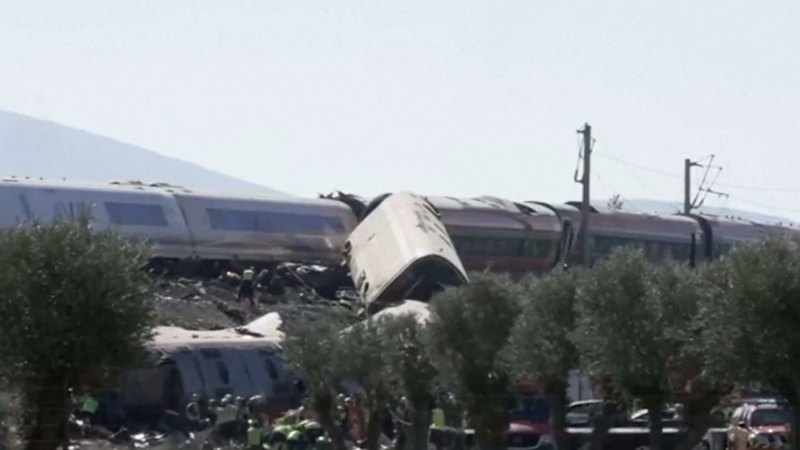
On July 24, 2013, an Alvia passenger train hurtled off the tracks near Santiago de Compostela in northwestern Spain, killing 79 people and injuring more than 140 others in the country's worst rail disaster in four decades. Initial news reports—including early dispatches stating that more than 60 people had died—focused almost exclusively on a single, easily digestible narrative. The train was traveling at roughly 190 kilometers per hour in an 80-kilometer-per-hour zone. The driver was distracted by a phone call from an on-board conductor. Human error had caused a catastrophe.
That explanation is factually accurate, yet completely insufficient.
When a multi-million-euro high-speed rail network suffers a mass-casualty event because one man missed a braking point, blaming the operator alone misses the structural reality of how modern transportation systems fail. The Santiago de Compostela crash was not simply a story about a distracted driver. It was an exposé of fractured safety architecture, mismatched signaling technologies, and the dangerous illusion of automation in European rail transit.
The Physics of the A Grandeira Curve
To understand why the casualties mounted so rapidly, you have to look at the geometry of the track at Angrois, just four kilometers outside the Santiago de Compostela station.
Trains on the Ourense–Santiago corridor travel along a modern, straight high-speed line where speeds of 200 kilometers per hour are routine. Then, abruptly, the track transitions into the A Grandeira curve, a tight bend with a radius of roughly 400 meters designed to feed trains into the older conventional station approaches. Physics does not negotiate with schedules. At 80 kilometers per hour, the centrifugal forces acting on a passenger car are manageable, keeping the steel wheel flanges securely seated against the outer rail. At more than double that speed, the lateral force quadruples.
When the Renfe Class 730 hybrid train entered the curve at nearly 190 kilometers per hour, the physics became irreversible in fractions of a second. The rear generator car—a heavy diesel-electric unit needed because parts of the Galician network lacked overhead electrification—lifted off the rails first. Its mass acted like a pendulum, yanking the lightweight passenger carriages behind it into a concrete retaining wall.
The kinetic energy dissipated instantly. Carriages telescoped, ruptured, and caught fire from ruptured diesel fuel tanks. Had the train been an all-electric unit without heavy, fuel-laden generator cars positioned directly behind the leading locomotive, the sheer structural violence of the derailment might have been measurably lower.
The Signaling Gap Nobody Wanted to Discuss
The central technical failure of the Santiago de Compostela disaster lies in the invisible handoff between two different train protection systems.
Across Europe, high-speed rail lines are supposed to be governed by the European Rail Traffic Management System (ERTMS). Under ERTMS, trackside transponders called eurobalises communicate continuously with the train's onboard computer. If a train approaches a speed restriction too fast, the computer automatically triggers the emergency brakes, overriding the human driver entirely. You cannot accidentally speed on an active ERTMS track. The machine simply will not let you.
On the Ourense–Santiago line, however, ERTMS was switched off on the train side due to persistent software compatibility issues between the track equipment and the rolling stock. More critically, the ERTMS coverage ended entirely right before the A Grandeira curve.
The track reverted to ASFA (Anuncio de Señales y Frenado Automático), a legacy Spanish signaling system designed in the 1970s. ASFA does not continuously monitor a train's speed curve. Instead, it relies on discrete beacons placed on the sleepers that tell the driver what the upcoming signal aspect shows—green, yellow, or red.
Because the signal ahead of the Santiago station was green, the ASFA beacon transmitted a clear-track indication. It did not care that the train was approaching a sharp curve at 190 kilometers per hour. There was no speed-enforcement beacon installed to force deceleration before the bend. In that four-kilometer transition zone, the safety net vanished completely. The entire burden of slowing a 300-ton projectile from highway-plus velocity to urban approach speed rested solely on the driver's memory, visual landmarks, and a paper route book.
The Illusion of Partial Automation
Engineers call this the automation paradox. When operators spend ninety percent of a journey monitored by sophisticated, fail-safe electronics, their baseline cognitive vigilance naturally drops. Then, at the exact moment the infrastructure degrades to legacy manual control, the human brain is expected to snap instantly back to peak situational awareness.
Consider a hypothetical scenario in commercial aviation. Imagine an airliner flying on full autopilot with automated terrain-avoidance systems active, only for those systems to silently disengage four miles before a treacherous mountain-ringed runway, leaving the pilot to rely on a stopwatch and a printed chart while fielding a routine call from the cabin crew. Aviation regulators would ground the fleet within hours. In rail transport, fragmented legacy infrastructure meant such transitions were treated as standard operating procedure.
Institutional Friction and the Cost of Delay
Why was ERTMS not functioning on the train, and why did the track lack a simple speed-control beacon before a notoriously sharp curve? The answers sit deep within the bureaucratic anatomy of state-backed rail expansion.
In the decade leading up to 2013, Spain embarked on one of the most aggressive high-speed rail construction programs in the world. Politicians prized ribbon-cutting ceremonies and record-breaking transit times between Madrid and peripheral regions like Galicia. Opening the Ourense–Santiago stretch on schedule in December 2011 was a major political milestone.
To meet operational timelines and integrate hybrid trains capable of running on both high-speed and conventional tracks, authorities authorized running the Renfe Class 730 trains with onboard ERTMS disabled while engineers worked out software glitches. Furthermore, the track layout at Angrois had been modified during the final phases of construction to connect the new high-speed line to the existing station without building an expensive new tunnel through urban terrain. That design compromise created the tight A Grandeira curve.
Safety assessments conducted prior to the line's opening noted the sharp speed reduction required at Angrois, yet the risk was deemed acceptable under existing ASFA protocols. Nobody installed a standalone ASFA digital speed-control balise—a piece of hardware costing a fraction of a single railcar—that would have automatically applied the brakes if a train passed a specific point above 80 kilometers per hour. Within days of the crash, infrastructure manager Adif quietly began installing those exact speed-control beacons across similar transition zones nationwide.
The Human Element Versus Systemic Design
Driver Francisco José Garzón Amo became the immediate face of the tragedy. Surviving the wreck with minor injuries, he admitted immediately to investigators that he had missed his braking point after answering a call on his company mobile phone from the train's conductor, who was asking about the platform layout at an upcoming stop.
Garzón Amo had thirty years of experience with the state rail operator Renfe. He knew the route. He had driven it dozens of times. Yet on that evening, a two-minute phone conversation consumed his working memory during the exact twenty-second window when he needed to initiate braking. By the time he saw the landmark indicating the curve, he applied the emergency brakes, scrubbing off roughly ten kilometers per hour before the wheels left the steel. It was four seconds too late.
Prosecutors and court-appointed experts spent years untangling the legal weight of his distraction versus the institutional negligence of the rail operators. Placing a single human being in the dock satisfies the public demand for accountability, yet it obscures an uncomfortable truth about safety engineering. Humans are predictably fallible. People get distracted, misjudge distances, and suffer momentary lapses in attention regardless of their training or seniority.
True safety engineering does not assume operators will perform flawlessly every single day. It assumes they will eventually fail, and builds physical and electronic barriers to ensure a single mistake does not kill nearly eighty people.
How Global Rail Networks Rewrote the Rules
The aftermath of the Santiago de Compostela crash forced a quiet reckoning across European and international rail authorities. While headlines moved on to other crises, the technical investigations altered how high-speed corridors are certified and audited.
- Elimination of Unprotected Speed Drops: Regulators across the European Union mandated strict audits of all transition zones where high-speed lines merge into conventional networks. Any abrupt speed reduction exceeding a specific threshold now requires mandatory physical speed-enforcement beacons, even on legacy signaling systems.
- Strict Cab Communication Protocols: Rail operators tightened rules regarding non-emergency communications during critical phases of transit. Much like aviation's sterile cockpit rule, which prohibits non-essential conversation below 10,000 feet, train crews face strict bans on operational calls during station approaches and speed transitions.
- Acceleration of Baseline ERTMS: The disaster exposed the danger of fragmented national signaling standards. European transport ministries accelerated funding to standardize ERTMS baselines, reducing the software incompatibilities that had forced Spanish operators to disable the system on hybrid rolling stock.
Even with these reforms, vulnerabilities persist wherever aging infrastructure meets modern speed. Across the United States, the delayed rollout of Positive Train Control (PTC) mirrors the exact tensions seen in Galicia—high capital costs, software integration headaches, and resistance from operators over implementation timelines. High-profile derailments in Washington state in 2017 and Philadelphia in 2015 followed the exact same script as Santiago de Compostela: a high-speed approach into a tight curve, a distracted or disoriented operator, and an automated braking system that had not yet been activated on that stretch of track.
The Unresolved Tension Between Speed and Safety
Rail remains statistically one of the safest ways to move people across land. Modern trains are engineering marvels capable of carrying hundreds of passengers at 300 kilometers per hour with minimal carbon emissions and remarkable punctuality.
Yet the tragedy at Angrois serves as a permanent warning against technological hubris. Building a high-speed train is only half the engineering challenge; building an environment that forgives human error at those speeds is the other half. When infrastructure budgets prioritize raw transit times over redundant safety nets, the gap between cutting-edge speed and legacy protection becomes a lethal trap. On a warm July evening outside Santiago de Compostela, eighty families paid the price for a safety system that stopped working four kilometers too soon.