The round-of-32 World Cup fixture between the Netherlands and Morocco in Monterrey concluded with a 3–2 penalty shootout victory for the Atlas Lions following a 1–1 draw. While the athletic outcome redefined the tournament trajectory for both nations, the immediate aftermath across major Dutch urban centers provided a textbook study in crowd dynamics, municipal policing strategies, and the friction that occurs at the intersection of sporting subcultures and diaspora identity.
Media narratives frequently rely on oversimplified dichotomies, framing post-match gatherings as monolithic outbursts of lawlessness. A granular, data-driven analysis of the events in Rotterdam, Amsterdam, and The Hague reveals a highly fractured phenomenon. Rather than uniform rioting, the structural reality consisted of large-scale celebratory assemblies interrupted by localized, acute flashpoints of tactical escalation between specific sub-segments of the crowd and law enforcement.
The Three Pillars of Post-Match Crowd Escalation
Understanding why the situation in The Hague's Schilderswijk district deteriorated while Amsterdam’s Mercatorplein remained manageable requires isolating three distinct variables that govern crowd behavior:
- Spatial Density and Chokepoints: The concentration of several hundred supporters at key intersections, such as the Vaillantlaan in The Hague, creates an environment where physical mobility is restricted. When celebratory behaviors—such as dancing on vehicles or igniting pyrotechnics—coincide with restricted traffic flow, municipal infrastructure reaches a breaking point.
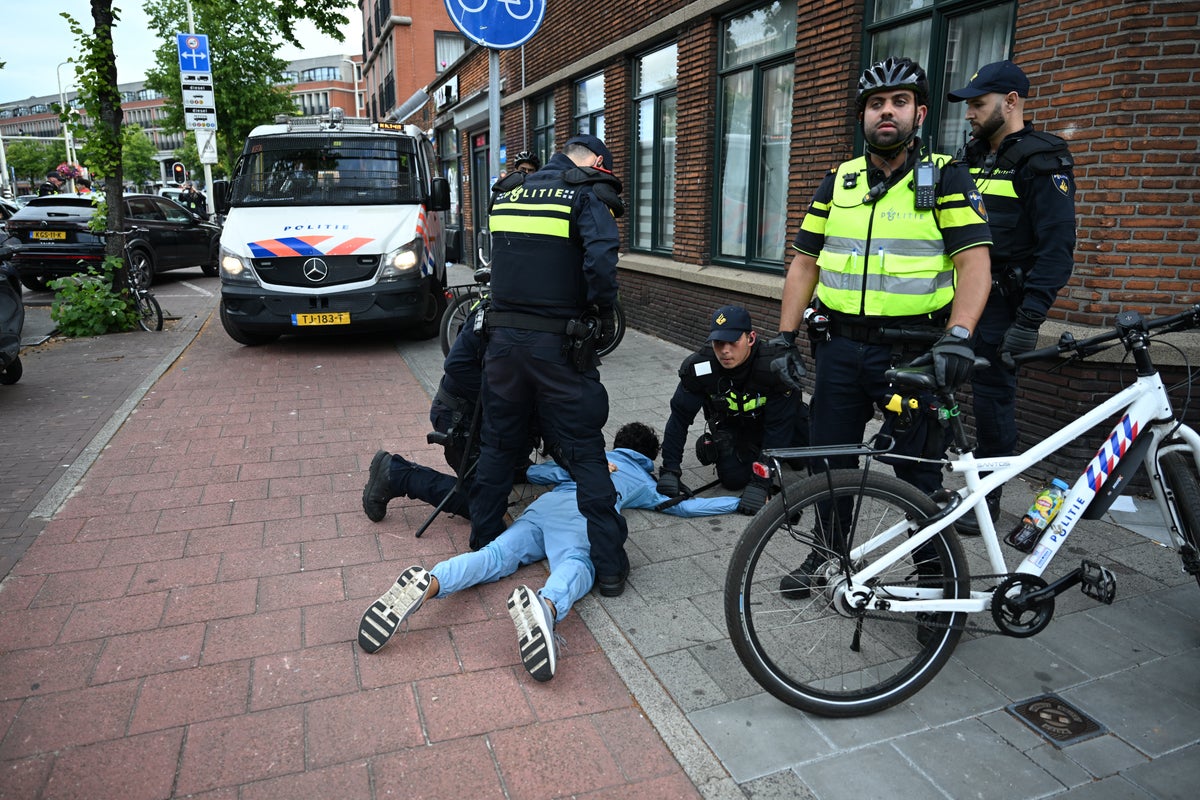
- Asymmetric Tactical Signaling: The visibility of specialized law enforcement assets operates on a delicate equilibrium. In The Hague, the preemptive deployment of bicycle units, mounted officers, and stationary riot police vans was intended as a deterrent. In practice, this overt presence can alter the crowd's psychological state from celebratory to defensive, lowering the threshold for confrontational behavior.
- The Temporal Delinquency Factor: The match concluded during the early morning hours, around 6:00 AM local time. This extreme timing introduces a stark demographic filtering mechanism. While families and casual supporters quickly dispersed to prepare for the workday, the remaining cohort on the streets shifted toward a younger, more risk-tolerant demographic, increasing the probability of friction.
The Trigger-Response Loop: Mechanics of the Clash
The transition from a high-energy celebration to an active public order enforcement action follows a predictable cause-and-effect sequence. Eyewitness accounts and police reports indicate that for the first hour post-match, the atmosphere across Dutch cities was overwhelmingly positive, characterized by flags, coordinated car horn patterns, and localized street football.
The structural breakdown occurs when specific prohibited items are introduced into the crowd matrix. The ignition of heavy consumer-grade fireworks and smoke bombs serves as the initial systemic shock. For law enforcement, these items are not merely technical violations; they represent a direct physical threat to officer safety and public property.
Once pyrotechnics or projectiles—such as stones and bottles—are directed at police lines, the operational mandate shifts instantaneously from passive monitoring to crowd dispersion. In The Hague, this triggered a specific tactical response loop:
[Projectile/Firework Launch]
             │
             ▼
[Targeted Dispersal Order]
             │
             ▼
[Failure to Comply within Threshold]
             │
             ▼
[Deployment of Water Cannons & Baton Charges]
This intervention mechanism successfully clears the geographical space but carries a secondary cost: it inevitably sweeps up non-violent bystanders. This creates a secondary perception of heavy-handed policing among the community, which can prolong systemic distrust long after the physical streets are cleared.
Quantifying the Scale of Unrest
Evaluating the severity of these events requires stripping away sensationalized vocabulary and looking strictly at operational metrics. The total volume of arrests across the country represents a microscopic fraction of the overall diaspora population participating in the celebrations.
| Municipality | Primary Hotspot | Key Tactical Interventions | Confirmed Arrests | Primary Booking Charges |
|---|---|---|---|---|
| The Hague | Vaillantlaan (Schilderswijk) | Water cannon deployment, baton charges | 10 | Open violence, assault, public order disruption |
| Rotterdam | West-Kruiskade | Crowd fracturing, tactical dispersal | 4 | Assault, breach of the peace |
| Amsterdam | Plein '40-'45 / Mercatorplein | Traffic management, distant monitoring | 0 | N/A |
The data proves that violence was highly localized rather than systemic. Amsterdam, which hosts a significant portion of the 440,000-strong Moroccan-Dutch community, remained entirely peaceful, with fans from both sides actively engaging in joint celebrations and displaying mutual respect. This indicates that the friction observed in The Hague was a failure of localized space management and tactical containment rather than an inevitable cultural flashpoint.
Limitations of Current Public Order Frameworks
The primary limitation of existing municipal strategies in handling high-stakes sporting events involving diaspora communities is the over-reliance on a reactive, binary enforcement model. Municipalities often treat large crowds as a singular fluid dynamics problem to be managed via physical barriers and kinetic force.
This approach fails to account for the digital amplification vector. Online rhetoric, heavily driven by partisan political figures leveraging the match to advance anti-immigrant narratives, creates an invisible layer of pre-match tension. When public figures explicitly frame a football match as a proxy war over social cohesion, they prime both the community and individual police officers to expect hostility. Consequently, when tactical units enter a neighborhood with a highly visible, adversarial posture, they risk validating the very defensive mechanisms that lead to projectile throwing.
Strategic Recommendations for Municipal Authorities
To mitigate future public order risks during high-profile international tournaments, municipal planning departments must transition toward a cooperative crowd-governance model.
First, cities should implement a decentralized fan-zone strategy. Rather than allowing organic, unmonitored mass gatherings to form at critical transit intersections like Vaillantlaan, municipalities must proactively establish designated, asset-backed viewing areas within neighborhoods. These zones should feature dedicated waste management, medical tents, and community-led safety marshals. By providing a structured environment with clear operational boundaries, the city can fulfill the community's demand for collective celebration while removing the structural bottlenecks that lead to street blockades.
Second, the operational deployment of police units must utilize a tiered visibility framework. Keeping riot-ready personnel and heavy machinery—such as water cannons—in immediate visual proximity to celebratory crowds creates a psychological feedback loop of mutual hostility. Operational command should place standard community officers at the front line of crowd interaction to maintain a low-stakes environment, holding tactical units in adjacent, non-visible staging areas. Kinetic intervention should be reserved strictly for clear, documented criminal actions rather than general crowd dispersal, minimizing the collateral alienation of peaceful citizens.