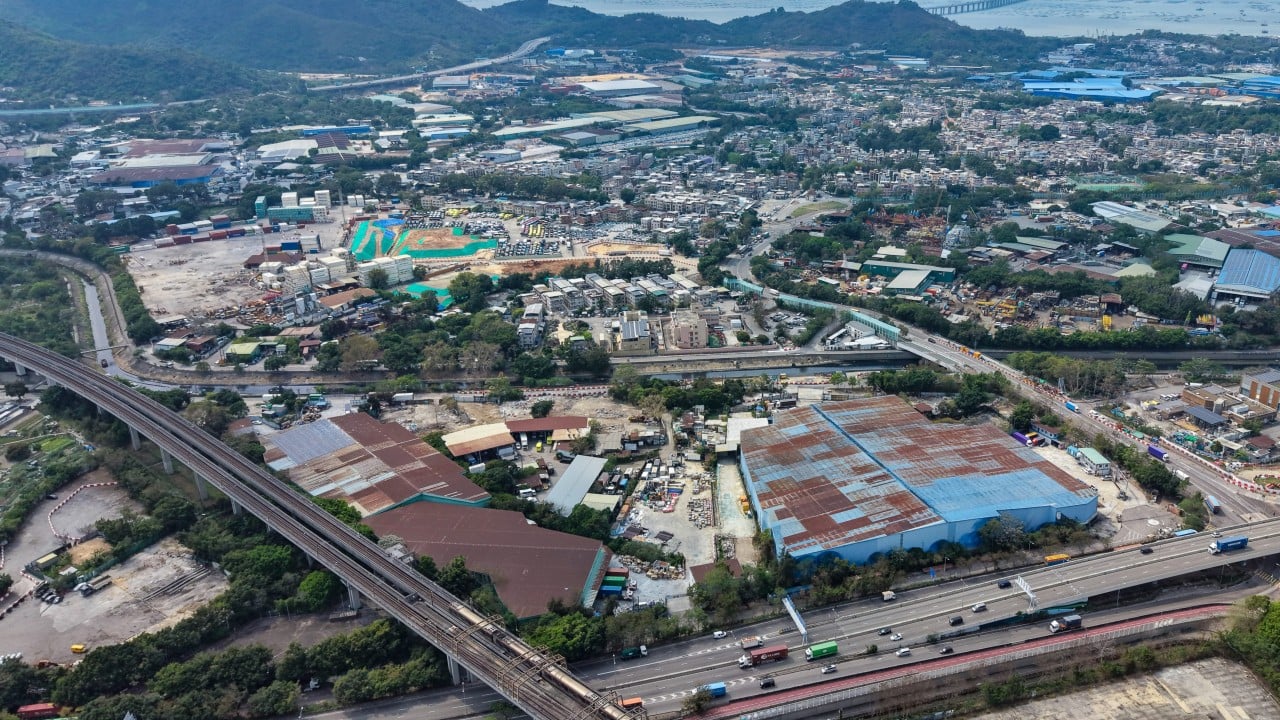
Hong Kong's capital allocation framework for regional development is undergoing an unprecedented structural shift. The imminent launch of the first 22-hectare land tender within the Hung Shui Kiu/Ha Tsuen New Development Area marks the transition of the Northern Metropolis from a conceptual planning initiative to a live economic market. This initial phase, dividing a 22-hectare zone into three distinct university campus plots (12.7 hectares, 5.3 hectares, and 4.4 hectares), establishes the operational blueprint for a project that has expanded rapidly to encompass a projected 1,000 hectares of development area.
By tying higher education infrastructure directly to commercial and industrial (I&T) ecosystems, the administration is attempting to solve a historical systemic bottleneck: the structural disconnect between academic research outputs and commercial product development. However, evaluating this initiative requires analyzing the underlying economic mechanisms, the specific risks embedded in the new dual-envelope land-sale model, and the real-world operational frictions facing the capital market. You might also find this related article insightful: The Financial AI Arms Race Is a Regulatory Myth.
The Dual Envelope Model: Quantifying Non-Price Allocation
The core operational mechanism governing these tenders departs entirely from Hong Kong’s traditional public land auction framework, which historically maximized short-term fiscal revenue by awarding sites to the highest cash bidder. Instead, this framework uses a structured two-envelope evaluation matrix that fundamentally alters the cost-benefit analysis for capital deployment.
The 70-30 Evaluation Split
The tender evaluation framework alters the traditional weighting system by assigning a dominant 70 percent value to non-price, qualitative operational proposals, leaving only 30 percent allocated to the financial land premium. Under this scoring mechanism, land is treated as a strategic economic subsidy rather than a pure commodity. The non-price criteria require consortia to commit to explicit, legally binding performance metrics including: As reported in recent reports by Harvard Business Review, the effects are significant.
- The immediate attraction and onboarding of strategic global enterprises.
- Guaranteed capital expenditure minimums for industrial laboratory and advanced manufacturing facilities.
- Fixed job creation targets within specific high-value sectors, including life sciences, health technology, robotics, and artificial intelligence.
- Tight construction and operational timelines, enforcing penalties if designated businesses fail to begin operations within specified months post-completion.
The Land-Sale Cost Function
This structural change fundamentally shifts the private sector's pricing model. In a traditional land auction, a developer calculates their bid using a standard residual land value formula:
$$L = GDV - (C + F + P)$$
Where $L$ is the land premium, $GDV$ is the Gross Development Value, $C$ represents construction costs, $F$ represents financing costs, and $P$ is the developer’s required profit margin.
Under the Northern Metropolis two-envelope paradigm, the equation expands to incorporate ongoing ecosystem development and compliance costs:
$$L_{max} = GDV - (C_c + C_i + F + P) - \mathbb{E}(C_e)$$
Here, $C_c$ represents standard core construction costs, while $C_i$ introduces the specialized industrial infrastructure outlays required to attract anchor tenants. The critical variable addition is $\mathbb{E}(C_e)$, representing the expected financial value of operational performance guarantees and long-term ecosystem management. Because $\mathbb{E}(C_e)$ introduces significant variable risk and requires capabilities outside traditional real estate asset management, the maximum viable cash land premium ($L_{max}$) that a rational market actor can offer drops significantly.
Ecosystem Co-Dependencies: The Three Pillars of Value Capture
The scale expansion of the University Town concept—advancing from an initial 80-hectare proposal to a 1,000-hectare integrated zone—is driven by an institutional recognition of the cluster effect. The plan relies on a model where three distinct capital inputs must align to capture economic value.
+-------------------------------------------------------------+
|                     VALUE CAPTURE MATRIX                    |
+-------------------------------------------------------------+
|  [Pillar 1: Academic Capital]                               |
|  - Inbound Talent Cohorts                                  |
|  - IP Generation / Basic Research                           |
+-------------------------------------------------------------+
                              |
                              v
+-------------------------------------------------------------+
|  [Pillar 2: Industrial Capital]                             |
|  - Corporate R&D Expenditure                                |
|  - Advanced Infrastructure Sharing                          |
+-------------------------------------------------------------+
                              |
                              v
+-------------------------------------------------------------+
|  [Pillar 3: Real Estate / Infrastructure Capital]           |
|  - Co-Working & Wet Lab Capex                               |
|  - Spatial Proximity Value (Cluster Effect)                 |
+-------------------------------------------------------------+
Academic Capital Accumulation
The first pillar requires establishing localized talent creation. By anchoring the Hung Shui Kiu plot with three campus sites, the government seeks to secure a consistent internal supply of research talent and intellectual property generation. This institutional anchoring acts as the foundational layer, lowering recruitment and exploratory research costs for nearby corporations.
Industrial Co-Location and Corporate R&D
The second pillar relies on physical proximity to the San Tin Technopole and the Loop. Academic institutions cannot sustain an industrial ecosystem in isolation; they require corporate R&D divisions to purchase, license, and scale their academic discoveries. The physical closeness of these sites is designed to minimize structural frictions in tech transfer, facilitating joint laboratory initiatives and shared use of high-cost testing and certification infrastructure.
Urban-Rural Spatial Integration
The third pillar addresses the physical support system. The model incorporates a "15-minute neighborhood" urban planning framework, integrating residential developments, green mobility corridors, and public amenities adjacent to the campus plots. This integration is designed to reduce employee commuting times, lower local infrastructure strains, and improve talent retention within the geographical boundaries of the Northern Metropolis.
Market Friction and the Developer Capital Strike
The initial market response to this structural pivot highlights a clear divergence between government planning timelines and private capital risk tolerances. The recent closing of the pilot industrial land tender in Hung Shui Kiu/Ha Tsuen yielded only two bids: a solo submission from Henderson Land Development and a broad consortium led by Sino Land alongside four mainland developers and JD.com. The absence of the city's other major diversified developers indicates deep-seated structural friction.
The Specialization Bottleneck
The primary friction point stems from a mismatch in corporate capabilities. For decades, Hong Kong property developers optimized their business models around high-turnover residential sales and stable commercial asset leasing. The two-envelope model demands that these entities function as industrial incubation managers and venture capitalists.
Sourcing manufacturing tenants, managing specialized wet-lab facilities, and guaranteeing long-term job creation metrics are complex operational tasks that lie far outside traditional property management expertise. The broader market's hesitation reflects a reluctance to assume long-term operational risks where the path to stable yields remains unproven.
Macro-Financial Timing Disconnects
The launch of these large-scale tenders occurs during a challenging macroeconomic cycle characterized by elevated capital costs and compressed commercial real estate valuations. Committing billions of dollars in capital expenditure to a greenfield industrial region requires discounting cash flows over an extended horizon.
+-------------------------------------------------------------------+
|                   FINANCIAL TIMING DISCONNECT                    |
+-------------------------------------------------------------------+
|  [Phase 1: Capital Outlay] ---> [Phase 2: Risk Horizon]           |
|  - Land Premium Payment         - Infrastructure Maturity (Years) |
|  - Specialized Infrastructure   - Unproven Industrial Demand      |
|                                                                   |
|  Current Result: Private capital prefers liquid, near-term       |
|  cash flows over extended, unproven greenfield horizons.          |
+-------------------------------------------------------------------+
With key transit links, such as the Northern Link Spur Line, and full commercial density projected to take years to mature, developers face a long cash-flow valley. Confronted with strict construction deadlines and penalty clauses, the majority of private capital has chosen to remain on the sidelines, preferring more predictable, liquid opportunities closer to established mass transit hubs.
Strategic Imperatives for Consortium Composition
To navigate the strict constraints of the dual-envelope framework, the private sector must change how it structures bidding groups. The solo developer model is no longer financially or operationally viable for projects of this scale. Successful execution requires forming highly integrated, cross-industry consortia that explicitly distribute risk and capability across three distinct operational entities.
Tier-1 Real Estate Asset Developers
The traditional developer must pivot to focus entirely on core strengths: large-scale project management, cost-efficient construction execution, and navigating local regulatory and planning approvals. Their capital allocation should be calibrated to the baseline asset build, avoiding exposure to operational business underwriting.
Industrial Tech and Corporate Partners
Consortia must structurally integrate technology operating partners—exemplified by the inclusion of JD.com in the Sino Land consortium. These entities provide the institutional track record needed to score high marks on the non-price envelope. Their role is to pre-lease large blocks of commercial space, anchor the industrial ecosystem with their own R&D divisions, and bring pre-existing supply chain networks into the district.
Post-Secondary Educational Institutions
Universities can no longer act simply as eventual end-users of state-allocated land; they must become active participants early in the bidding design phase. By co-authoring the programmatic use cases for the 22-hectare plots, academic institutions ensure that the physical facilities match their long-term research strategies. This integration helps de-risk the developer’s investment by guaranteeing immediate, high-density occupancy upon site handover.
This structured alignment represents the only viable path forward. The administration's policy direction is clear: public land assets will increasingly be leveraged to drive industrial and economic outcomes rather than simple fiscal generation. Market participants who adapt their capital structures and consortium models to this approach will capture early-mover advantages in the city's new economic engine; those who insist on evaluating these opportunities through a traditional real estate lens will find themselves structurally excluded from the market.