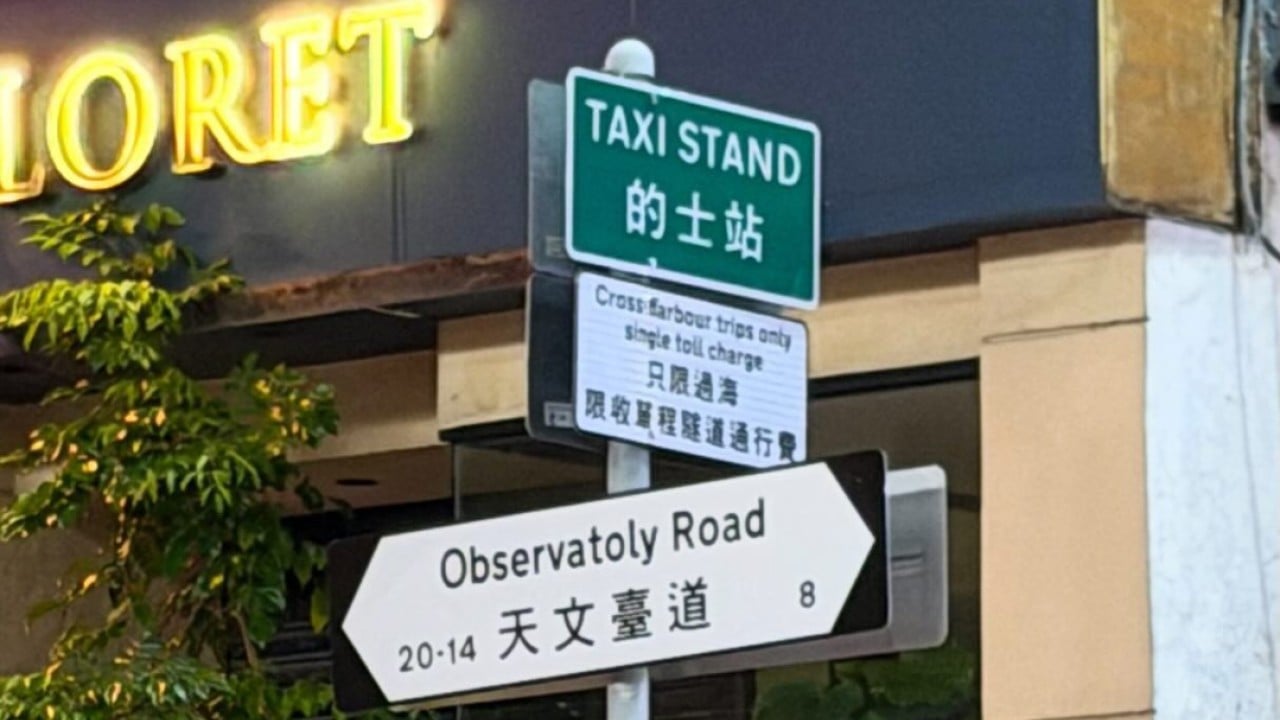
A single typographical variance on a municipal asset is rarely an isolated human error; it is the logical output of a compromised quality assurance framework. When a contractor replaces a public asset using legacy, unverified physical markers as their primary source of truth, they expose a structural vulnerability in public works procurement. The recent spelling error on Hong Kong's "Observatoly" road sign—where a contractor fabricated a new marker based on an old, scratched sign rather than an authorized digital registry—highlights the systemic breakdown that occurs when manual data extraction overrides centralized configuration management.
To prevent these public errors, municipal departments must shift from reactive inspections to closed-loop verification systems. This analysis deconstructs the operational mechanics behind infrastructure asset failures, evaluates the cost functions of quality control, and outlines a prescriptive framework for migrating physical inventory management into an immutable digital workflow.
The Three Pillars of Municipal Infrastructure Vulnerability
Municipal asset management operations fail along three distinct structural axes: data inheritance, vendor optimization incentives, and decentralized validation protocols. When these components break down simultaneously, systemic errors manifest in the physical environment.
1. Legacy Data Inheritance and Asset Decay
The reliance on physical assets to replicate identical physical assets introduces historical drift. In the case of the misspelled street sign, the contractor extracted text from a degraded, weathered physical marker. This represents a breakdown in asset data inheritance.
Physical infrastructure is subject to environmental degradation, vandalism, and wear. When a municipal workflow permits the source of truth for an asset replacement to be the asset being replaced, it creates an unmanaged feedback loop. Instead of querying a centralized, digital database containing the definitive topological and textual attributes of the roadway, the operational workflow defaults to local, visual replication.
2. Misaligned Contractor Optimization Incentives
Public works procurement models frequently incentivize speed and cost reduction over precise verification. In a standard fixed-fee or volume-based municipal contract, a private vendor minimizes overhead by reducing the time spent per asset.
Forcinng a technician to halt operations, log into a remote database, and cross-reference an alpha-numeric string against an approved plan adds friction. If the contract lacks strict financial penalties for typographical or dimensional variances—or if the cost of administrative delay exceeds the projected penalty of an error—the contractor will rationally optimize for rapid installation based on immediate visual heuristics.
3. Decentralized and Subjective Validation Protocols
The final vulnerability lies in the inspection framework. A quality assurance process that relies entirely on human visual inspection at the point of installation is fundamentally flawed. Human inspection suffers from high cognitive variance, fatigue, and confirmation bias.
If the Highways Department or its outsourced supervising engineers use the same flawed physical context to approve the installation, the error is codified. Without a mandatory, multi-factor validation check that compares the physical output against an independent digital reference, the probability of catching low-frequency, high-visibility anomalies remains low.
The Infrastructure Quality Cost Function
To optimize municipal quality control systems, operations managers must balance the total cost of quality ($C_Q$), which comprises prevention costs, appraisal costs, and internal/external failure costs.
$$C_Q = C_P + C_A + C_F$$
Where:
- $C_P$ (Prevention Costs) represents the capital spent establishing digital registries, training personnel, and building automated validation software.
- $C_A$ (Appraisal Costs) represents the ongoing operational expense of inspecting physical signs, auditing contractor sites, and running field checks.
- $C_F$ (Failure Costs) represents the direct financial expense of removing and replacing incorrect signs, alongside the indirect reputational damage to the civic administration.
Historically, municipal departments under-allocate capital to prevention ($C_P$), assuming that field appraisal ($C_A$) will capture defects. However, field appraisal costs scale linearly with the number of assets deployed, making 100% manual inspection financially unviable.
When appraisal is minimized to save budget, failure costs ($C_F$) spike. A single public error requires deploying a secondary crew, fabricating a replacement asset under expedited lead times, and managing public relations friction. The optimal strategic play is to front-load expenses into automated prevention mechanisms, lowering both appraisal and failure costs over the asset lifecycle.
Technical Mechanics of Structural Failure: Manual Data vs. Digital Registries
The systemic breakdown observed in the "Observatoly" incident can be mapped as a failure in configuration management. The diagram below illustrates how an open-loop process introduces error compared to a closed-loop digital verification architecture.
The Vulnerable Open-Loop Process
- Physical Trigger: A sign becomes old, scratched, or damaged.
- Contractor Extraction: The field technician visually inspects the degraded sign.
- Manual Interpretation: A scratched "R" is misread or mistyped as an "L".
- Fabrication: The asset is manufactured using unverified text strings.
- Field Installation: The sign is mounted without digital confirmation.
- Public Detection: The error is identified post-deployment, maximizing failure costs.
The Resilient Closed-Loop Process
- Physical Trigger: A sign requires replacement due to wear.
- Digital Query: The contractor scans a localized asset tag (e.g., a QR code or RFID chip) or utilizes GPS coordinates to query the central GIS (Geographic Information System) registry.
- Automated Verification: The fabrication system pulls the immutable string ("OBSERVATORY") directly from the database via an API.
- Machine-Readable Production: The automated manufacturing equipment laser-cuts or prints the text based entirely on the verified digital file, bypassing human data entry.
- Computer Vision Audit: Prior to leaving the factory, an automated optical inspection (AOI) camera scans the completed asset, running a character-recognition algorithm against the database string.
- Validated Installation: The asset is deployed, with the installation crew uploading a geo-tagged, time-stamped photo to close out the work order in the system.
Systemic Limitations of Proposed Post-Incident Reviews
In response to public errors, public works departments typically promise to "review checking procedures" or "increase oversight." While politically expedient, these interventions rarely solve the root operational vulnerabilities.
- Increased Administrative Overhead: Mandating that supervisors sign off on every physical asset before fabrication introduces an operational bottleneck. It slows down deployment cycles without changing the underlying vulnerability of human error.
- The Compliance Illusion: Adding more manual signature steps creates an illusion of security. In practice, managers facing high volumes of work orders quickly resort to rubber-stamping approvals, failing to look closely at individual text fields.
- Lack of Audit Immutability: Paper-based or unencrypted digital logbooks can be retroactively altered or filled out incorrectly. They do not provide a tamper-proof audit trail that links a specific worker, timestamp, and asset configuration together.
The Blueprint for Zero-Defect Infrastructure Management
To transition from a reactive posture to an optimized, high-authority engineering workflow, municipal agencies must implement a structured, software-driven framework.
+-------------------------------------------------------------+
|               CENTRALIZED DIGITAL GIS REGISTRY             |
|   Contains verified textual data, coordinates, & specifications |
+-------------------------------------------------------------+
                               |
                               | Secure API Integration
                               v
+-------------------------------------------------------------+
|           CONTRACTOR FABRICATION WORKFLOW (AOI)             |
|      Automated Optical Inspection verifies physical sign     |
+-------------------------------------------------------------+
                               |
                               | Pre-Deployment Match
                               v
+-------------------------------------------------------------+
|            FIELD VALIDATION VIA COMPUTER VISION             |
|  Technician mobile app cross-checks installation against GIS |
+-------------------------------------------------------------+
Mandating a Centralized Digital Registry as the Sole Source of Truth
Contractors must be contractually barred from using existing physical assets as blueprints for replacements. Every procurement contract should specify that the official GIS database is the only legal reference for text, dimensions, font requirements, and geographic placement. If an asset is missing from the database or contains a perceived error, the contractor must trigger a formal Request for Information (RFI) rather than improvising in the field.
Integrating Automated Optical Inspection (AOI) into Manufacturing
Municipalities should require major manufacturing vendors to integrate computer vision into their quality control lines. Before any road sign, directional marker, or information board leaves the fabrication plant, a high-resolution camera must capture the text and run a string-matching algorithm against the municipal database. Any asset with a matching confidence score below 100% is automatically rejected at the factory gate, eliminating failure costs before the sign ever reaches a service truck.
Deploying Mobile Computer Vision for Field Technicians
Field installation crews should be equipped with utility applications that feature integrated optical character recognition (OCR). Upon mounting a new sign, the technician must take a photo through the application. The software automatically processes the image, extracts the text, checks the location via GPS coordinates, and compares it to the asset registry. The work order cannot be closed out—and the contractor cannot receive payment—until the application verifies that the installed asset matches the digital record.
Rewriting Procurement SLAs with Strict Escalation Claws
Quality cannot be managed solely through technical tools; it must be reinforced by contract design. Service Level Agreements (SLAs) must contain clear financial penalties for structural and typographical deviations.
Instead of treating a misspelled sign as a minor maintenance issue, procurement rules should classify it as a breach of quality protocols, triggering an automatic financial penalty and an audit of the vendor’s internal manufacturing pipeline. This aligns the vendor’s profit motives directly with the municipality's quality goals.
Executing these steps removes human variability from asset management. By enforcing a digital chain of custody from the registry to the factory floor, public works departments can protect civic infrastructure from preventable failures, ensuring that physical assets accurately reflect their digital blueprints.

.webp)