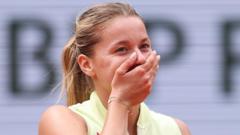
The progression of Maja Chwalinska to the semi-finals of the 2026 French Open, capped by a 7-6(3), 6-3 victory over 22nd seed Anna Kalinskaya on Court Philippe-Chatrier, challenges traditional modeling of elite athletic trajectory. Entering the tournament ranked world number 114 with a career record of just two WTA tour-level main-draw match wins on clay, Chwalinska’s transformation into only the second female qualifier in the Open Era to reach the Roland Garros semi-finals represents a severe statistical anomaly.
Standard sports forecasting models heavily weight recent historic baseline performance and raw power metrics. This approach routinely miscalculates the value of variance-reduction strategies in adverse environmental conditions. Chwalinska's performance on a blustery Paris afternoon reveals a highly systematic tactical framework capable of neutralizing high-seed kinetic advantages through precise court geometry, localized micro-adjustments, and psychological stabilization.
The Micro-Mechanics of Clay-Court Variance Neutralization
Tennis commentary frequently categorizes unexpected tournament progressions as a "dream run," a narrative choice that substitutes emotional resonance for tactical analysis. To understand how a low-ranked qualifier neutralizes a seeded opponent, the match must be modeled as a series of resource-allocation problems dictated by environmental constraints.
The prevailing variable during the quarter-final match was the high-velocity, erratic wind blowing across Court Philippe-Chatrier with the stadium roof open. High-wind environments act as a tax on high-velocity, flat-hitting styles. Linear ball trajectories require microscopic timing precision; a crosswind of even 15 to 20 kilometers per hour alters the ball's flight path mid-trajectory, compounding errors for players who rely on fixed mechanical striking points.
Wind Vectors (Asymmetric Force)
       │
       ▼
[High-Velocity Flat Strike] ───► High Air Resistance ───► Geometric Deviation (Error)
[High-Spin Heavy Trajectory] ──► Margin for Error     ───► Regulated Ball Placement
Kalinskaya’s primary strategic asset is linear velocity off both wings, particularly her flat backhand. In stable indoor or low-wind environments, this creates a time-deficit for the opponent. Under the atmospheric conditions on Chatrier, however, Kalinskaya’s flat-ball mechanics suffered from heightened geometric drift. Chwalinska countered this through a distinct tactical framework centered on heavy top-spin and high-arc trajectories.
- Pillar 1: Kinetic Absorption and Height Allocation. By utilizing looping defensive structures rather than attempting to match Kalinskaya’s pace, Chwalinska increased the ball’s clearance margin over the net. This structural adjustment directly mitigates the risk of unforced errors induced by erratic wind gusts.
- Pillar 2: Extreme Variational Mixing. Chwalinska systematically broken the rhythmic pacing of the baseline rallies. The deliberate deployment of low-bounce slice backhands, alternating with heavy, looping forehands, prevented Kalinskaya from establishing a consistent strike-zone height.
- Pillar 3: Geometric Displacement via Chops and Lobs. During critical neutral rallies, Chwalinska utilized low-momentum drop shots to draw Kalinskaya forward out of her preferred baseline depth. When Kalinskaya responded with a low-clearance counter-drop, Chwalinska leveraged defensive lobs to exploit the open vertical space. A primary example occurred at 5-5 in the first set, where Chwalinska won a 27-shot rally using an ultra-low crosscourt drop shot followed by an immediate lob-volley sequence.
Mathematical Breakdown of Efficiency Losses and Break-Point Fragility
The first set exposed the structural volatility of serving in high-wind conditions, operating as a case study in efficiency degradation. Chwalinska established an early 5-1 lead by converting early break points, primarily driven by Kalinskaya's inability to calibrate her return depth against the wind. However, closing out a set introduces an asymmetrical psychological load that alters physiological output, specifically narrowing the swing path and reducing racquet-head speed.
As Chwalinska served for the set at 5-1 and 5-3, her first-serve conversion rate deteriorated, shifting the tactical advantage to the receiver. In clay-court tennis, a drop in first-serve velocity or placement accuracy allows the receiver to step inside the baseline and dictate the point geometry. Kalinskaya capitalized on this mechanical tightening, mounting a four-game comeback to level the set at 5-5.
[Serve Efficiency Drops] ──► [Shallow Second Serve Return] ──► [Receiver Enters Baseline] ──► [Court Geometry Control]
The subsequent tie-break at 6-6 served as the statistical turning point of the match. In a tie-break, the value of unforced errors increases exponentially due to the condensed scoring format. The strategic imperative shifts from hitting winners to minimizing variance.
Chwalinska adjusted by executing extended baseline sequences, highlighted by a punishing 25-stroke rally that pushed her ahead 5-3 in the breaker. Rather than forcing a low-probability winner down the line, she maintained a high-clearance crosscourt pattern, forcing Kalinskaya to generate all the kinetic energy. This design succeeded; Kalinskaya overcompensated on a looping defensive backhand, sending it past the baseline to cede the tie-break 7-3.
The Attrition Curve of the Second Set
In elite tennis, winning a high-leverage opening set often induces a brief physical and cognitive decompression in the victor, paired with acute demoralization in the loser. Chwalinska minimized this decompression phase by immediately pressuring Kalinskaya’s opening service games in the second set, securing a double-break to establish a 4-1 lead.
The structural cause of Kalinskaya's second-set decline was an accelerating attrition curve. Flat hitters who face constant variation are forced to hit from sub-optimal body positions, bending lower for slices and reaching higher for heavy topspin. This continuous physical recalibration degrades the kinetic chain—the sequential transfer of energy from the feet through the torso to the racquet. As Kalinskaya's leg drive fatigued, her balls began to land shallow, allowing Chwalinska to become the aggressor.
A temporary breakdown occurred when Chwalinska served for the match at 5-2. Facing match points, Kalinskaya engaged in hyper-aggressive, low-margin striking, unloading off both flanks to break back for 5-3. This sequence represents a common statistical phenomenon in sports analytics: a trailing competitor, facing certain defeat, completely abandons risk management. When a player strikes with zero inhibition, their effective accuracy temporarily spikes.
However, this hyper-aggressive model is unsustainable over multiple games. Serving at 3-5 to stay in the match, Kalinskaya's fatigue resurfaced. Facing a final match point, she rushed a mid-court forehand from a compromised baseline stance, launching the ball wide into the alley. Chwalinska secured the second set 6-3, concluding a match that required one hour and 54 minutes of sustained physical and mental output.
Historical Context and Structural Limitations of the Qualifier Run
Chwalinska's achievement matches a highly exclusive historical baseline. In the Open Era of women's tennis, she is only the sixth qualifier to reach a Grand Slam semi-final, and the second at Roland Garros, matching Nadia Podoroska's 2020 run.
While public focus centers on the novelty of an unseeded player advancing deep into a major, an analytical perspective must isolate the structural advantages and distinct limitations inherent to a qualifier's pathway.
+───────────────────────────────────────+───────────────────────────────────────+
| Strategic Advantages of Qualifiers    | Structural Constraints of Qualifiers   |
+───────────────────────────────────────+───────────────────────────────────────+
| 1. Advanced Surface Adaptation        | 1. High Cumulative Fatigue            |
| Three qualifying matches provide      | Eight completed matches over two      |
| elite acclimation to clay moisture    | weeks creates an extreme physical     |
| and wind patterns before seed entry.  | deficit in later rounds.              |
+───────────────────────────────────────+───────────────────────────────────────+
| 2. Low-Density Scouting Data          | 2. Lack of Top-Tier Exposure          |
| Top-25 opponents possess minimal      | Limited historic matches against      |
| recent film on a challenger-level     | top-10 pace and weight of shot        |
| player's specific tactical habits.    | creates systemic adaptation delays.   |
+───────────────────────────────────────+───────────────────────────────────────+
The underlying limitation of Chwalinska's run moving forward is the compounding physical deficit. While top seeds enter the semi-finals having played five matches, a qualifier has played eight. On a demanding surface like clay, this deficit manifests as reduced lateral explosive speed and a decay in first-serve velocity.
Furthermore, Chwalinska’s historical context includes a prolonged struggle with clinical depression that caused her to take an indefinite hiatus from the sport after Wimbledon qualifying in 2021. From a sports science and performance management perspective, her return to elite status highlights a critical variable often omitted from analytical models: psychological equilibrium.
The sport-wide normalization of mental health management, championed by contemporary peers, provided a structural blueprint for her return. By decoupling her personal identity from match outcomes, Chwalinska has developed an on-court demeanor characterized by low emotional volatility. This internal stability directly manifests in her high-pressure performance metrics, allowing her to process mid-match collapses—such as losing the 5-1 lead in the first set—not as catastrophic failures, but as temporary statistical deviations requiring mechanical correction.
Modeling the Semi-Final Matchup against Elite Kinetic Power
Chwalinska’s semi-final opponent will be the winner of the quarter-final between world number one Aryna Sabalenka and 25th seed Diana Shnaider. Should Sabalenka advance, the semi-final will present an extreme contrast in tactical frameworks: Chwalinska's variance-driven, defensive geometry versus Sabalenka's relentless, flat kinetic power.
To engineer a competitive strategy against a player of Sabalenka's caliber, Chwalinska cannot rely on the passive attrition framework that defeated Kalinskaya. Top-tier power hitters possess a significantly higher technical ceiling; their unforced error rates under neutral conditions are strictly lower than those of sub-top-20 players.
The optimal strategic playbook for Chwalinska in the semi-finals requires a severe commitment to three tactical parameters:
- First-Serve Directional Specialization. Chwalinska must maintain a first-serve percentage above 70%, directing at least 65% of those serves to the opponent's body or non-dominant wing to prevent immediate, high-velocity return winners. If her first-serve percentage drops below 60%, the second-serve win probability against an elite returner falls below an unsustainable 35% threshold.
- Early-Strike Drop Shot Depths. Rather than waiting for an extended rally to deploy the drop shot, Chwalinska must execute the shot on the second or third ball of the sequence. This forces a heavy-moving opponent to sprint linearly before they can establish their baseline hitting foundation.
- Extended Defensive Groundstroke Depth. Looping defensive returns must land within the final meter of the baseline. Any ball landing shallow in the mid-court will be immediately exploited by an elite opponent's inside-out forehand, eliminating Chwalinska's ability to run out the point.
Chwalinska's progression has proved that when environmental conditions degrade the efficiency of linear power, a highly specialized, adaptive tactical framework can bridge a massive ranking deficit. However, the semi-final stage will test whether this framework can withstand the highest density of kinetic pressure tennis has to offer.