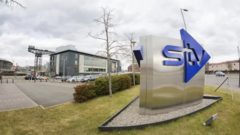
Linear television networks face a compounding structural crisis: operating costs remain tethered to geographic distribution while advertising yields migrate rapidly to borderless digital platforms. The decision by UK media regulator Ofcom to ratify STV’s plan to overhaul its STV News at 6 broadcast model is not an isolated regulatory adjustment. It is a mathematical inevitability for commercial public service media (PSM) companies bound by legacy infrastructure.
By allowing the Scottish broadcaster to consolidate its distinct Central and North licensing outputs into a centralized transmission originating from Glasgow, the regulator has established a precedent for balancing structural economic deficits against statutory local public obligations. To understand the operational and economic forces driving this consolidation, one must dissect the mechanism of regional broadcasting costs, the shift in consumption elasticity, and the regulatory compromise structures that govern commercial public service contracts.
The Economic Disconnect in Regional Linear Media
The traditional commercial broadcasting model relies on geographic monopolies or regional licensing to capture localized advertising spend. A dedicated regional news program requires a duplicated fixed-cost infrastructure, which can be expressed through a simple cost function:
$$C_{Total} = F_{Studio} + F_{Transmission} + V_{Newsgathering} + V_{Presentation}$$
Where:
- $F_{Studio}$ represents the fixed overhead of maintaining physical production environments in multiple regions (e.g., Aberdeen and Glasgow).
- $F_{Transmission}$ represents the technical infrastructure cost to split signals for sub-regional "opts" or variations.
- $V_{Newsgathering}$ reflects the variable cost of field journalists and equipment.
- $V_{Presentation}$ covers the on-air talent and dedicated technical studio crew.
The underlying vulnerability for STV was the inflation of fixed overheads ($F_{Studio} + F_{Transmission}$) relative to a shrinking linear audience base. The broadcaster suffered a £200,000 loss in the first half of 2025, forcing a target of £2.5 million in operational savings. When linear viewing figures drop, the cost per thousand viewers (CPM) demanded by advertisers faces downward pressure, yet the fixed physical costs of running an independent studio facility like the one in Aberdeen remain completely rigid.
By shifting the presentation layer ($V_{Presentation}$) entirely to Glasgow and eliminating the five-minute sub-regional presentation "opts" across the four sub-regions (Glasgow, Edinburgh, Dundee, and Aberdeen), STV alters its cost architecture. The fixed studio cost of the northern operation is minimized, converting a dual-stream production line into a single centralized engine with localized inputs.
The Content Partitioning Strategy and Quota Architecture
The compromise mandated by Ofcom introduces a strict mathematical framework for airtime distribution within the flagship 30-minute evening news slot. Rather than maintaining a fully separate northern edition, the new structure enforces a 70/30 content split:
- Shared National Core (Maximum 70%): A standardized segment containing stories of pan-Scottish interest, produced and anchored from Glasgow, utilizing field reports from across the country.
- Regional Specific Windows (Minimum 30%): Dedicated segments tailored to the North and Central licence areas respectively, broadcast simultaneously via targeted regional transmission feeds.
The tension in this model lies in the drastic reduction of true regional airtime. Journalistic union calculations indicate that dedicated local news coverage within the STV North edition will effectively contract from approximately 17.5 minutes down to 7.5 minutes per day.
Localism vs. Distribution Efficiency
| Variable | Legacy Model | Approved Consolidated Model |
|---|---|---|
| Primary Studio Anchor | Dual Location (Glasgow / Aberdeen) | Centralized (Glasgow) |
| Sub-Regional Opt-Outs | Active (5-minute localized windows) | Discontinued |
| Minimum Region-Specific Airtime | ~58% of broadcast duration | 30% of broadcast duration |
| Newsgathering Footprint | Distributed Bureaus | Distributed Bureaus (Maintained as condition) |
The operational risk of this structural compression is the dilution of hyper-local coverage. While newsgathering resources are legally obligated to remain on the ground in Inverness, Aberdeen, Dundee, Edinburgh, and Glasgow, the bottleneck shifts from data collection to broadcast allocation. Reporters in the field will compete for a significantly smaller pool of linear broadcast minutes, structurally biasing the editorial selection toward stories that can satisfy a broader geographic denominator.
Regulatory Trade-offs and the Precedent Risks
Ofcom’s statutory duty requires it to maximize viewer utility while ensuring the commercial viability of Channel 3 licence holders, who receive no public funding or license fee revenue. The regulator’s approval reveals an explicit acknowledgement of "Transmission Critical" realities: forcing a commercial entity to maintain an unsustainable legacy cost structure inevitably leads to corporate insolvency or a complete breakdown of the public service component.
The regulatory architecture relies on enforceable license conditions to prevent total centralization. These safeguards include:
- Shared Interest Mandate: Content broadcast in the 70% shared segment must possess verifiable relevance to both licence areas simultaneously.
- Asset Preservation: The Aberdeen studio facility must remain functional and "regularly in use," preventing a complete liquidation of northern production assets.
- Bureau Maintenance: Explicit legal headcount protections to ensure field journalists remain stationed outside the central belt.
The strategic risk is the potential for regulatory contagion. If a 70/30 centralization framework is deemed neutral to audience service quality in Scotland, other commercial public service networks across the United Kingdom will look to deploy identical consolidation frameworks to protect margins against structural ad-market declines.
Digital Rebalancing and the Transition Bottleneck
The executive defense of the consolidation rests on a classic corporate rebalancing thesis: capital saved from linear presentation inefficiencies will be deployed into digital platforms to match modern consumption habits. This strategy relies on an assumption of audience transition elasticity—the belief that legacy linear viewers can be successfully funneled into digital apps and social streams where content can be updated continuously throughout the day.
The primary limitation of this strategy is the monetization deficit. Linear television commands a premium for synchronous mass-audience reach, an attribute highly valued by regional advertisers. Digital impressions, by contrast, operate in a hyper-competitive, programmatic ecosystem dominated by global technology platforms. A local commercial broadcaster rarely possesses the scale or data infrastructure to match the ad-targeting efficiency of programmatic giants.
Consequently, a dollar saved in linear production costs does not automatically yield an equivalent dollar of digital revenue. The shift instead risks accelerating the commoditization of the broadcaster's core product: high-integrity local journalism.
The Audience Alignment Gap
Public sentiment metrics indicate a profound misalignment between institutional strategy and consumer preference. Surveys across the affected northern regions—including Aberdeen, Aberdeenshire, Angus, Moray, and the Highlands—demonstrated that only 4% of viewers supported the consolidation plan.
This creates a severe trust deficit. Public service broadcasting operates on a social contract: viewers grant attention and regulatory privileges in exchange for authentic local representation. When that representation is perceived as being managed remotely from a city 150 miles away, brand equity degrades, undermining the very audience base required to sustain the digital transition.
Strategic Playbook for Independent Regional Media
To survive this structural shift, regional media operations must abandon legacy infrastructure assumptions and restructure their production workflows around high-margin, low-overhead models. The following tactical execution blueprint provides the framework for this adaptation:
1. Uncouple Production from Physical Studio Footprints
The requirement for million-dollar physical galleries and dedicated studio crews creates an insurmountable fixed cost. Implement cloud-based switching, remote production over IP, and automated virtual sets. This shifts the cost matrix from fixed capital expenditure ($F_{Studio}$) to flexible, usage-based variable operating expenses.
2. Monetize via Direct-to-Consumer Niche Channels
Relying strictly on programmatic display ad revenue is a losing proposition for local content providers. Shift the monetization architecture toward high-yield subscription tiers, localized business sponsorships, and transactional events. Build a hyper-focused, low-churn subscriber base rather than chasing empty programmatic impressions.
3. Transition from Presentation to Aggregation
If linear airtime is legally restricted or compressed by regulatory quotas, focus capital on owning the raw newsgathering layer. Become the primary content engine for third-party aggregators, digital platforms, and national networks. The highest value resides in proprietary access and local investigative capability, not the physical delivery system of a television antenna.