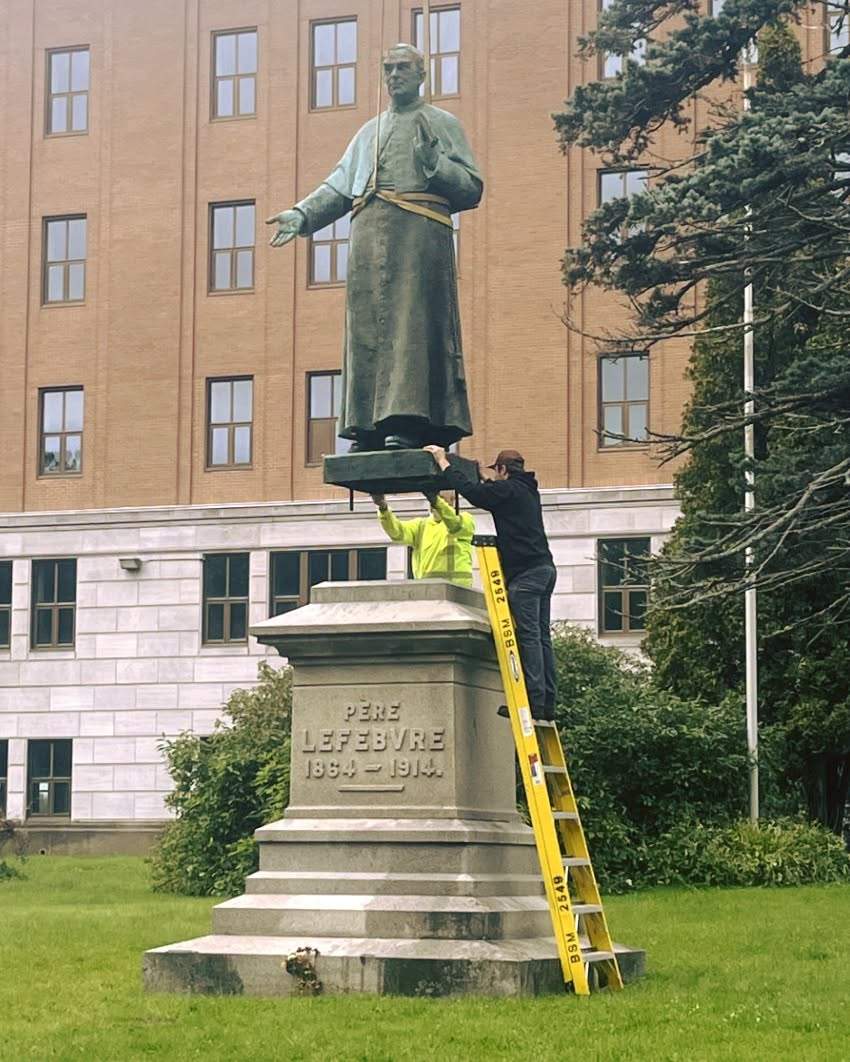
Public infrastructure asset management relies on a fragile equilibrium between open community access and physical security architecture. When a century-old monument in Memramcook, New Brunswick, was systematically targeted by vandals and subsequently restored to its structural base, the incident exposed fundamental vulnerabilities in how municipalities handle cultural capital. Physical heritage assets operate under a zero-margin-for-error framework: single-point failure vectors, such as unmonitored public squares or unreinforced mounting joints, leave unvalued historical artifacts exposed to asymmetric destruction costs. Perpetrators inflict thousands of dollars in cultural and physical damage with minimal effort, while asset owners bear asymmetric recovery expenses, operational downtime, and permanent integrity degradation.
Physical heritage vulnerability stems directly from the spatial economics of public monuments. These artifacts are intentionally placed in high-visibility, low-barrier municipal zones to maximize civic engagement. However, this architectural openness creates an inherent security deficit. The Memramcook restoration case highlights the immediate operational response protocol required when an artifact is compromised. Asset recovery follows a strict path: forensic site assessment, structural integrity verification of the mounting plinth, material-matching restoration, and re-anchoring using modern tamper-resistant fasteners.
The economic model of public monument preservation exposes a persistent market failure. Municipal budgets allocate capital primarily to initial fabrication and installation, treating heritage assets as sunk costs with negligible ongoing maintenance liabilities. This approach ignores depreciation schedules and the rising cost function of specialized stone or bronze restoration labor. When a century-old statue is damaged, the financial burden falls entirely on local tax bases or emergency heritage grants, highlighting the absence of risk-adjusted insurance mechanisms for civic art.
Security hardening for public installations requires balancing deterrence against aesthetic degradation. Traditional solutions, such as perimeter fencing or continuous closed-circuit surveillance, conflict with the primary purpose of public art, which is to foster accessible civic identity. To resolve this tension, municipal planners must transition from reactive repair models to proactive risk mitigation strategies.
The Three Tiers of Heritage Asset Defense
Material Reinforcement focuses on the substrate and anchoring systems. Modernizing a century-old installation involves replacing degraded iron dowels with structural epoxy and stainless steel pins that distribute physical stress loads evenly, preventing catastrophic fracture during an impact event.
Environmental Engineering alters the immediate geography of the monument. Strategic landscape design, optimized focal lighting, and natural elevation changes create psychological and physical deterrents without erecting visible barriers that alienate the public.
Digital Surveillance Integration deploys low-profile, edge-processed optical sensors that monitor unauthorized proximity or tampering without relying on expensive, constantly monitored live-feed networks.
The recovery of the Memramcook statue serves as a case study in operational resilience, yet it underscores a wider systemic deficiency in how municipal infrastructure protects non-fungible cultural assets. Communities must abandon the assumption that historical permanence is self-sustaining. Without continuous capital allocation toward preventive reinforcement and threat-vector analysis, public monuments will remain vulnerable to low-cost vandalism while taxpayers absorb the high-cost consequences of inadequate structural defense. Municipal asset managers must audit existing vulnerability matrices immediately, shifting expenditures from post-damage restoration budgets to integrated site-hardening protocols before the next high-value artifact is compromised.