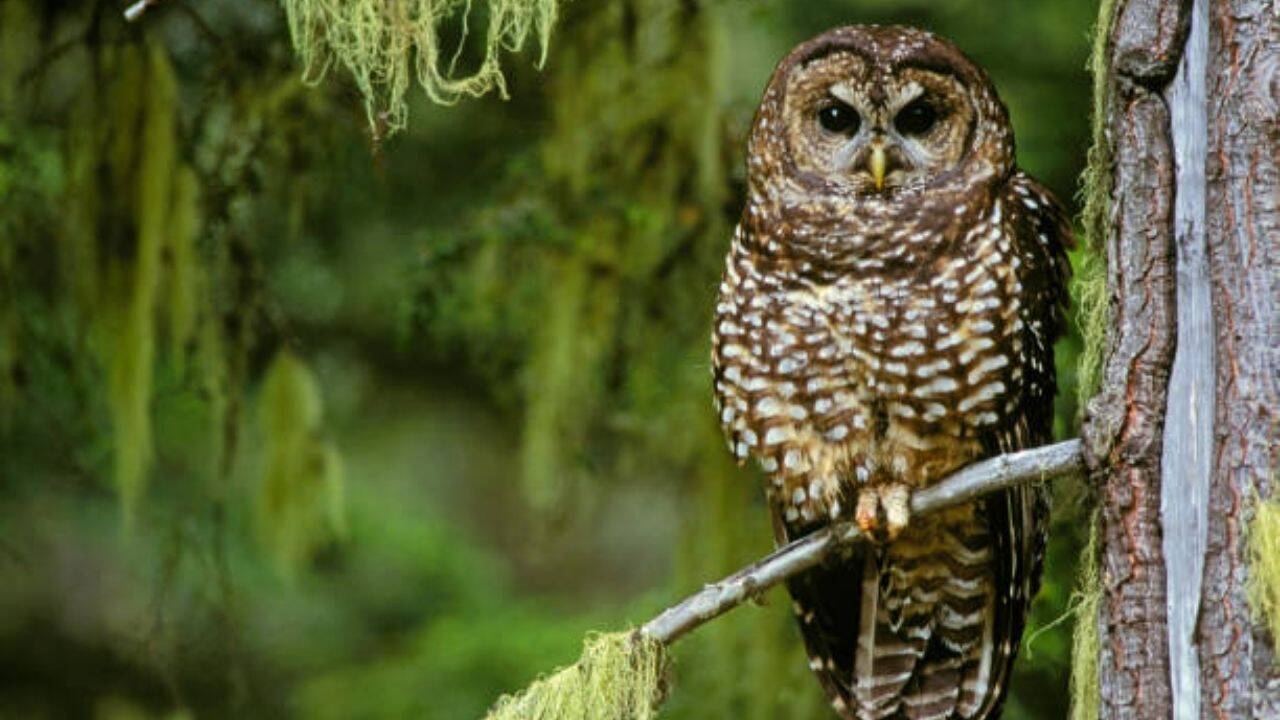
Decades of conservation policy framed the ecological trajectory of the Pacific Northwest as a binary economic conflict. The northern spotted owl served as a proxy for old-growth forest preservation, pitting industrial timber extraction against federal regulatory intervention. Recent bioacoustic and machine-learning assessments across tens of thousands of square miles of federal forest reveal that this political framing obscured a structural ecological shift. Populations across broad swaths of Washington, Oregon, and northern California have crossed the threshold of functional extinction. The species no longer maintains densities sufficient to perform its baseline ecological functions or sustain viable reproduction, rendering thirty-six years of static habitat preservation policies mathematically insufficient against dynamic multi-variable pressures.
The mechanics of this decline cannot be understood through single-variable attributions. Ecosystem degradation operates as a compound cost function where habitat fragmentation, competitive displacement, and environmental volatility compound non-linearly. Understanding why traditional protections failed requires deconstructing the specific feedback loops governing the organism's collapse.
The Structural Drivers of Population Collapse
The trajectory of the northern spotted owl is shaped by three distinct variables: spatial habitat compression, competitive asymmetry, and acoustic saturation. Each factor imposes a different vector of pressure on demographic stability.
Spatial habitat compression stems from historical timber harvest patterns and modern high-severity wildfire regimes. Old-growth forests provide the structural complexity required for nesting, roosting, and foraging. When fragmented, these patches increase the perimeter-to-area ratio, exposing nesting pairs to microclimatic shifts and elevated predation rates. Even when large tracts are legally designated as reserves, structural immaturity across secondary-growth forests limits carrying capacity.
Competitive asymmetry accelerates this spatial squeeze. The barred owl, a generalist species native to eastern North America, expanded its geographic range westward due to historical anthropogenic changes in the Great Plains and subsequent forest maturation. Barred owls possess higher dietary plasticity, smaller territory requirements, and superior thermal and physiological tolerance compared to the northern spotted owl.
Acoustic and behavioral dominance compounds this competition. Passive monitoring data demonstrates that barred owls outnumber northern spotted owls by factors exceeding eight to one across core historical ranges. Because barred owls initiate territorial calls earlier and more frequently, they induce behavioral suppression in northern spotted owls, reducing foraging efficiency and mating success.
[Habitat Fragmentation & Wildfire] --> [Reduced Carrying Capacity]
                                                                    \
                                                                     --> [Demographic Collapse]
                                                                    /
[Barred Owl Range Expansion]      --> [Competitive Asymmetry]  --^
The Mathematical Reality of Functional Extinction
Functional extinction differs fundamentally from complete demographic eradication. A species is functionally extinct when population density drops below the minimum viable threshold required to exert top-down or bottom-up trophic influence, or when recruitment rates fall permanently below mortality rates.
Data from recent multi-scale acoustic surveys indicate that northern spotted owls are entirely absent from large sub-regions, such as portions of the Washington Cascades north of Seattle. In zones where detections occur, occupancy rates are heavily skewed against the native species.
The demographic deficit is driven by a stark drop in annual survival and recruitment. Long-term demographic studies across multiple demographic monitoring areas show sustained population declines of several percentage points annually. When annual mortality consistently outpaces recruitment, population vectors follow an exponential decay curve. Once this curve crosses a critical density floor, Allee effects take over. Low population density impairs mate finding, increases inbreeding depression, and leaves local populations vulnerable to stochastic environmental events.
Evaluating Policy Deficits in Legacy Conservation Frameworks
The 1990 listing of the northern spotted owl under the Endangered Species Act and the subsequent implementation of the 1994 Northwest Forest Plan anchored conservation strategies in a static paradigm. These frameworks operated on an assumption of equilibrium: protect the physical matrix of the old-growth forest, and the species will self-correct.
This approach suffered from three fundamental analytical flaws.
First, the regulatory apparatus treated habitat as a static spatial constraint rather than a dynamic variable interacting with climate and invasive species dynamics. Preserving timber stands does not insulate a species from an aggressive biological competitor capable of utilizing those exact same spatial resources more efficiently.
Second, legal and political interventions focused heavily on defensive litigation over harvest quotas rather than offensive population-level biological management. While timber restrictions successfully preserved physical forest architecture in certain zones, they exerted zero influence over the interspecific competition vector driving the northern spotted owl toward displacement.
Third, administrative oscillations across presidential cycles created regulatory instability. Critical habitat designations were repeatedly expanded, slashed, and reinstated through successive political transitions. This regulatory friction prevented long-term, adaptive biological interventions, leaving land managers reacting to judicial mandates rather than executing cohesive ecological strategies.
Strategic Interventions and Implementation Bottlenecks
Reversing or halting functional extinction requires shifting from passive preservation to active intervention. Current scientific consensus points toward a multi-pronged operational model, each element carrying distinct implementation costs and systemic hurdles.
Targeted removal of invasive barred owls represents the most empirically supported lever for stabilizing northern spotted owl demographics. Experimental removal studies demonstrate that where barred owls are systematically culled, northern spotted owl populations stabilize, whereas unmanaged control sites continue to experience double-digit declines. Scaling this strategy across the entire Pacific Northwest, however, introduces severe operational friction. It requires sustained public funding, highly trained personnel, and acceptance of lethal management within wildlife conservation frameworks—a practice historically met with resistance from animal welfare coalitions.
Captive breeding and assisted reintroduction programs offer a secondary mechanism to inject genetic diversity into isolated, fragmented sub-populations. While utilized effectively in other avian recovery initiatives, captive breeding for secretive forest owls involves high capital expenditures, complex husbandry protocols, and low post-release survival rates when juvenile birds encounter high densities of territorial competitors.
Ecosystem-scale resilience management remains necessary to protect remaining high-quality nesting sites from catastrophic wildfire. This involves proactive thinning of overly dense younger forests and prescribed burning to protect mature structural reserves. However, mechanical thinning in remote old-growth buffers frequently triggers legal challenges from conservation groups wary of commercial logging interests exploiting restoration mandates.
The operational path forward demands an explicit decoupling of habitat preservation from invasive species management. Land management agencies must transition from a defensive posture centered on court-mandated acreage targets to an aggressive, resource-heavy matrix intervention model that prioritizes competitive relief for native species over passive non-interference policies.