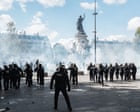
Mass street mobilization in France rarely fails from lack of grievance; it breaks down when peaceful protest marches, violent fringe actors, and opportunistic looting converge along the same urban corridors. Reporting on the October 2026 demonstrations—which saw more than 1,800 arrests nationwide, hundreds of injured security personnel, and widespread damage across Paris and provincial cities—often treats these distinct phenomena as a single undifferentiated wave. Breaking the unrest into structured operational and economic mechanics reveals why the state struggled to contain both the political pressure and the physical damage simultaneously.
To understand what happened and why conventional crowd-control narratives miss the deeper dynamics, this analysis examines four structural dimensions:
- The grievance stack driving peaceful turnout across students, unions, and cost-of-living demonstrators.
- The actor bifurcation separating peaceful marchers, confrontational radical subgroups, and property-focused looters.
- The cost function of urban disorder across municipal infrastructure, retail balance sheets, and public safety capacity.
- The state response bottleneck created when policing heavy riots risks escalating peaceful dissent or straining emergency services.
How Competitor Coverage Frames the Event
Live-blog coverage of mass unrest excels at speed and eyewitness detail, but its structure imposes analytical limits. An event feed naturally stacks chronological updates—arrest tallies, ministerial quotes, transit closures, and regional incidents—without separating cause from correlation. When a headline links nationwide arrest counts directly to "devastated" streets in Paris, a reader can easily infer that every arrested individual was a street vandal or that the entire marching crowd engaged in arson and looting.
In practice, official statements and ground reporting point to a sharp divergence between protest participation and property destruction. Union tallies and police estimates placed participants in the hundreds of thousands across France, including over 100,000 in Paris, while Interior Ministry officials and independent observers distinguished large peaceful marches from smaller cohorts engaged in targeted violence, arson, and store pillaging. Confusing total crowd size with violent intent distorts both political diagnosis and operational planning.
The Grievance Stack Behind Mass Mobilization
Large-scale French protests rarely spring from a single policy dispute. Instead, grievances stack across household budgets, public institutions, and political trust until a scheduled march or school walkout acts as a coordination point.
The first layer is household purchasing power. Rising living expenses, housing pressure, and energy or fuel costs—compounded in late 2026 by broader inflationary pressures tied to geopolitical instability in the Middle East—hit wage earners and students directly. When essential outlays consume a larger share of monthly income, discretionary buffers shrink and political tolerance for perceived mismanagement drops.
The second layer is public service strain. Student demonstrations that began in late September over school conditions, staffing, and educational standards created an active mobilization network before the mid-October national day of action. Parallel frustrations over job prospects, perceived corruption, and high-visibility yellow-vest symbols gave disparate groups a shared vocabulary of opposition.
The third layer is political timing. With presidential campaign dynamics already shaping public debate in autumn 2026, street mobilization became a vehicle for signaling discontent outside ballot cycles. External political commentary—ranging from domestic opposition figures to foreign leaders attributing the disorder to immigration or cultural assimilation—quickly folded domestic economic anger into broader ideological battles. Here, a crucial distinction applies: economic strain and service dissatisfaction are well-documented drivers cited by participants and analysts, whereas claims pinning the violence primarily on specific demographic or ideological groups remain contested political interpretations rather than established operational findings for every incident.
Actor Bifurcation: Marchers, Confrontational Groups, and Looters
Treating "protesters" as a monolithic block obscures how street disorder actually propagates. In large urban demonstrations, three distinct behavioral profiles operate in the same space with different incentives:
- Peaceful demonstrators seek visibility, leverage, and political pressure through marches, banners, and union or student organizing. Their primary vulnerability is reputational and physical: violent clashes nearby can delegitimize their demands and expose them to tear gas, water cannons, or baton charges.
- Confrontational and radical subgroups—often masked or dressed in black—target symbols of state authority, commercial power, or public order, such as police lines, banks, government offices, and municipal buildings. Their tactics rely on crowd density for cover and rapid movement across intersections to stretch security perimeters.
- Opportunistic looters and vandals exploit perimeter gaps and police distraction to break into retail stores, steal high-value goods, or set fires. Unlike ideological activists, their objective is immediate private gain or destruction enabled by temporary law-enforcement congestion.
Consider how these dynamics interact along a major commercial boulevard. A peaceful march moves along a designated route, drawing a heavy police presence to manage crowd flow. Smaller, mobile groups peel off into side streets or commercial strips—such as retail corridors in Paris or provincial hubs like Marseille, Lyon, Lille, and Limoges—where security coverage is thinner. Once storefronts are breached or fires are lit in town halls and commercial premises, emergency crews must divert attention from crowd management to fire suppression and site security, sometimes facing hostility that slows rescue and firefighting work.
The Cost Function of Urban Disorder
The economic and institutional toll of widespread unrest is non-linear. Adding a small fraction of violent or destructive actors to a massive demonstration produces outsized costs across four channels:
- Direct retail and property losses. Retail trade leadership estimated around 1,500 damaged shops and commercial establishments across the October weekend, with costs projected in the hundreds of millions of euros. High-street boutiques, electronics shops, restaurants, and banks face immediate repair bills, inventory loss, and insurance friction.
- Civic and heritage destruction. Fires at public buildings—most starkly the severe damage to the historic town hall in Limoges and the burning of Lyon's tourist office—destroy irreplaceable local infrastructure and impose long-term reconstruction burdens on municipal budgets.
- Human casualties and force exhaustion. Hundreds of police officers, gendarmes, and firefighters suffered injuries over the unrest, alongside hundreds of arrests and at least one reported health-related fatality during the Paris march. Sustained deployments erode operational readiness and increase overtime and medical costs.
- Mobility and tourism drag. Preventive Métro station closures around sensitive districts, road blockages, and visible clashes disrupt daily commutes and rattle visitors. Even when physical damage is localized to specific streets, broader perception shocks can dampen short-term foot traffic and commercial confidence.
Exact aggregate figures across all municipalities, insurance claims, and long-term macroeconomic drag are still evolving as investigations and assessments proceed; what is already clear is the asymmetry of the cost function. A few hundred aggressive actors can impose hundreds of millions of euros in localized damage and tie down tens of thousands of security personnel.
Operational Trade-Offs and Limits of Crowd Control
Managing large demonstrations under high political pressure forces security planners into sharp trade-offs. Tightening perimeters and deploying heavy force—tear gas, water cannons, station closures, and mass arrests—can deter looting and protect key institutions, yet aggressive tactics carry real risks. Heavy-handed policing can draw accusations of excessive force, trigger watchdog investigations, inflame bystanders who arrived peacefully, and harden anti-state sentiment. Conversely, a lighter or more dispersed posture leaves vulnerable commercial streets and municipal buildings exposed to fast-moving vandals.
Legal and judicial follow-through faces a similar constraint. Rapid arrests and fast-tracked prosecutions signal firm state resolve, but high arrest volumes can strain processing capacity, legal representation, and court dockets without resolving the underlying economic grievances driving mainstream demonstrators back into the streets. No policing doctrine or legal measure is a silver bullet: security forces can contain street violence and protect critical infrastructure, but durable de-escalation requires addressing why hundreds of thousands of citizens are willing to march in the first place.
Tactical Execution Blueprint for Crisis Response
For municipal leaders, security planners, and commercial operators confronting recurring mass demonstrations, an effective response separates crowd facilitation from crime suppression through disciplined sequencing:
- Decouple march corridors from high-risk commercial and civic nodes. Map predictable march routes against vulnerable targets—municipal halls, police stations, transit hubs, and dense retail streets—and establish layered ring protection around critical buildings rather than relying solely on linear crowd confrontation.
- Deploy dedicated rapid-response units for opportunistic looting and arson. Assign specialized mobile teams to intercept small breaking-and-entering or arson crews quickly so main public-order units do not lose cohesion during large march movements.
- Protect emergency access with clear ingress and egress lanes. Coordinate police cordons with fire and medical command so firefighters and ambulances can reach blazes and injured personnel without delay.
- Publish granular, real-time operational updates. Separate verified counts of peaceful marchers, arrests, injuries, and property incidents in official briefings so businesses, commuters, and international observers rely on accurate spatial information rather than rumor.
- Pair near-term order restoration with targeted grievance relief. Use post-event stabilization windows to address concrete pressure points—such as school staffing, student support, or targeted cost-of-living relief—before the next mobilization cycle builds momentum.
Strategic Play
Authorities and institutions should treat street violence as a perimeter and rapid-interdiction problem, while treating mass marches as a policy-legitimacy signal—ring-fencing vulnerable civic and retail zones with mobile response units while opening concrete administrative channels on school conditions and living costs before subsequent protest waves form.