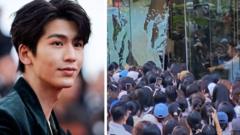
Physical real estate infrastructure operates on predictable, historical load assumptions, whereas globalized digital celebrity functions as an unpredictable demand shock. When thousands of individuals converged on a Nanning shopping center on May 31, 2026, to witness Chinese actor Zhang Linghe, the physical point of failure—a shattered glass entrance panel that injured five people—was merely the mechanical symptom of a deeper operational bottleneck. The mismatch between algorithmic hype cycles and static crowd-management protocols exposes an existential risk for commercial brands executing brick-and-mortar activations.
To optimize public commerce environments against structural failure, operators must dismantle the traditional assumption that local footprint limitations can contain digitally amplified demand. The incident in Nanning, which forced the immediate cancellation of an eyewear brand promotion and a rapid shift to digital livestreaming, provides the exact empirical data needed to map the velocity, structural mechanics, and financial liabilities of modern mass fandom.
The Tri-Unite Framework of Digital Demand Shocks
The transition of a celebrity from a regional asset to a systemic crowd-safety hazard relies on three distinct variables. When these variables align, they form a demand curve that outpaces the reaction time of standard municipal or commercial security frameworks.
Platform-Driven Global Distribution
Zhang Linghe's sudden structural impact stems from the cross-platform proliferation of the historical romance drama Pursuit of Jade. Premiering on March 6, 2026, the series bypassed traditional regional content silos by broadcasting simultaneously across domestic platforms Tencent Video and iQIYI, alongside global distribution via Netflix.
The metrics reveal the scale of the distribution engine: a heat index exceeding 31,000 on Tencent and 10,000 on iQIYI within seven days, paired with a debut at number six on Netflix’s Global Top 10 Non-English Shows chart. This dual domestic-international pipeline creates a highly concentrated, hyper-engaged audience matrix. Unlike traditional television rollouts that build localized affinity over years, algorithmic global streaming models condense the fame-acquisition timeline into weeks, generating a compressed wave of consumer demand.
The K-Popification of C-Drama Fandom
Modern entertainment consumption utilizes the behavioral architecture of idol culture. Consumers are no longer passive viewers; they are active stakeholders managed via micro-communities on networks like Weibo and Instagram.
This behavioral model prioritizes physical presence at corporate events as a metric of collective devotion and individual status within the fandom hierarchy. The operational challenge is that these fan communities coordinate implicitly via decentralized networks, meaning that thousands of individuals can decide to occupy a physical coordinate hours before commercial property management realizes a crowd is forming.
The Corporate Monetization Bottleneck
The final variable is the commercial exploitation strategy utilized by luxury and consumer brands. Companies capitalize on digital relevance by securing localized brand ambassadorships.
When an eyewear or fashion brand schedules an open-air or un-ticketed mall appearance to leverage this star power, they create an open invitation to a borderless digital community. The financial objective—generating foot traffic and viral marketing collateral—inherently conflicts with the physical limitations of the venue.
The Mechanical Failure Matrix
The physical destruction of commercial architecture during public celebrity appearances is a predictable outcome of mass physics, specifically the transition of a crowd from fluid to crystalline states. Understanding the mechanics of this transformation explains why standard storefront engineering cannot withstand fan surges.
[Decentralized Fan Coordination]
               │
               ▼
   [High-Density Convergence] (Static Crowd Accumulation)
               │
               ▼
     [The Open-Door Ingress] (Sudden Compression Vector)
               │
               ▼
 [Crystalline Crowd Pressure] ──> [Exceeded Load Limit] ──> [Structural Glass Failure]
The first phase involves static crowd accumulation. For hours prior to the event, thousands of fans packed the exterior perimeter of the Nanning shopping center. In this state, the crowd retains a degree of internal compressibility; individuals can shift or absorb minor movements.
The second phase occurs at the moment of ingress—when the shopping center's doors open. This creates a sudden forward movement vector. As individuals at the front stop to navigate security barriers or entrance frames, the mass behind them continues forward, driven by the psychological fear of missing vantage points on interior balconies, escalators, and walkways.
The final phase is the transition to a crystalline structure. When crowd density surpasses four individuals per square meter, the space between human bodies drops to zero. The crowd acts no longer as a collection of people, but as a solid, fluid mass capable of transmitting shockwaves over vast distances.
When this mass pushes against a fixed architectural barrier, such as a large glass entrance panel, the force is cumulative. Tempered glass possesses exceptional tensile strength against uniform wind distribution, but it experiences sudden catastrophic failure when subjected to concentrated, uneven point pressure from a compressed human wave. The material shatters instantly, transforming an engineering safety feature into a debris hazard.
Quantifying the Liability and Financial Repercussions
When a public brand activation undergoes structural failure and subsequent cancellation, the resulting economic losses extend far beyond damaged glass. The incident demonstrates a comprehensive model of total financial liability distribution between the talent studio and the corporate host.
Direct Damage Mitigation and Medical Indemnification
The immediate financial obligation requires compensating injured consumers. Local authorities confirmed five hospitalizations for cuts and abrasions. Under standard corporate liability frameworks, the venue and the organizing brand face immediate exposure for failing to maintain a safe commercial environment, requiring them to cover medical care costs and provide individual compensation settlements to affected attendees.
Sunk Capital Reimbursement Strategy
The true fiscal outlier in this case is the sweeping compensation policy enacted by Zhang Linghe’s talent studio. In an official Weibo statement, the studio committed to fully reimbursing fans for all verified financial losses stemming from the abrupt cancellation, including:
- Commercial aviation tickets
- High-speed rail fares
- Hotel accommodations
- Localized ground transportation (taxi fares)
This aggressive financial posture serves as an equity-protection mechanism for the artist’s personal brand. By setting a strict documentation deadline (June 3) and a rapid capital disbursement timeline (June 15), the studio absorbs a substantial short-term cash outflow to prevent long-term damage to the artist's commercial viability. For an actor holding ambassadorships with elite luxury houses such as Gucci, Chopard, and Roger Vivier, preserving consumer goodwill and preventing a reputational narrative of corporate negligence is worth the immediate cost of travel indemnification.
The Digital Pivot Opportunity Cost
Canceling a physical activation forces an emergency transition to a digital livestream. While this mitigates immediate physical safety concerns, the return on investment (ROI) drops significantly.
The hosting brand loses the premium, high-value experiential content of a live public spectacle, replacing it with a standard digital stream that competes in an already saturated online ecosystem. The cost per impression skyrockets because the overhead of the physical venue rental, security staff, and structural damage remains on the balance sheet, while the physical conversion funnel is entirely destroyed.
Operational Playbook for High-Yield Brand Activations
To execute physical celebrity marketing initiatives without incurring catastrophic infrastructure failure, enterprise operators must replace reactive crowd control with preventive logistical frameworks. Relying on standard mall security guards and temporary stanchions to contain modern fan surges is an obsolete strategy.
The first limitation of standard security models is the reliance on un-ticketed, open-access environments. If an event featuring a top-tier streaming star is free and accessible to the public, the volume of the crowd cannot be regulated.
The primary strategic recommendation is the mandatory enforcement of an inverse invitation model. Brands must transform public appearances into closed, invitation-only, or strictly ticketed micro-events. By introducing a digital verification wall or a pre-allocated ticketing system days before the event, the organizing team establishes an absolute ceiling on physical attendance, turning a volatile crowd surge problem into a manageable guest-list protocol.
The second operational limitation is architectural vulnerability. Entrance vectors must be physically decoupled from the main venue. If thousands of individuals gather at a single glass storefront door, structural failure remains a statistical probability.
The structural solution requires creating an external, multi-tiered staging perimeter located at least 50 meters away from building entryways. This perimeter must utilize heavy, interlocking steel barricades engineered to redirect lateral crowd pressure away from vertical glass structures. Furthermore, the ingress velocity must be throttled using serpentine queueing systems that break down large human masses into single-file lines before they reach physical building thresholds.
The ultimate strategic play for brands navigating this high-risk environment is the geographic isolation of the talent. Instead of placing the celebrity in a ground-floor atrium where they are visible to external street crowds, the stage must be situated in deep, upper-level interior spaces with controlled escalator access. This configuration allows security teams to use the vertical architecture of the building as a series of natural valves, stopping or slowing the flow of pedestrian traffic across multiple levels before density reaches critical failure thresholds.
If these structural parameters cannot be guaranteed by the venue, the activation must be designed from its inception as a digital-first, studio-isolated broadcast. Moving the asset out of harm's way removes the physical liability entirely, turning an unpredictable crowd risk into a controlled, high-margin media event.