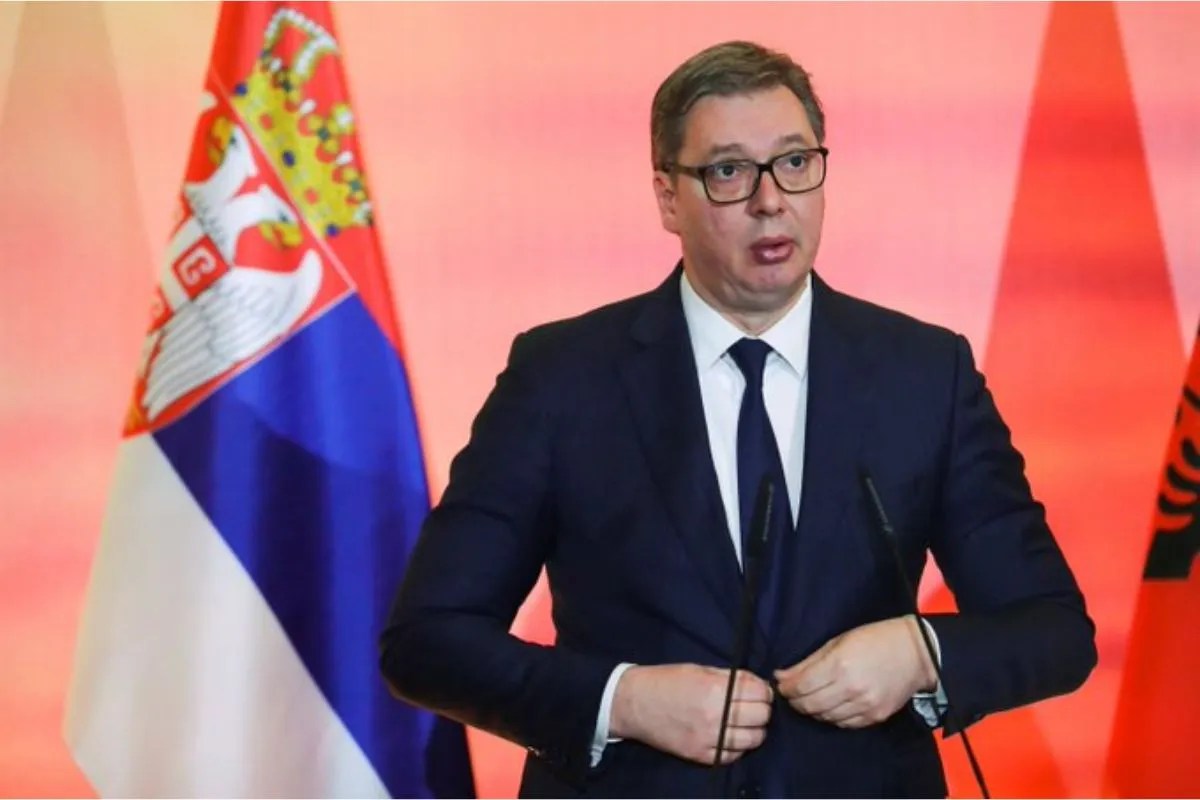
Aleksandar Vucic’s announcement that he will resign from the Serbian presidency within weeks is not an admission of defeat; it is a calculated structural relocation of political capital. By stepping down approximately one year before the formal expiration of his second mandate in 2027, Vucic is executing a classic consolidation maneuver designed to absorb domestic shocks and front-run systemic risk. The move forces immediate, early presidential and parliamentary elections, effectively resetting the political clock on terms optimized for the ruling Serbian Progressive Party (SNS).
Understanding this sudden transition requires moving past surface-level political rhetoric and examining the precise operational and systemic mechanisms driving the decision.
The Tri-Factor Pressure Matrix
The resignation operates as a direct response to a compounding three-part structural crisis that threatened to permanently erode the ruling party’s institutional advantage if left unaddressed until 2027.
1. The Infrastructure Accountability Bottleneck
The structural catalyst for sustained domestic unrest originated on November 1, 2024, when a concrete canopy collapsed at the Novi Sad railway station, resulting in 16 fatalities. Because the station was a high-profile state modernization project executed by state-backed international contractors, the incident created an immediate accountability loop linking infrastructural failure directly to institutional corruption. This eliminated the government's ability to compartmentalize blame, transforming local negligence into a systemic vulnerability.
2. Sustained Youth Mobilization Scale
The Novi Sad incident triggered a continuous, 18-month wave of student-led, anti-government demonstrations. The durability of this movement altered the cost-benefit analysis of the state security apparatus. In historical political models, decentralized protests experience decay over a six-to-eight-week horizon due to resource depletion and fatigue. The persistence of these demonstrations for over a year and a half indicated a permanent shift in urban youth alignment, necessitating a structural intervention rather than tactical containment.
3. Geopolitical Equilibrium Decay
Serbia’s grand strategy relies on a delicate hedging mechanism: pursuing European Union membership while simultaneously maintaining deep military, logistical, and energy dependencies with Russia and China. This balancing act has faced severe friction due to shifting continental security dynamics. Facing increased pressure to formalize its alignment with Western institutional frameworks, the executive office found its domestic maneuvering room highly constrained.
The Strategic Logic of Selected Resignation
Vucic’s exit from the presidency is explicitly timed to convert an uncontrolled external crisis into a controlled internal election cycle. The operational mechanics of this strategy rely on three core principles.
[Systemic Crisis: Novi Sad + 18 Months of Protests]
                       │
                       ▼
         [Strategic Resignation Executed]
                       │
         ┌─────────────┴─────────────┐
         ▼                           ▼
[Asymmetric Electoral   [De-escalation via Institutional
     Advantage]                     Reset]
Asymmetric Electoral Advantage
By triggering snap general and presidential elections simultaneously, the ruling party capitalizes on a highly fragmented opposition. Public polling indicates that while the student-led protest movement commands significant urban traction (holding roughly 31% of theoretical voter alignment), the SNS retains a consolidated baseline of approximately 47%. Forcing an immediate election deprives the opposition of the runway required to build a unified legislative coalition, formalize leadership structures, or establish a coherent alternative policy platform.
De-escalation via Institutional Reset
A core demand of prolonged protest movements is the removal of executive leadership. By voluntarily fulfilling this condition, the executive drains the core narrative energy of the demonstrations. The act of resigning reframes the political conflict from an asymmetric struggle between the street and the state into a formalized, democratic electoral process. This shifts the burden of action back to the electorate, where the ruling party possesses superior organizational machinery, media saturation, and rural voter mobilization networks.
Rebranding the Party Vehicle
Free of the immediate constitutional constraints of the presidency, Vucic is repositioning himself to anchor the legislative campaign. The proposed consolidation of the ruling electoral list under the singular banner of "United Serbia" represents a deliberate effort to dilute localized corruption vulnerabilities. It replaces a fragmented local party identity with a centralized, nationalistic, and unified brand designed to maximize turnout among pensioners and rural demographics through targeted economic distribution packages.
Institutional Risk Factors and Strategic Limitations
This transition strategy is not a guaranteed success; it carries substantial operational vulnerabilities that could destabilize the planned consolidation.
- The Campaign Mobilization Overextension: The strategy relies heavily on the state's capacity to maintain voter loyalty via fiscal incentives, such as immediate financial support distributions to pensioners. If macroeconomic pressures limit the scale of these transfers, rural turnout may drop below the threshold required to offset urban losses.
- The Neutrality Paradox: The incoming executive administration must maintain the current military neutrality posture while assuring foreign investors of long-term stability. Any disruption in energy supply lines or sudden regulatory shifts in major infrastructure projects could trigger capital flight, compounding the domestic economic pressures that fueled the protest movement initially.
The upcoming electoral cycle will not determine whether the ruling elite remains entrenched, but rather whether its highly centralized model of state management can survive transition into a more volatile, fragmented political era. Executive survival now depends entirely on whether the organizational speed of the state machinery can outpace the mobilization velocity of an agitated urban electorate.