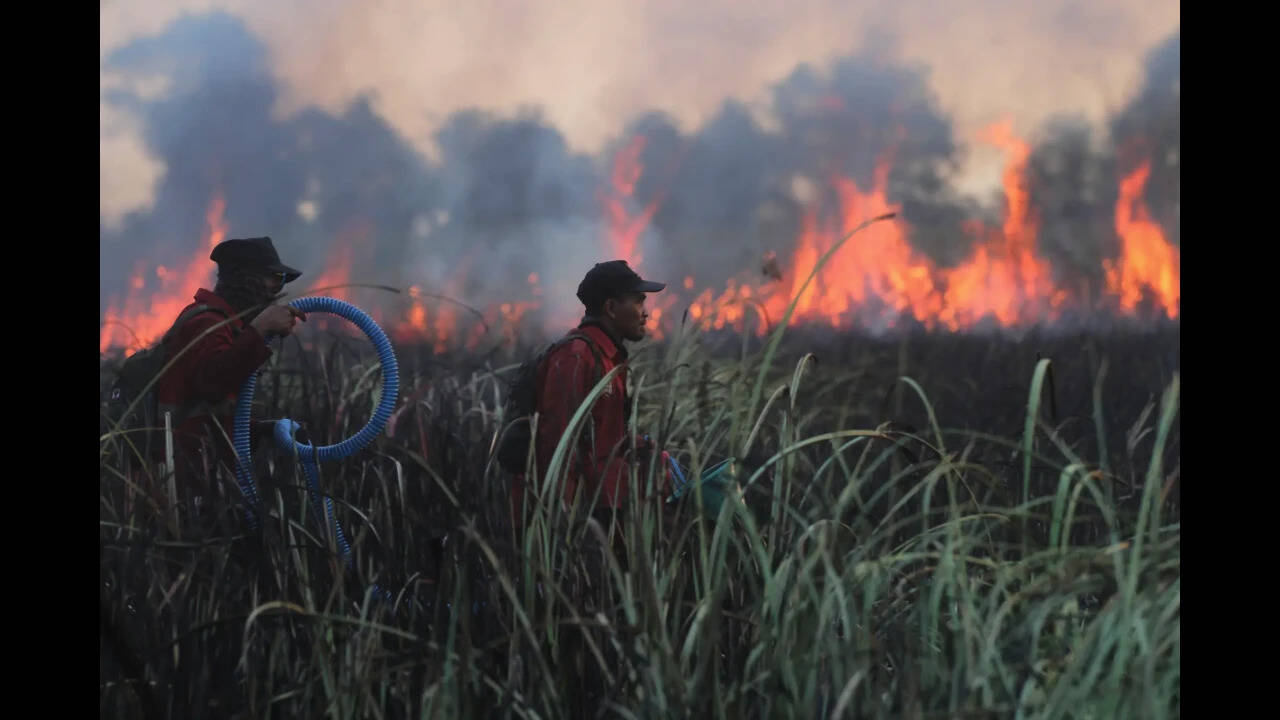
When a wildfire front advances from one kilometre out to within one hundred metres of a high-security animal facility over the span of a few days, the crisis is no longer an environmental abstraction. It represents an operational failure of regional land management and an acute physical threat to critically endangered species. In West Kalimantan, Indonesia, the YIARI orangutan rehabilitation centre faced precisely this trajectory. Sixty resident animals, previously rescued from traffickers or displacement, required immediate tactical evacuation into internal compound enclosures as sustained drought and human-induced land clearance converged into an extreme fire regime.
Analyzing this event requires stripping away emotional narratives to examine the systemic vulnerabilities exposing wildlife sanctuaries to catastrophic failure during peak burning seasons. Learn more on a related subject: this related article.
The Macro-Environmental Vectors
The acceleration of fire frequency in Indonesian peatlands and forests is governed by distinct meteorological and anthropogenic variables. Understanding the current crisis requires mapping three primary drivers:
- Prolonged Hydrological Deficits: The region experienced a documented stretch of forty consecutive days without rainfall prior to the peak outbreaks. This desiccation lowers the fuel moisture content of understory vegetation and dried peat layers, exponentially increasing ignition susceptibility.
- Climatic Amplification: Prolonged drought phases driven by regional weather patterns and shifting climatic conditions create compounding thermal stress across tropical ecosystems, turning rainforest zones into volatile fuel beds.
- Anthropogenic Land Clearing: Agricultural expansion, specifically slash-and-burn practices intended for palm oil and pulpwood production, acts as the primary ignition source. When land-clearing fires break containment lines, they transition into uncontrolled crown and ground fires.
In the first half of August, Indonesia registered more than triple the forest fire hotspots compared to the entire corresponding month of the previous year. This followed an unprecedented accumulation of blazes between January and July, during which forestry ministries reported over 107,000 hectares burned nationwide—double the total footprint recorded two years prior. More journalism by NBC News delves into similar perspectives on this issue.
The Micro-Level Operational Mechanics of Sanctuary Defense
When an active fire perimeter breaches the immediate buffer zone of a conservation facility, management shifts from rehabilitation protocols to emergency triage. The YIARI response blueprint illustrates the tactical constraints faced by field teams:
- Perimeter Breach Detection: Fires moving from a one-kilometre radius down to the facility perimeter compress the decision window for staff from days to hours.
- Internal Relocation Topology: Moving sixty adult and juvenile Bornean orangutans requires shifting specimens from expansive, semi-natural learning enclosures into inner core cages. This containment strategy minimizes exposure to radiant heat and smoke inhalation but introduces severe psychological stress and social friction among rehabilitated groups.
- Resource Allocation and Exhaustion: Facility staff cannot rely solely on external municipal support. Personnel must transition into active frontline firefighters, operating alongside state water-bombing aircraft while managing toxic air quality indexes that threaten both human respiratory systems and animal health.
The mechanical effort required to hold a perimeter against shifting winds is immense. Teams operating around the clock until the early morning hours face constant risks of subterranean peat reignition, where fires smoulder underground before bursting through the surface days later.
Systemic Vulnerabilities and Mitigation Deficits
The recurring threat to captive and wild orangutan populations highlights systemic failures in regional buffer zone maintenance and enforcement capacity.
Conservation facilities operate under the constant handicap of insufficient perimeter defense infrastructure. Most rehabilitation centres rely on limited cleared firebreaks that prove inadequate against high-velocity crown fires driven by seasonal winds. Furthermore, the socio-economic pressures on surrounding rural communities—where local populations utilize fire for agricultural management despite seasonal bans—maintain a continuous high probability of ignition.
The financial cost of defending these facilities extends far beyond immediate firefighting efforts. Emergency procurement of specialized pumps, hoses, and personal protective equipment drains operating budgets intended for long-term rehabilitation and eventual reintroduction into protected wild habitats.
Deploy strategic investments directly into automated early-detection thermal sensors along sanctuary perimeters and establish mandatory five-kilometre buffer zones free of combustible agriculture to eliminate the propagation vector before fires reach critical proximity.