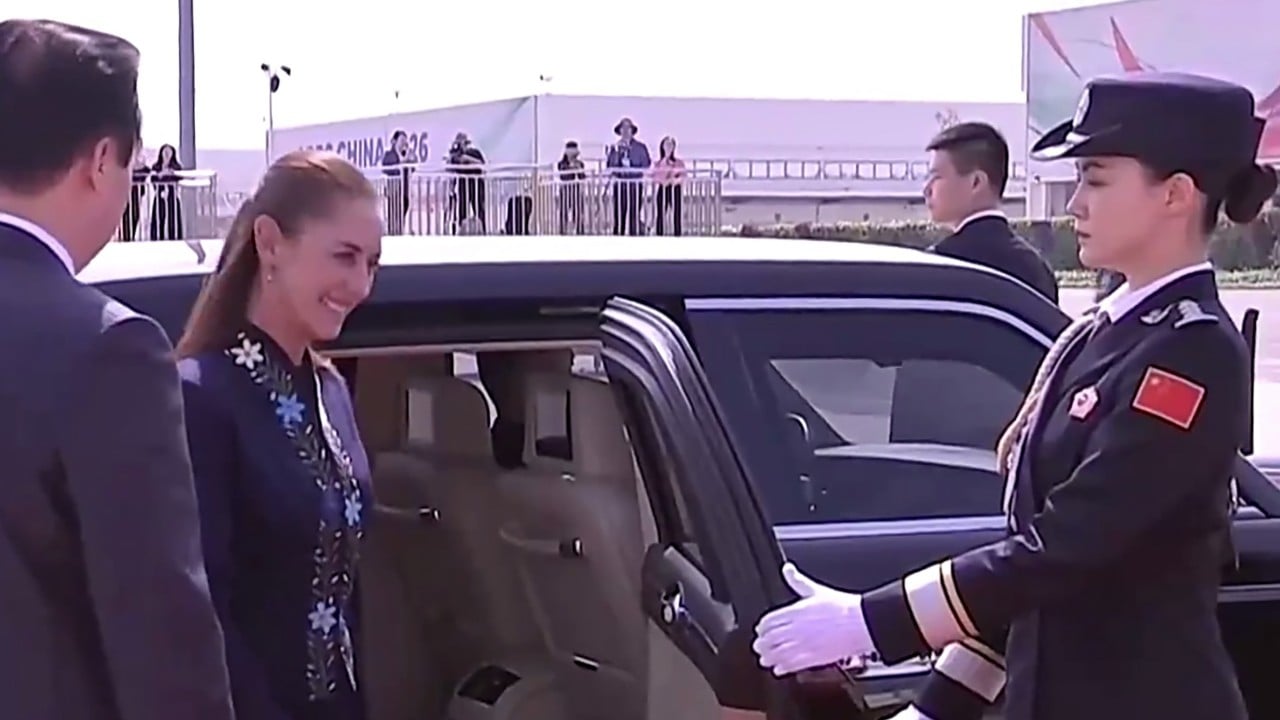
When an executive protection operative eclipses a visiting head of state in global media coverage, the phenomenon is not a viral accident; it is a predictable convergence of visual contrast, geopolitical signaling, and algorithmic amplification. During the Asia-Pacific Economic Cooperation (APEC) forum, the arrival of the Mexican delegation generated an asymmetric media event centered on Xu Jin, a female security officer assigned to the protective detail. Standard news coverage reduces this event to superficial commentary on appearance and novelty. A rigorous analysis reveals a multi-layered operation involving statecraft, tactical positioning, and attention economics.
To understand why a single security detail captured disproportionate international bandwidth, we must separate the theatrical layer of diplomatic protocol from the operational mechanics of executive protection.
The Three Pillars of Diplomatic Close Protection
High-level state visits operate under strict bilateral security protocols. When a foreign leader arrives on host soil, security responsibility is rarely unilateral. Instead, it relies on a tiered integration of the visiting dignitary’s personal protective detail and the host nation’s specialized state security apparatus.
1. Jurisdictional Layering and Host-Nation Sovereignty
In international diplomacy, the host nation bears primary legal and physical responsibility for the safety of visiting heads of state. For an event of APEC’s magnitude, the host deploys elite units—in China’s case, personnel drawn from the Central Security Bureau or specialized divisions of the People's Armed Police. The assignment of a high-profile host operative to the immediate perimeter of a visiting leader, such as Mexico’s representative, fulfills a dual mandate:
- Operational Control: Host operatives possess intimate knowledge of local terrain, venue choke points, emergency extraction routes, and direct communication channels with municipal tactical units.
- Sovereign Assurance: Placing a top-tier domestic agent within arm's reach of a foreign dignitary demonstrates the host state's absolute commitment to the guest's physical security, preventing diplomatic friction before negotiations begin.
2. The Tactical Advantage of Female Operatives
The deployment of female close-protection officers in the innermost ring—commonly referred to in security doctrine as the "diamond" or "box" formation—is driven by operational utility rather than optics. Traditional male protection details frequently create a rigid, visually aggressive perimeter that can escalate crowd tension and obstruct diplomatic photo opportunities.
Female agents solve several tactical bottlenecks:
- Access and Screening: Female operatives can accompany principals into gender-segregated spaces, private holding rooms, and secure rest areas without disrupting the protective envelope.
- Threat Assessment De-escalation: Threat actors are statistically conditioned to scan for large, overtly muscular male profiles when identifying security personnel. A female operative maintains a lower threat signature while retaining identical kinetic capabilities, delaying an adversary's OODA (Observe, Orient, Decide, Act) loop.
- Proximity Tolerance: Principals and foreign dignitaries often permit female agents closer physical proximity during formal greetings and transit, shrinking the reaction time required to intercept a close-range projectile or lunging assailant.
3. The Attention Economy of Statecraft
State summits suffer from severe visual homogenization. Thousands of hours of footage feature identical motorcades, dark suits, tarmac handshakes, and static podiums. In information theory, low-entropy signals—those that are entirely predictable—fail to register with audiences.
Xu Jin’s presence introduced high informational entropy into a standardized broadcast feed. The sharp contrast between formal diplomatic attire, the ceremonial environment of an airport tarmac, and the disciplined, hyper-vigilant posture of a female protective specialist created an immediate focal point. Social media algorithms, optimized for anomaly detection and high engagement velocity, rapidly prioritized this visual contrast over policy briefings.
The Mechanics of Viral Diplomatic Optics
The transformation of a routine airport arrival into an international media narrative follows a distinct causal chain. Analyzing this progression exposes the vulnerabilities and opportunities inherent in modern public diplomacy.
Visual Semiotics and Behavioral Micro-Cues
Observers fixated on Xu Jin not merely because of her gender, but because of observable behavioral markers that signal elite tactical training. In close protection, professional competence is visible through specific physical disciplines:
- Visual Scanning Patterns: Unlike ceremonial guards who maintain a fixed gaze, an active close-protection officer executes continuous, systematic sector scans. Cameras captured rapid eye and head movements independent of the principal's conversational focus, signaling active threat hunting.
- Stance and Center of Gravity: Even while standing stationary near a vehicle door or red carpet, an operative maintains a balanced, staggered stance with hands positioned near the centerline of the body. This posture enables explosive lateral movement or immediate access to concealed equipment without telegraphing intent.
- Spatial Geometry: The operative consistently maintained a precise distance—roughly one arm's length—from the Mexican official, adjusting dynamically to every shift in the principal's posture to keep the VIP's center mass shielded from uncontrolled angles.
Algorithmic Amplification Loops
Once domestic broadcast cameras captured these micro-cues, the footage entered a secondary distribution ecosystem. Domestic platforms amplified the clips through national pride framing, highlighting the professionalism and capability of state security personnel. International media outlets subsequently aggregated the domestic trend, reframing it through a lens of human-interest novelty.
This cross-border amplification creates a feedback loop:
- Initial Capture: State media broadcasts high-definition tarmac arrivals.
- Micro-Segmentation: Digital editors isolate 5-to-15-second clips focusing on the security detail's intense focus.
- Narrative Attachment: Commentators assign archetypes to the subject (e.g., the "stoic protector" or "sharp-eyed bodyguard"), stripping away the complex institutional training behind the role.
- Global Syndication: Foreign outlets publish secondary stories reporting on the reaction to the footage, effectively turning a domestic social media trend into international diplomatic coverage.
Strategic Implications for Bilateral Relations
While the media coverage focused on an individual operative, the underlying event carries measurable implications for China-Mexico bilateral relations and broader APEC optics.
Soft Power Projection Through Institutional Competence
Modern statecraft relies heavily on indirect soft power. By showcasing highly disciplined, modern security personnel, the host nation projects institutional stability, gender integration within elite state organs, and meticulous organizational control. For an international audience, the visual evidence of a poised, capable female officer counters outdated narratives regarding rigid, monolithic state apparatuses. It communicates modernity and operational precision without requiring a single diplomatic communiqué.
The Risk of Principal Eclipse
From the perspective of the visiting delegation, however, viral focus on a host-nation bodyguard introduces a strategic liability: message dilution.
When a head of state or senior minister travels to a multilateral summit like APEC, the primary objective is to project economic leadership, negotiate trade terms, and secure domestic political capital through international statesmanship. If the dominant global headline from the arrival reduces the visiting leader to a secondary figure in their own arrival footage, the diplomatic communications team has lost control of the narrative frame.
The mechanism of this failure is straightforward:
- Visual Hierarchy Inversion: In a properly managed diplomatic arrival, all visual lines—red carpets, honor guards, camera angles—converge on the visiting principal. When a secondary figure exhibits markedly higher visual intensity or novelty, the viewer's eye decouples from the principal.
- Headline Hijacking: Media outlets have finite space for summit coverage. Every article dedicated to the security detail's appearance or background displaces coverage of bilateral trade agendas, supply chain negotiations, or investment announcements.
Operational Limitations of High-Visibility Protection
Elevating a close-protection operative to celebrity status creates immediate operational friction for security directors. In executive protection doctrine, anonymity is a primary defensive asset. Once an agent's face, movement patterns, and assignment parameters become public knowledge, their tactical utility degrades.
Compromise of Covert Capabilities
Elite security units rely on the ability to blend into various environments, from formal galas to crowded public markets. Public recognition eliminates an operative's ability to conduct advance reconnaissance or operate in low-profile protective details. Adversaries can study publicly available footage to map the agent's dominant hand, weapon retention style, reaction times, and blind spots.
Shift from Protection to Performance
When security personnel become aware that cameras are tracking them as primary subjects rather than background elements, psychological interference occurs. The cognitive load required to scan for threats competes with the awareness of public scrutiny. Security directors must actively rotate high-visibility personnel out of front-line media zones to prevent degradation in situational awareness and to preserve the operational integrity of the unit.
The Fallacy of Symbolic Diversity
A common analytical error in media commentary is treating the presence of a single high-profile female officer as definitive proof of systemic structural parity within national security institutions. While Xu Jin’s assignment demonstrates high individual competence and tactical deployment by the host agency, single data points cannot be extrapolated to represent broader organizational demographics. True institutional integration is measured by command-level representation and standard deployment ratios across non-televised assignments, neither of which can be verified through tarmac footage.
Tactical Blueprint for Diplomatic Communications and Security Teams
To prevent security operations from cannibalizing diplomatic messaging while maintaining maximum physical protection, state protocol offices and protective details must synchronize their operational frameworks.
- Enforce Strict Perimeter Discipline: Protective formations must calibrate their visual footprint to match the threat level of the environment. In fully sanitized, military-controlled zones like diplomatic tarmacs, close-protection agents should adjust their spatial positioning slightly outward during stationary greeting phases, allowing the principal to occupy the unambiguous center of the visual frame.
- Implement Media-Rotation Protocols: Security commanders must treat viral exposure as an operational compromise. Any operative who becomes the subject of widespread public identification during a multi-day summit should be reassigned immediately from outer-ring visible duties to command-post logistics or advance-team planning for the remainder of the event.
- Pre-empt Narrative Drift with High-Contrast Diplomatic Visuals: Visiting delegations must counter the algorithmic pull of human-interest anomalies by engineering stronger primary visuals. Rather than relying on static tarmac handshakes, communications teams should schedule immediate, substantive visual engagements—such as bilateral working sessions with clear visual indicators of economic scale—within thirty minutes of arrival to capture the initial news cycle.
- Decouple Ceremonial Escorts from Tactical Details: Host nations should maintain a clear operational boundary between ceremonial security officers and active close-protection specialists. Keeping tactical specialists out of primary press corridors until the principal transitions to unscripted environments preserves agent anonymity and keeps media focus anchored on statecraft.