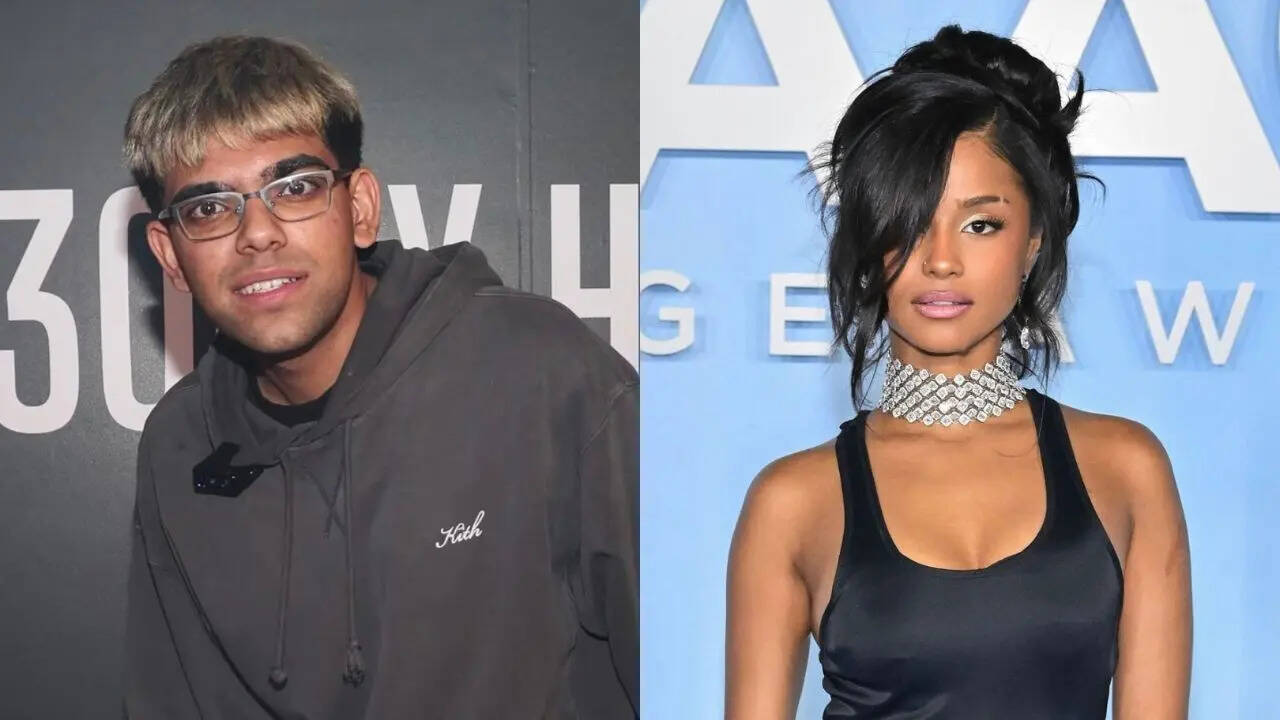
The velocity at which misinformation travels through digital ecosystems depends entirely on the alignment of three distinct operational variables: high-profile celebrity intellectual property, friction-heavy real-world interaction, and the optimization algorithms of decentralized social media accounts. When these components intersect, the truth becomes a secondary priority to engagement optimization. The viral rumor claiming that South African singer Tyla ordered the removal of internet personality N3on from an exclusive celebrity dinner in Monaco serves as a precise case study in systemic validation failure across digital networks.
Deconstructing this incident requires looking past the superficial internet drama to analyze the structural mechanisms that allowed a completely fabricated narrative to generate millions of impressions within hours. The architecture of this viral event reveals how algorithmic incentives, confirmation bias, and structural flaws in decentralized news amplification create a direct bottleneck for factual accuracy. Recently making news in this space: Stop Mourning Icons While Starving the Industry That Built Them.
The Mechanics of Structural Misidentification
The foundation of the rumor rests on an fundamental attribution error during a live broadcast. During a IRL (In Real Life) livestream in Monaco, N3on and his entourage engaged in a friction-heavy interaction with an unidentified diner, subsequently identified by audiences as an Instagram model. The sequence of events unfolded across a defined chain of escalation:
- The Inbound Camera Incursion: The streamer's production framework involves continuous, unedited documentation of immediate surroundings. This process inevitably captures non-consenting third parties within high-end, semi-private venues.
- The Privacy Boundary Assertion: The individual in question issued a direct verbal boundary, stating, "I said don't film me."
- The Operational Standoff: The streamer's team attempted to deflect by claiming, "We're filming us," followed by a request from the individual's party to "cut for a second." The streamer's operational constraint was then exposed: "He can't cut, it's a livestream."
The escalation itself represents a standard structural conflict within modern digital media production—the collision between private spatial expectations and the continuous monetization of live public feeds. The systemic failure, however, occurred post-incident when external aggregation accounts weaponized the footage. Additional information into this topic are detailed by E! News.
Accounts such as KnoxClipz and dashfrl served as the primary distribution vectors, publishing the footage with captions explicitly naming Tyla. The mechanics of this misidentification operate on an engagement-maximization framework. Tyla, a Grammy-winning artist with immense global digital search volume, represents a high-value keyword string. By mapping her identity onto an anonymous conflict involving a controversial streamer, aggregation channels achieved an immediate optimization of click-through rates. The actual identity of the individual in the video was discarded because accuracy lacks the immediate financial utility of celebrity indexing.
The Feedback Loop of Algorithmic Amplification
Once the initial misidentification crossed a critical threshold of impressions, the social media architecture took over, moving the narrative through a predictable three-stage amplification pipeline.
Phase 1: The Engagement Arbitrage
Aggregator accounts on platforms like X (formerly Twitter) exploit a systemic vulnerability in monetization structures. Because creators receive compensation based on verified impressions and comment thread velocity, there is a financial disincentive to fact-check material prior to distribution. The caption "Tyla CRASHED OUT on N3on" utilizes emotionally volatile language designed to trigger immediate outrage or defensive behaviors from fanbases, maximizing metric density.
Phase 2: Audience Confirmation Bias and Tribal Defense
The structural tension between different digital subcultures creates a self-sustaining feedback loop. Tyla’s audience operates on a defensive protection model of celebrity brand value, while N3on’s audience operates on an adversarial, anti-establishment model. When the clip debuted, neither faction audited the physical evidence. Instead, they weaponized the premise to validate pre-existing biases:
- The celebrity advocacy faction used the narrative to criticize the invasive nature of live-streaming culture in premium spaces.
- The streamer faction used the narrative to argue that mainstream celebrities exhibit disproportionate entitlement when encountering digital-native creators.
Because both arguments are structurally cohesive, the underlying lie—that the woman was not actually Tyla—remained unexamined for hours. The discourse thrived on the context of the argument, not its validity.
Phase 3: The Correction Bottleneck
The correction of digital misinformation faces an asymmetric distribution problem. A lie designed for maximum algorithmic velocity scales exponentially. Conversely, the correction—which requires visual comparison, facial verification, and a retraction of the initial premise—scales linearly.
By the time discerning users pointed out the distinct physiological and vocal differences between the individual in the Monaco video and Tyla, the original posts had already secured their primary traffic dividends. The correction phase of a viral rumor rarely achieves the scale of the infection phase because a corrected fact possesses lower emotional utility than a scandalous falsehood.
Structural Realities of Livestreaming in High-Value Environments
The incident exposes a growing legal and operational vulnerability for hospitality venues and public figures alike. The friction observed in the Monaco video is the direct result of a fundamental incompatibility between two distinct economic models: the Traditional Premium Experience and the Decentralized Attention Economy.
| Variable | Traditional Premium Experience | Decentralized Attention Economy |
|---|---|---|
| Primary Value Metric | Privacy, exclusivity, spatial control | Visibility, metric velocity, live engagement |
| Spatial Requirement | Controlled environments, strict non-disclosure | Unbounded access, continuous data harvesting |
| Monetization Engine | Direct capital deployment (high fees, luxury purchases) | Digital ad revenue split, viewer donations, subscriptions |
| Legal Architecture | Strong expectation of privacy, commercial filming bans | Fragmented public recording laws, immediate cloud distribution |
This systemic friction creates an operational bottleneck for security personnel and management at high-end venues. When a livestreamer enters a premium environment, they are effectively running a commercial production enterprise without a permit, bypassing the traditional gatekeeping mechanisms that public figures rely on for security.
The defense mechanism employed by the individual’s team in Monaco—threatening to involve venue security—is often the only immediate tool available, yet it carries the inherent risk of creating the exact "spectacle" that drives the streamer's monetization model. For the creator, a confrontation with security or an alleged celebrity expulsion is not a failure mode; it is a premium content generation event.
Strategic Mitigation for Public Figures and Brands
The total silence from Tyla’s official management team regarding the Monaco rumor represents a calculated, high-authority public relations strategy. When false narratives emerge from the online streaming ecosystem, legacy communication teams face a critical decision matrix: execute a formal denial or enforce a containment silence.
A formal statement from an artist of Tyla's stature would inadvertently validate the rumor’s baseline significance, drawing her brand into an adversarial relationship with a digital subculture. By remaining completely detached, her team allowed the internal correction mechanisms of the platform to resolve the identity error naturally among users. This preserves the celebrity's brand equity, shielding it from direct association with low-tier internet controversies.
The definitive forecast for digital media ecosystems points toward an escalation of this specific brand of identity crisis. As high-resolution mobile capture, decentralized streaming architectures, and algorithmic financial incentives continue to converge, the frequency of high-velocity misidentification events will increase. Brands and public figures can no longer rely on retrospective corrections to manage reputational assets. The next operational stage requires the implementation of proactive digital footprint tracking, rapid community-led correction networks, and clear legal frameworks governing live commercial broadcasts within private and semi-private commercial properties. Any organization failing to construct an active defense against algorithmic misidentification leaves its brand value entirely at the mercy of the next viral caption.