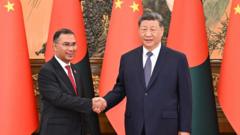
Bangladesh is operating on a razor-thin margin of economic survival that renders conventional zero-sum geopolitical alignments obsolete. Following the domestic political upheaval that displaced the previous regime, the government led by Prime Minister Tarique Rahman faces a dual crisis: an economy under structural stress and a stark geographic dependency on an uneasy neighbor. Dhaka’s recent executive decisions—granting China the economic zone project at Mongla Port and initiating a technical study for the Teesta River Comprehensive Management Project—are not signals of ideological realignment. They are the calculated outputs of a state executing a high-stakes balancing formula: importing capital from Beijing to stave off insolvency while rebuilding minimal security and trade arrangements with New Delhi.
Understanding this dynamic requires discarding the superficial narrative of a country "choosing sides." Instead, the situation must be evaluated through the lens of asymmetric economic needs, structural trade deficits, and geography.
The Asymmetric Capital Formula
Dhaka's foreign policy is dictated by its balance of payments and immediate domestic employment requirements. The current administration inherited an economy projected by the World Bank to slow to 3.9% growth, paired with an exit from its previous $5.5 billion IMF lending arrangement in pursuit of a restructured reform framework.
To prevent domestic destabilization, the state must maximize infrastructure utilization and industrial employment. This creates a specific demand for capital that India cannot meet, but China is structured to supply.
The Import Dependency Bottleneck
The structural reality of Bangladesh’s manufacturing sector, particularly its Ready-Made Garment (RMG) industry, creates an irreversible reliance on Chinese supply chains.
- The Input Imbalance: Bilateral trade with China reached Tk 2.246 trillion, compared to India’s Tk 1.463 trillion. Bangladesh's industrial base depends fundamentally on Chinese machinery, intermediate chemical inputs, and raw textiles.
- The Project Delivery Metric: Chinese state-owned enterprises operate with a liquidity and deployment velocity that regional alternatives lack. Between 2016 and 2025, Chinese capital injections exceeded $11 billion across power generation, transport, and water infrastructure.
The allocation of the Mongla Port economic zone to China—a site previously earmarked for Indian development—demonstrates that allocation decisions are determined by execution speed and financing volume rather than diplomatic sentimentality. By establishing a Chinese Economic and Industrial Zone (CEIZ) in Chittagong and upgrading Mongla, Dhaka is attempting to secure a manufacturing multiplier effect to absorb a growing domestic labor surplus.
The Teesta River Paradox and Border Security Cost Functions
Geography dictates that India remains Bangladesh's primary environmental and territorial risk factor. The decision to permit Chinese technical involvement in the Teesta River Comprehensive Management and Restoration Project represents a major policy shift, deliberately testing New Delhi’s red lines.
The Geopolitical Friction Points
[Siliguri Corridor / "Chicken's Neck"]
               │
      (Strategic Vulnerability)
               │
               ▼
       [Teesta River Project] <─── (Chinese Feasibility Study & Engineering)
               ▲
               │
      (Water Flow Control)
               │
               ▼
          [Bangladesh]
The Teesta River is a critical agricultural lifeline for northern Bangladesh. Decades of stalled water-sharing negotiations with India have left Dhaka vulnerable to seasonal droughts and sudden water releases. Engaging Beijing to execute a comprehensive treatment, river dredging, and flood-prevention network introduces a highly capable engineering partner into a zone less than 100 kilometers from India’s Siliguri Corridor, or "Chicken's Neck." This narrow strip of land connects mainland India to its northeastern states.
The strategic cost function for New Delhi is severe. From India's perspective, Chinese engineering footprints near this frontier constitute a structural intelligence and military risk. Bangladesh’s calculus, however, assumes that India's anxiety over Chinese proximity will force New Delhi to offer better economic concessions or formalize water-sharing terms that it previously delayed.
The Indian Re-Calibration and Boundary Constraints
New Delhi has recognized that its past policy of exclusive alignment with a single political faction in Dhaka has backfired. The post-uprising landscape forced a shift from comfortable diplomatic monopoly to defensive diplomatic management.
India’s strategy relies on structural leverage points to maintain its influence:
- The Energy Pipeline and Transit Vector: India holds significant leverage over Bangladesh's energy security through transborder pipelines. When domestic fuel shortages threatened Dhaka's stability, Delhi maintained cross-border fuel supplies, proving its value as a literal utility provider.
- The Visa and Commercial Exchange Mechanism: The resumption of Indian tourist visa applications for Bangladeshi citizens, coupled with the appointment of a high-ranking High Commissioner in Dhaka, signals an economic truce. Millions of Bangladeshis rely on India for healthcare tourism, retail commerce, and educational access. By offering Yunnan province as an alternative destination for medical tourists via agreements with Beijing, Dhaka is trying to reduce this specific vulnerability.
- The Transshipment Bottleneck: India's withdrawal of Bangladesh's transshipment facility last year ended Dhaka’s ability to route export cargo through Indian land ports and customs stations to global markets. This bottleneck inflicts a direct financial penalty on Bangladeshi exporters, demonstrating the costs of alienating New Delhi.
Strategic Hedging Vulnerabilities
No silver bullet exists for a middle power positioned between nuclear-armed rivals. The current strategy pursued by the administration has three distinct structural limitations.
First, the debt-servicing ceiling. While Chinese investments provide immediate liquidity and infrastructure assets, the terms of these loans require high-yield repayment schedules. If the upgraded ports and economic zones fail to generate immediate foreign-currency export revenues, Dhaka risks entering a fiscal trap where new debt merely services old interest.
Second, the defense hardware trap. Bangladesh relies heavily on China for defense procurement, including a recent agreement to establish a domestic drone assembly capability. This reliance limits interoperability with Western and regional security systems. The United States’ recent offers of alternative defense systems underscore the pressure Dhaka faces to diversify its security architecture or risk Western trade sanctions.
Third, the Myanmar instability variable. The proposed economic corridor linking China, Myanmar, and Bangladesh to provide Beijing access to the Bay of Bengal remains structurally unfeasible. The ongoing civil war in Myanmar renders any cross-border supply chain highly unstable, making this corridor more of a diplomatic talking point than a real economic solution.
The Strategic Playbook
Bangladesh must optimize its position by enforcing strict transparency frameworks. To prevent infrastructure from turning into strategic liabilities, Dhaka needs to mandate open, competitive bidding on all subsequent phases of the Mongla Port and Teesta River projects.
The administration must use China’s willingness to fund heavy infrastructure as leverage to negotiate better terms with India on water rights and border security. At the same time, it should offer India equal investment rights in manufacturing zones outside of strategically sensitive areas. If Dhaka allows its territory to be integrated into an exclusive, China-centric economic and security network, it will trigger defensive countermeasures from India and the United States. This would jeopardize the Western export markets that sustain its economy.
Autonomy for Bangladesh is maintained not through isolation, but by making its infrastructure too valuable for either regional power to destabilize.