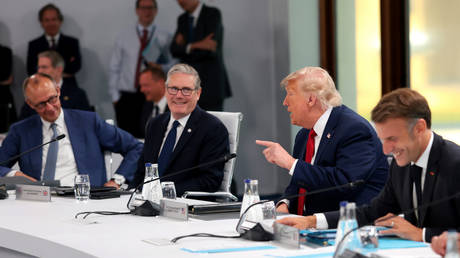
The imminent collapse of Keir Starmer’s premiership represents more than a localized leadership crisis in Downing Street; it is a structural manifestation of a broader macroeconomic and geopolitical squeeze. When US President Donald Trump publicly forecasted Starmer’s resignation via Truth Social, citing failures in immigration and energy policy, he did not trigger the crisis. Instead, the intervention merely exposed the absolute depletion of political capital that occurs when a state’s domestic policy constraints collide with changing international realities.
The unraveling of the Labour administration can be quantified through two primary friction points: the domestic structural bottleneck that enabled an internal party coup, and the international alignment breakdown that stripped the executive of its global leverage.
The Mechanics of Internal Displacement: The Burnham Lever
The direct catalyst for Starmer's political insolvency is not public disapproval alone, but a calculated institutional maneuver engineered within his own party. The return of former Greater Manchester Mayor Andy Burnham to the House of Commons via the Makerfield by-election provides a precise mechanism for leadership replacement under Labour Party rules.
By winning 55% of the vote in a seat specifically cleared to facilitate his return, Burnham bypassed the classic limitation faced by external party rivals: the constitutional requirement that a leadership challenger must be a sitting Member of Parliament.
This internal challenge operates on a clear cost function for backbench lawmakers:
- The Baseline Equation: Lawmakers calculate the probability of retaining their seats based on the current executive’s popularity vs. the expected electoral dividend of a challenger.
- The Squeeze: With Reform UK consistently leading nationwide polling and the Green Party draining liberal voters, the perceived electoral risk of maintaining the status quo exceeded the risk of a chaotic mid-term leadership contest.
- The Tipping Point: The resignation of key figures, such as former Health Secretary Wes Streeting, signaled that the cabinet’s internal defensive cohesion had completely failed, turning a structural vulnerability into an open succession race.
The Transatlantic Disalignment Vector
While domestic political commentators focus on internal party rules, the terminal decline of Starmer's authority accelerated due to a profound strategic misalignment with Washington. The doctrine of the "Special Relationship" operates under a basic transactional framework: secondary powers exchange strategic geopolitical compliance for economic and security guarantees. Starmer's administration miscalculated the cost of non-compliance.
The first major fracture occurred in March 2026 over operational access to the Diego Garcia airbase in the Indian Ocean. By initially withholding permission for the United States to utilize the base for strike operations against Iran, citing international legal concerns, Starmer created a permanent diplomatic bottleneck.
[UK Strategic Choice]
       │
       ├─► Initial Refusal ( Diego Garcia Access denied due to legal risk )
       │         │
       │         └─► Result: Disruption of US Operational Timelines; Loss of Washington Trust
       │
       └─► Belated Acceptance ( Restricted to "Defensive" Strikes )
                 │
                 └─► Result: Perception of Executive Indecision; Zero Diplomatic Credit
Though Downing Street eventually conceded to "defensive" operations, the delay eroded trust with the Republican administration. The friction was compounded by a parallel diplomatic error: the appointment of Peter Mandelson as the UK Ambassador to the United States. This decision introduced severe reputational baggage into the diplomatic channel, generating friction with a Washington administration focused intently on counter-establishment politics. When the United Kingdom opted out of the subsequent joint US-Israeli military actions, the transatlantic security architecture broke down completely, leaving Starmer isolated during the subsequent G7 summit in France.
The Energy and Immigration Cost Functions
The public critique leveled by the US executive focused heavily on immigration and energy—specifically demanding that the UK "Open North Sea Oil." This critique targets a core economic vulnerability: the trilemma of balancing decarbonization, energy security, and industrial competitiveness.
Starmer's administration attempted to maintain a rapid green transition framework while simultaneously managing high domestic inflation. By restricting new production licenses in the North Sea, the government increased the state's reliance on imported energy, effectively making the domestic cost of living highly vulnerable to global wholesale price shocks.
Simultaneously, the administration failed to stabilize structural immigration patterns. In a highly anxious macroeconomic environment, the visible inability to control border inflows created an ideal environment for the growth of populist alternatives like Nigel Farage's Reform UK. The intersection of these two policy failures created a compounding feedback loop:
- Restricted Resource Extraction: Suppressing domestic fossil fuel production reduced direct state revenues and increased energy input costs for domestic manufacturing.
- Fiscal Strain: Rising structural costs reduced the capital available to repair degraded public services, notably the National Health Service.
- Electoral Leaks: Discontented working-class voters migrated toward anti-immigration parties, while progressive voters defected to the Greens over perceived compromises in climate execution.
The Strategic Play
The United Kingdom is now poised to install its seventh prime minister in a single decade. This rate of institutional turnover creates a profound instability discount for international capital markets. For any incoming executive—whether Andy Burnham or a compromise candidate—the immediate tactical blueprint requires an optimization of the state’s primary structural relationships.
The next Prime Minister cannot rely on a rhetorical reset; they must execute a cold, transactional realignment. First, the executive must offer immediate, unhedged clarity on strategic military assets, explicitly repairing the Diego Garcia precedent to re-establish deterrence integration with Washington. Second, domestic policy must shift toward economic pragmatism; this means decoupling energy security from ideological timelines by pragmatically greenlighting North Sea extraction to lower industrial input costs.
Ultimately, the Starmer premiership serves as a stark demonstration that in the modern geopolitical arena, a massive legislative majority offers no protection if an administration cannot manage its structural dependencies.
For a deeper look into how geopolitical shifts are reshaping European governance, the analytical breakdown in Keir Starmer's Resignation Timetable Analysis outlines the immediate timeline of the transfer of power in Whitehall.


