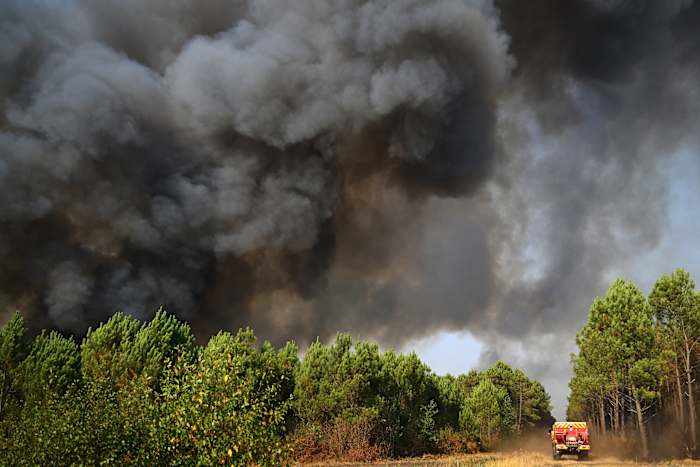
Emergency management operations follow a predictable decay curve once acute disaster phases transition into repopulation protocols. The recent large-scale evacuations across southern France caused by aggressive Mediterranean wildfire activity provide a stark operational study. Tens of thousands of displaced residents moving from temporary shelters back to primary residences represent a logistical vector often misunderstood in public discourse as a simple binary switch.
Recovery requires a multi-tiered validation sequence before civilian reintegration can occur safely. When meteorological variables shift—specifically when ambient temperatures drop, humidity levels rise, and wind vectors decelerate—civil protection authorities initiate a staged rollback of evacuation zones. This process tests the structural limits of municipal infrastructure, utility grids, and public health systems.
The Operational Mechanics of Wildfire Repopulation
Repopulating a disaster zone demands an explicit calculus balancing civilian safety against the pressure of housing displaced populations. Civil protection agencies measure risk through three distinct operational vectors: perimeter stability, infrastructure integrity, and environmental toxicity.
Perimeter stability relies on suppression holding actions rather than total containment. When firefighting aircraft and ground crews establish anchor points, incident commanders evaluate whether flare-up probabilities fall below a strict statistical threshold. A drop in temperature does not extinguish deep-seated root fires or smoldering peat beds. Instead, it reduces the rate of spread, buying time for tactical consolidation.
Infrastructure integrity determines whether a returning population can physically survive in the affected geography. A wildfire does not merely scorch flora; it compromises water distribution networks through localized pressure loss and electrical grid integrity through thermal damage to transmission lines. Chemical leaching from melted municipal assets can render local water supplies toxic until thorough flushing protocols are completed.
Environmental toxicity remains the least visible yet most hazardous variable. Soot, particulate matter smaller than 2.5 micrometers, and volatile organic compounds generated by burning synthetic building materials settle heavily over residential zones. Before civilian re-entry is authorized, environmental sanitation teams must confirm that air and soil contamination metrics meet baseline occupational safety standards.
The Economic and Logistical Friction of Mass Displacement
Displacement strains regional economies through immediate resource reallocation and long-term productivity loss. The financial footprint of housing tens of thousands of evacuees spans temporary municipal lodging, emergency feeding operations, and security deployments to prevent opportunistic property crime within abandoned zones.
Municipalities absorbing evacuees face acute resource bottlenecks. Hotel capacities in unaffected neighboring districts vanish within hours of an evacuation order, forcing governments to utilize sports complexes, exhibition centers, and temporary tented camps. Each day of displacement compounds the logistical expenditure geometrically, creating intense political and economic momentum to declare zones safe at the earliest viable meteorological window.
This urgency introduces operational risk. Premature repopulation exposes returning citizens to residual flare-ups, compromised sanitation, and psychological distress. Conversely, overly conservative re-entry protocols trigger friction with business owners and residents facing severe economic disruption and housing fatigue. Managing this friction requires transparent risk communication that treats civilian return as a phased deployment rather than a general amnesty.
Systemic Vulnerabilities Exposed by Mediterranean Pyrodynamics
The recurrence of intense wildfire seasons across southern Europe highlights structural vulnerabilities in regional climate adaptation strategies. Traditional firefighting models, built around rapid initial attack and localized suppression, are increasingly inadequate against mega-fires driven by prolonged drought and extreme heat domes.
Vegetation management policies often lag behind ecological shifts. Decades of fire suppression have allowed forest fuel loads to accumulate to unnatural densities. When ignition events occur under high wind conditions, the sheer thermal energy release overwhelms suppression assets, forcing a reactive posture focused purely on life safety and evacuation logistics rather than property preservation.
Urban-wildland interface planning further exacerbates the crisis. Residential expansion into heavily forested Mediterranean corridors creates complex defensive perimeters that are mathematically impossible to protect during peak fire behavior. Evacuation routes in these legacy regions are frequently restricted to narrow two-lane roadways, creating severe evacuation bottlenecks during sudden wind shifts.
Strategic Realignment for Future Displacement Events
Mitigating the systemic costs of wildfire evacuation requires shifting the operational paradigm from emergency response to predictive resilience. Municipalities must decouple evacuation execution from ad-hoc decision-making by codifying strict quantitative thresholds for re-entry.
Investment must prioritize real-time environmental monitoring networks capable of rapid deployment in post-fire zones to assess air and water toxicity within hours rather than days. Furthermore, upgrading communication infrastructure to ensure redundant warning channels during power grid failures remains essential for maintaining public trust and compliance during rapid-onset evacuations.
Urban planners must enforce stricter defensible space regulations and upgrade arterial evacuation corridors in high-risk zones to prevent gridlock. By treating displacement and recovery as quantifiable engineering problems rather than unpredictable natural disasters, regional authorities can compress recovery timelines and minimize the socio-economic damage of recurring climate volatility.