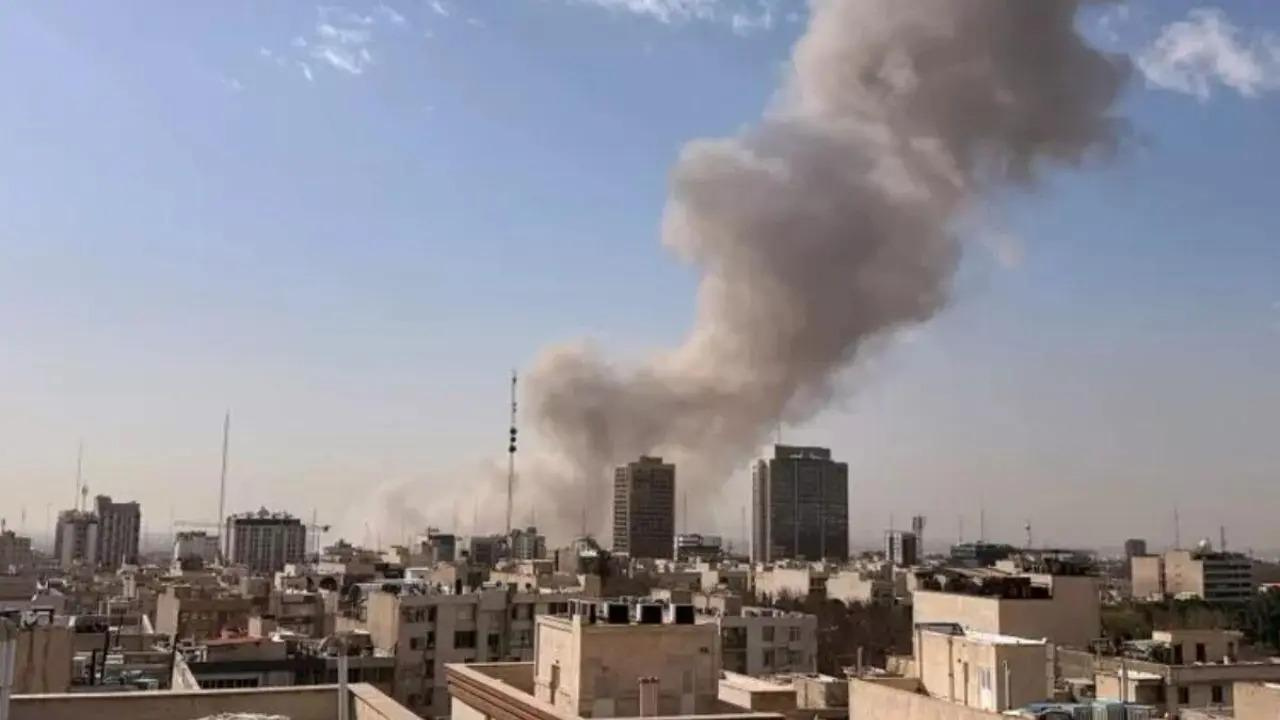
The recent Iranian missile strike targeting a Kuwaiti airbase highlights a critical, structural vulnerability in forward-deployed United States military infrastructure: the asymmetry between low-cost offensive saturation and high-value, unhardened logistical and unmanned assets. While mainstream reporting focuses on the immediate shock of personnel injuries and kinetic impact, a rigorous operational analysis reveals a more profound systemic vulnerability. The strike did not merely damage hardware; it exposed a failure in theater-wide integrated air and missile defense (IAMD) architectures to protect non-hardened, high-utility operational nodes.
To understand the strategic implications of this engagement, the incident must be broken down into three distinct operational vectors: the vulnerability of forward-operating drone infrastructure, the mechanics of theater air defense saturation, and the economic calculus of asymmetric attrition.
The Vulnerability of Unhardened Drone Infrastructure
Forward-operating bases in the Persian Gulf, particularly those historically viewed as secondary or logistics-heavy nodes rather than frontline combat garrisons, frequently lack the robust passive defense infrastructure found in high-threat theaters. Unmanned Aerial Vehicles (UAVs) like the MQ-9 Reaper or MQ-4C Triton require extensive physical footprints for maintenance, launch, and recovery.
This footprint creates a highly vulnerable target profile characterized by specific operational bottlenecks:
- Soft-Skinned Hangars: Unlike legacy manned fighter aircraft often housed in reinforced concrete protective aircraft shelters (PAS), long-endurance drones are frequently stationed in large, soft-skinned, or temporary fabric-tension hangars. These structures offer zero protection against kinetic impact, fragmentation, or blast overpressure.
- Maintenance Hub Concentration: High-altitude, long-endurance (HALE) and medium-altitude, long-endurance (MALE) drones rely on centralized, specialized ground control stations (GCS) and satellite communication data link terminals. Damaging a single GCS or maintenance depot neutralizes multiple aircraft simultaneously, even if those aircraft are airborne or parked elsewhere.
- Fuel and Payload Proximity: The infrastructure required to service these platforms—including aviation fuel storage and precision-guided munition depots—is often positioned adjacent to the runways for operational efficiency, creating a compounding secondary explosion hazard when targeted by precision ballistic or cruise missiles.
When an offensive strike successfully penetrates a base perimeter, the destruction of drone assets degrades theater intelligence, surveillance, and reconnaissance (ISR) capabilities. This disrupts the strike cycle, blinding command structures exactly when high-fidelity, real-time data is required to coordinate retaliation or defense calibration.
The Mechanics of Air Defense Saturation
The penetration of a well-defended airspace hosting American assets suggests a calculated exploitation of defense system limitations. Modern integrated air defense relies on a multi-tiered array of sensors and interceptors, typically combining systems like Patriot (PAC-2/PAC-3), Terminal High Altitude Area Defense (THAAD), and short-range defensive systems (C-RAM, Avenger).
A failure in this defensive umbrella occurs through three primary mechanisms:
[Offensive Swarm/Salvo]
       │
       ├─► Sensor Overload (Radar tracking limits exceeded)
       ├─► Interceptor Depletion (Magazine depth exhausted)
       └─► Low-Altitude Radard Horizon Exploitation (Terrain/Curvature masking)
Sensor Overload and Target Tracking Limits
Every radar system, regardless of its sophistication, possesses a finite capacity for simultaneous target tracking and engagement guidance. By utilizing a mixed salvo of short-range ballistic missiles (SRBMs), land-attack cruise missiles (LACMs), and low-slow loitering munitions, an adversary can exceed the maximum processing threshold of local engagement radars.
Interceptor Magazine Depth
The mathematical reality of air defense requires firing multiple interceptors per incoming target to ensure a high probability of kill ($P_k$). In a saturation attack, an adversary leverages cheap, low-tier projectiles to force the expenditure of highly expensive, limited-supply interceptors. Once the magazine depth of a local battery is exhausted, subsequent waves of precision missiles achieve unhindered access to the target area.
Low-Altitude Radar Horizons
Cruise missiles and loitering munitions exploit the radar horizon by traveling along low-altitude, terrain-following flight paths. In flat coastal regions like Kuwait, clutter and the Earth's curvature limit the detection range of ground-based radars. This compresses the defensive reaction timeline from tens of minutes to mere seconds, preventing optimal engagement sequencing.
The Economic and Operational Cost Function
The structural imbalance of this engagement model can be quantified through an asymmetric cost function. The financial and operational friction imposed on the defending force scales exponentially relative to the investment required by the attacking force.
$$\text{Asymmetric Attrition Ratio} = \frac{\text{Cost of Defense} + \text{Asset Replacement Value}}{\text{Cost of Offensive Salvo}}$$
On the offensive side, a modern short-range ballistic missile or precision cruise missile manufactured within a localized, vertically integrated defense sector may cost between $100,000 and $500,000. Loitering munitions often cost significantly less, sometimes dropping below $50,000 per unit.
On the defensive and asset replacement side, the financial equation shifts radically:
- Interceptor Costs: A single Patriot PAC-3 Missile Segment Enhancement (MSE) interceptor costs approximately $4 million to $5 million. Engaging a ten-missile salvo with standard two-shot doctrine costs upwards of $80 million in interceptors alone.
- Platform Attrition: A single lost or severely damaged MALE drone represents a capital loss ranging from $15 million to over $30 million depending on its sensor suite payload.
- Operational Footprint Reconstruction: The cost of repairing specialized runway infrastructure, replacing calibrated ground control stations, and medically evacuating or replacing highly trained personnel introduces frictional costs that cannot be easily amortized over a standard defense budget cycle.
This creates a negative economic feedback loop. An adversary can sustain a high-frequency launch cadence over months using a fraction of their national budget, whereas the defending force faces rapid depletion of both its immediate interceptor stockpiles and its specialized regional air frame inventories.
Regional Escalation Dynamics and Strategic Constraints
The selection of a base in Kuwait rather than a more direct deployment node in Iraq or Syria represents a calculated geopolitical maneuver. It signals a willingness to expand the geographic scope of conflict to traditional safe havens, challenging the security assumptions of Gulf Cooperation Council (GCC) partners.
This introduces distinct strategic constraints for regional actors:
- Host-Nation Sovereignty Friction: Countries hosting American installations face domestic and regional political pressure when those bases are used for kinetic counter-strikes. If hosting US assets shifts from a security guarantee to a kinetic liability, host nations may restrict the types of missions or platforms allowed to operate from their soil.
- Dispersal Logistical Bottlenecks: The standard military doctrine to counter precision targeting is dispersal—spreading assets across multiple smaller, austere fields rather than concentrating them at large hubs. However, the heavy logistical tail of drone systems, which require substantial maintenance equipment and secure data links, makes rapid dispersal exceptionally difficult to execute without a massive drop in operational sorties.
- The Deterrence Paradox: Deploying additional air defense batteries to protect these nodes draws critical assets away from other vital global theaters, such as Western Europe or the Indo-Pacific. This creates a dilemma where reinforcing a defensive position in one sector directly induces vulnerability in another.
Strategic Action Plan
To mitigate the systemic vulnerabilities exposed by this strike, defense planners must abandon the assumption of regional sanctuaries and pivot toward a resilient, high-attrition operational model.
First, implement immediate infrastructure hardening at all forward-operating locations in the Persian Gulf. Transition from temporary fabric structures to rapidly deployable, modular reinforced steel and concrete aircraft pens for all unmanned platforms. Prioritize the physical segregation of fuel depots and maintenance hubs from the primary flight line to prevent compounding blast damage.
Second, adjust the regional air defense doctrine from a reliance on expensive kinetic interceptors to a layered, deep-magazine architecture. Accelerate the deployment of high-power microwave (HPM) and directed-energy weapons to handle low-tier loitering munitions, preserving high-end Patriot and THAAD interceptors exclusively for hypersonic or ballistic profiles.
Third, decentralize drone operations by decoupling the launch and recovery phase from the mission control phase. Utilize localized, austere strips for the physical take-off and landing of aircraft via automated systems, while positioning the sensitive ground control stations and specialized maintenance personnel hundreds of miles away in heavily fortified or subterranean facilities. This ensures that even a direct, successful kinetic strike on a runway node yields nothing more than easily replaceable aluminum and composite airframes, rather than disabling core operational capabilities.