The United States Treasury Department's directive to evaluate the reallocation of $24 billion in frozen Iranian assets for Gulf state reconstruction is not a standard diplomatic maneuvering tactic. It represents the structural liquidation of a sovereign negotiating chip. By transforming these frozen revenues from a tradeable instrument of sanctions relief into an active pool for war reparations, Washington has fundamentally decoupled financial statecraft from conventional ceasefire sequencing. This strategic pivot structurally nullifies Iran’s primary negotiating leverage on Day 100 of the conflict, altering the economic parameters of Middle Eastern security.
The core mechanics of this confrontation rely on two entirely irreconcilable legal and financial claims over the exact same capital pool. To evaluate the strategic viability and systemic fallout of this policy, the situation must be disassembled into its structural component parts: the leverage conflict, the legal transformation mechanism, and the operational bottlenecks of execution.
The Zero-Sum Capital Pool: Competing Preconditions
The current diplomatic impasse between Washington and Tehran is defined by an absolute structural incompatibility regarding the sequence of economic and military concessions. The friction centers on $24 billion in frozen Iranian oil revenues, which both nations have designated as their absolute Phase 1 priority, albeit for diametrically opposed economic functions.
+---------------------------------------------------------------------------------+
|                               THE $24B CAPITAL POOL                             |
+---------------------------------------------------------------------------------+
|                                                                                 |
|   IRANIAN LEVERAGE STRATEGY                    US TREASURY DIRECTIVE            |
|   (Oman Counteroffer Framework)                (Asset Reclassification Protocol)|
|                                                                                 |
|   1. Immediate asset unfreezing                1. Quantitative damage auditing  |
|   2. Relief from maritime blockade             2. Sovereign asset conversion    |
|   3. Sanctions waivers on crude                3. Direct capital deployment     |
|                                                                                 |
|   OUTPUT: Capital injection into               OUTPUT: Permanent denial of      |
|           domestic war economy                 Tehran's non-negotiable asset    |
+---------------------------------------------------------------------------------+
The Iranian strategy, codified in its Oman-filed counteroffer, treats the asset pool as a baseline liquidity injection necessary to sustain its domestic war economy amid a 94% drop in commercial transit through the Strait of Hormuz. For Tehran, the release of these billions is the non-negotiable prerequisite before any technical de-escalation can occur, including the physical removal of naval mines or the restoration of commercial shipping lanes. The Iranian framework views asset repatriation as a mechanism to offset the structural damages of the U.S. and Israeli precision strikes on its domestic military infrastructure.
The directive issued by U.S. Treasury Secretary Scott Bessent fundamentally subverts this logic. Rather than treating the $24 billion as a concession to be traded, the Treasury’s asset reclassification protocol converts the capital pool into an indemnity fund for Gulf Cooperation Council (GCC) allies—specifically Kuwait and Bahrain—that have sustained infrastructure damage from Iranian ballistic missile and drone strikes. This maneuver removes the asset pool from the negotiating table entirely.
The strategy creates an immediate paradox: the very asset Iran requires to justify an exit from hostilities is systematically eroded to pay for the physical consequences of those hostilities.
The Cost Function of Regional Destruction
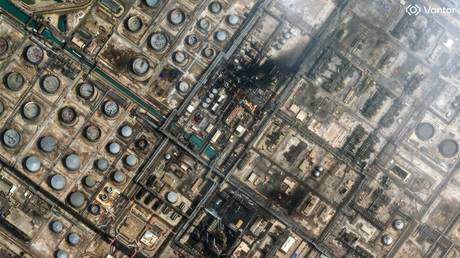
The financial pressure driving this policy stems from the severe economic burden shifted onto key U.S. security partners in the Gulf. Since the outbreak of hostilities on February 28, the economic impact on host nations of U.S. military installations has followed a clear cost function, driven by physical infrastructure degradation and macroeconomic stabilization demands.
- Direct Infrastructure Losses: Iranian retaliatory strikes have hit high-value regional targets, including energy infrastructure such as Qatari liquefied natural gas installations, commercial ports, and areas adjacent to Prince Sultan Air Base. Repairing these facilities requires immense capital expenditure that regional national budgets must absorb.
- Macroeconomic Liquidity Shocks: The localized conflict has driven Brent Crude to over $93 per barrel—a 30% surge from pre-war baselines. While higher oil prices historically benefit Gulf exporters, the physical restriction of shipping lanes and skyrocketing maritime insurance premiums have severely disrupted export volumes. This friction forced several Gulf states to request emergency currency swap lines from the U.S. Treasury to defend local market liquidity.
- The Valuation Mandate: The Treasury's directive commands officials to obtain granular, audited financial projections from partner nations regarding total expenditures required to repair infrastructure hit since February. This shifts the calculation from a vague political estimate to a formalized, quantitative claim.
By binding the volume of seized Iranian assets directly to the audited damage reports of GCC partners, the United States establishes a reciprocal cost function: for every strike Tehran executes against regional nodes, a proportional segment of its frozen capital is permanently extracted from the sanctions-relief pool and reallocated as Western-backed reconstruction capital.
Legal Realities and Enforcement Bottlenecks
While the strategic logic of converting frozen capital into war reparations is sound from a leverage perspective, the execution faces severe structural and legal limitations. International financial law distinguishes sharply between freezing assets as a temporary diplomatic leverage mechanism and permanently seizing or liquidating those assets for third-party reallocation.
The primary legal bottleneck rests on the nature of the holdings under review. The asset pool is fundamentally divided between two classes of capital, each presenting distinct enforcement profiles.
Liquid Financial Assets
These consist of cash deposits and sovereign debt instruments held within Western financial institutions or intermediate foreign central banks. While highly accessible for electronic transfer, reallocating these funds without a formal United Nations Security Council mandate or an internationally recognized claims tribunal risks fracturing the broader international financial architecture. It sets a precedent that could induce non-Western states to pre-emptively diversify away from dollar-denominated clearings.
Illiquid Physical Properties
This class includes captured physical assets, such as seized Iranian oil tankers and their underlying crude payloads currently held under U.S. maritime blockades. Liquidating these assets requires formal admiralty court forfeitures, a process notoriously prolonged by protracted international litigation. Selling seized crude into an already volatile energy market also presents complex commercial clearing challenges.
The Treasury Department must navigate these domestic and international statutory limits. If the legal machinery fails to provide an airtight framework for permanent asset transfer, the policy risks becoming a hollow threat that hardens Iranian resolve without delivering the necessary liquidity to rebuild Gulf infrastructure.
Structural Implications for the Ceasefire Framework
The immediate operational consequence of this financial strategy is the destabilization of the fragile, nominal ceasefire currently in place. Because the U.S. strategy eliminates Iran's primary economic incentive for peace, the conflict dynamics are reverting to rapid, tactical military exchanges designed to establish alternative forms of leverage.
This friction was clearly demonstrated when U.S. Central Command executed targeted strikes against Iranian coastal radar installations in Goruk and Qeshm Island to protect maritime lanes. Iran immediately countered by launching ballistic missiles at U.S. military facilities in Kuwait and Bahrain.
These rapid military exchanges reveal a critical flaw in the broader diplomatic track: regional combat operations have become deeply intertwined with broader financial and external geopolitical variables. Tehran’s insistence on linking any Gulf-wide progress to a comprehensive ceasefire involving Israel and Hezbollah, combined with Israel's stated intent to sustain independent operations, ensures that the physical theater remains highly volatile.
[U.S. Tactical Radar Strikes (Goruk/Qeshm)]
                 │
                 ▼
[Iranian Retaliatory Missile Barrages (Kuwait/Bahrain)]
                 │
                 ▼
[Treasury Reclassifies $24B Asset Pool to Pay for Damage]
                 │
                 ▼
[Tehran Negotiating Leverage Nullified]
                 │
                 ▼
[Diplomatic Deadlock / Escalation of Asymmetric Maritime Warfare]
The introduction of the asset-redirection strategy changes the calculus. Iran can no longer rely on a prolonged, low-intensity conflict to pressure the West into concessions via energy market disruption. If the path to reclaiming the $24 billion is permanently blocked by an ongoing reconstruction audit, Tehran's incentive structure shifts away from structured diplomatic settlements toward asymmetric maritime warfare designed to maximize the economic costs imposed on Western shipping.
The Strategic Path Forward
The United States cannot treat the reallocation of Iranian assets merely as an accounting exercise or a rhetorical deterrent. To avoid a permanent diplomatic deadlock that perpetuates a high-intensity energy shock, Washington must operationalize this policy through a disciplined, multi-layered framework.
First, the Treasury must prioritize the legal conversion of highly specific, liquid accounts where domestic executive authority is clearest, avoiding broad-spectrum seizures that threaten global central bank trust in dollar clearings.
Second, the valuation of Gulf war damages must be conducted by independent, international auditing firms to insulate the findings from charges of political inflation, establishing an undeniable, rule-of-law basis for the indemnities.
Finally, the United States must explicitly communicate to Tehran that the asset reclassification is an incremental, time-bound function. Washington must state clearly that while a baseline portion of the $24 billion has been permanently forfeited to cover current damages, the liquidation of the remaining capital pool will accelerate or freeze based on verifiable Iranian compliance with maritime freedom of navigation.
If Washington fails to couple the seizure of assets with a clear, alternative off-ramp for sanctions relief, it will leave Tehran with nothing left to lose—effectively ensuring the permanent collapse of the regional security architecture.