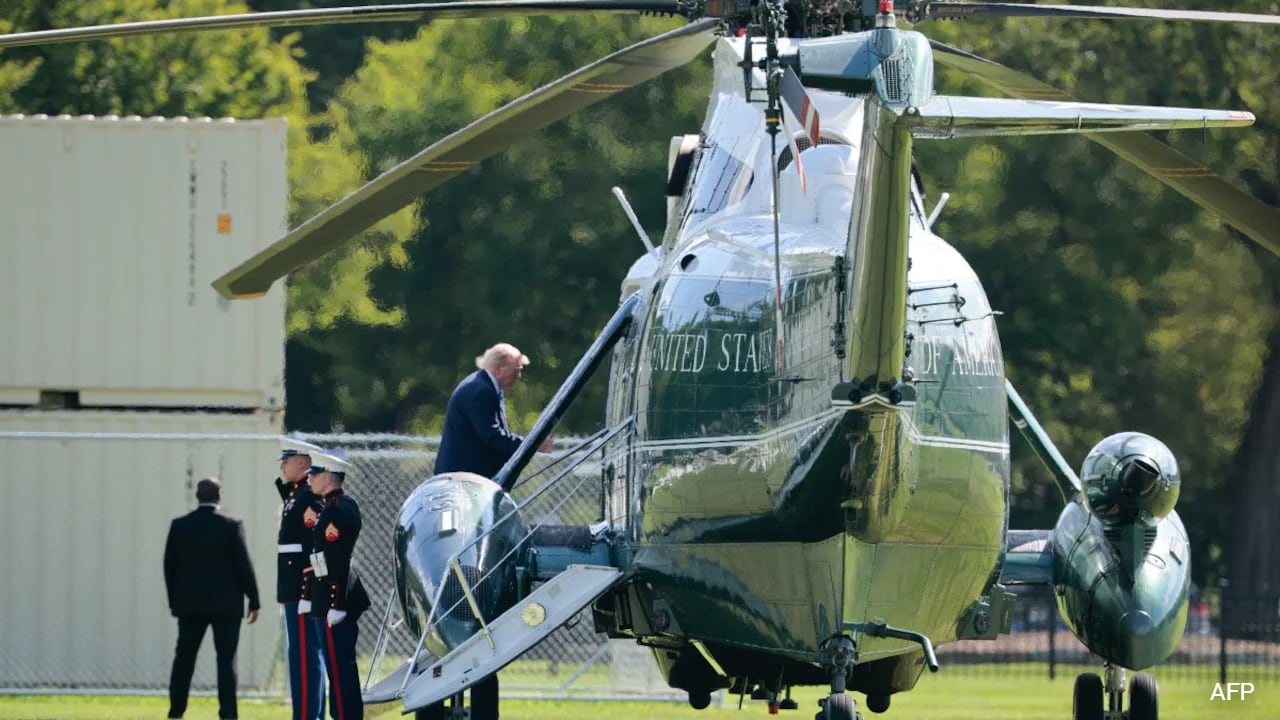
Operating aircraft inside the Washington, D.C. Special Flight Rules Area requires adherence to microscopic error margins. When Marine One carrying the president lifted off from the Ellipse while an Envoy Air regional jet departed Ronald Reagan Washington National Airport, the resulting proximity event triggered investigations from both the Federal Aviation Administration and the National Transportation Safety Board. Dismissing the episode as a routine hiccup ignores the systemic structural failures baked into high-density terminal environments. To understand why this separation breach occurred, one must deconstruct the operational variables governing military-civilian air traffic integration, communication loops, and procedural enforcement.
The Operational Mechanics of the National Capital Region Airspace
The airspace surrounding the United States capital functions as a hyper-constrained corridor where high-priority state transport intersects commercial aviation throughput. Ronald Reagan Washington National Airport operates under distinct geographical pressures, hemmed in by restricted zones, the Potomac River, and complex multi-agency jurisdiction.
Under baseline protocols, standard terminal separation requires maintaining specific minimums: typically 1.5 miles horizontally and 500 feet vertically between moving aircraft. When a presidential transport sequence initiates, the operational tempo shifts from standard scheduling to an exclusionary protocol. Commercial movements are supposed to freeze to create a sterile corridor for the military rotorcraft transit to Joint Base Andrews.
The failure mode during this specific event stemmed from a breakdown in the synchronization sequence. The Envoy Air Embraer E-170 departed Runway 1 concurrently with Marine One's transit corridor activation. Rather than a kinetic collision risk—given that the commercial jet was climbing above the helicopter's altitude vector, widening the physical gap—the systemic failure lies in the erosion of procedural buffer zones.
The Three Vulnerability Vectors in Air Traffic Control Coordination
Systemic breakdowns in aviation infrastructure rarely trace back to a single human error. Instead, they expose vulnerabilities across three distinct operational pillars:
- Communication Latency and Transmission Integrity: Transmissions between mobile presidential flight crews and fixed terminal towers are susceptible to auditory degradation. Audio logs indicate that Marine One pilots attempted multiple advance advisories regarding their impending lift-off time. When transmissions return as broken or unreadable to tower personnel, the temporal baseline shifts. The control tower operates on perceived intent rather than confirmed synchronization.
- Protocol Enforcement vs. Operational Momentum: Following historical safety overhauls designed to eliminate mixed traffic conflicts near the airport, rigidity is mandated. However, commercial scheduling demands high throughput. When departure queues back up—evidenced by the Envoy flight pushing back late from its gate—the cognitive load on air traffic controllers multiplies. Balancing a delayed commercial flight against a rigid presidential departure window creates a decision bottleneck where procedural halts can be inadvertently bypassed or mistimed.
- Inter-Agency Handoff Friction: Presidential transport involves overlapping jurisdictions between the White House Military Office, United States Marine Corps aviation units, and civilian FAA controllers. Each entity operates with distinct telemetry tools and priority hierarchies. When command-and-control loops lack unified real-time data feeds, synchronization relies entirely on voice communication, introducing an unacceptable margin of human error.
Evaluating the Cost Function of Regulatory Drift
Every aviation safety mandate carries an economic and operational cost function. Tightening restrictions around Reagan National Airport reduces airport capacity, increases taxi delays, and cascades schedule irregularities across commercial airline networks. Conversely, relaxing these parameters to optimize flow introduces catastrophic tail risk.
The cost of a false positive—halting commercial traffic unnecessarily for a presidential helicopter that is delayed or routed elsewhere—manifests as measurable financial loss and passenger disruption. The cost of a false negative—failing to halt traffic when separation minimums are compromised—manifests in catastrophic loss of life, as tragically demonstrated by prior mid-air incidents in the same sector.
When controllers allowed the Envoy jet to roll down the runway while Marine One was inbound, the system optimized for throughput over absolute isolation. The mathematical reality of a "momentary loss of separation" indicates that the buffer designed to absorb human and mechanical variance evaporated. Even though the aircraft were diverging vertically, relying on geometric divergence after a rule has been breached is an unacceptable substitute for preemptive separation.
Systemic Corrections and Strategic Implementation
Preventing future recurrence requires moving away from voice-dependent coordination toward automated, system-enforced boundaries.
- Implement Hard Geofenced Interlocks: Integrate automated software blocks between military flight plan activation systems and civilian tower departure clearances. If a presidential route is active, runway release buttons must be electronically interlocked to prevent clearance issuance regardless of controller input.
- Mandate Dedicated Transponder Integration: Ensure that primary and secondary radar feeds broadcast absolute positioning vector data directly to automated terminal collision-avoidance logic, removing auditory misinterpretation from the equation.
- Decouple Scheduling Dependencies: Treat presidential movements not as dynamic insertions into an active commercial schedule, but as absolute corridor closures that automatically pause airport departure queues 10 minutes prior to rotorcraft wheel-lift.
Eliminating friction in the national capital airspace demands a zero-tolerance architecture for procedural overlap. Safety margins are not negotiable variables to be balanced against airport efficiency.


