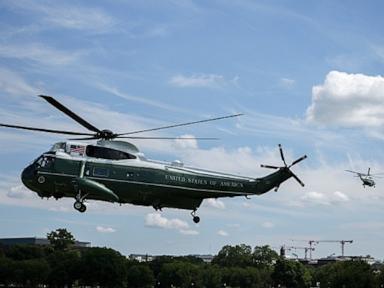
Low-altitude flight corridors in the National Capital Region operate under a zero-margin-of-error constraint. When President Donald Trump boarded Marine One on the White House lawn for a routine transit to Joint Base Andrews, systemic vulnerabilities in air traffic control execution manifested as a momentary loss of separation near Ronald Reagan Washington National Airport. While federal authorities and military spokespersons confirmed that the aircraft were never on a direct collision course, the procedural breakdown exposes systemic friction points in high-density airspace management. Deconstructing this event requires analyzing the communication bottlenecks, the operational protocols designed after previous tragedies, and the mechanical limits of urban airspace control.
The Protocol Failure Mechanics
Under Federal Aviation Administration mandates established following the January 2025 fatal midair collision near Reagan National Airport, commercial departures and arrivals must be halted whenever presidential or military rotorcraft transit critical local sectors. These protocols are designed to eliminate simultaneous occupation of proximate airspace by fixed-wing commercial jets and helicopters. In similar updates, we also covered: Inside the Bradley Creek Wildfire Crisis Left Burning in the Ashes.
The breakdown on Tuesday occurred not due to an absence of rules, but through a cascade of communication and coordination gaps between the cockpit and the control tower. The sequence of events highlights three distinct operational failures:
- Radio Transmission Degradation: Initial radio check-ins from the Marine One flight crew to the Washington National Tower were impeded by broken or unreadable signal transmissions, preventing a clean exchange of intent prior to liftoff.
- Ground Stop Omission: Air traffic controllers failed to implement the mandatory temporary ground stop for commercial operations before the presidential helicopter lifted off from the Ellipse.
- Reactive Traffic Warning: Rather than preventing conflict via pre-departure sequencing, the control tower was forced to issue tactical alerts mid-flight, warning the presidential helicopter that a regional jet was rotating off runway one.
This dynamic converted a deterministic safety procedure into a reactive adjustment. When the Envoy Air regional jet departed at 2:34 p.m., just moments after Marine One’s departure, the spatial buffer required under federal flight rules was compressed. BBC News has provided coverage on this critical issue in great detail.
The Cost Function of Urban Airspace Congestion
The airspace circumscribing the District of Columbia represents one of the most densely managed and topographically restricted zones in global aviation. The proximity of Reagan National Airport, the Pentagon, Joint Base Andrews, and the White House forces an immense volume of heterogeneous traffic through narrow altitude bands.
When evaluating the risk profile of this environment, safety functions as an inverse relationship between traffic volume and procedural adherence time:
Risk = (Traffic Density times Complexity) / (Communication Clarity plus Response Latency)
In this incident, response latency increased because the tower did not receive clear, advance notice of the departure sequence, or failed to process the incoming notification before clearance was issued to the commercial carrier. Although standard separation standards require maintaining specific horizontal and vertical buffers—typically 1.5 miles horizontally and 500 feet vertically—transitory bottlenecks in high-tempo environments consistently threaten these margins.
The inclusion of a secondary event—where a regional flight operated by Republic was instructed to circle out of caution before landing—indicates that the control bottleneck rippled outward, affecting subsequent traffic flow management.
Systemic Vulnerabilities and Mitigation Limits
The Federal Aviation Administration and the National Transportation Safety Board evaluate these anomalies through safety review teams to isolate whether the root cause stems from human error, protocol ambiguity, or technological limitations in radio hardware.
Relying solely on administrative mandates or post-incident reviews introduces significant limitations. Systemic interventions face structural barriers:
- Human Factors in Air Traffic Control: Controllers managing Reagan National face extreme cognitive loads, balancing high-frequency commercial slots with unpredictable military and VIP movements. Manual coordination remains susceptible to lapses during shift handoffs or communication dropouts.
- Hardware Impediments: Audio degradation on primary frequencies creates dangerous informational voids. When a pilot's transmission is unreadable, the burden shifts to immediate verbal confirmation, consuming precious seconds in compressed timeframes.
- Exemption Complexities: While commercial and private helicopter operations face strict limitations or bans around the airport following previous disasters, essential movements like Marine One retain exemptions that require dynamic, real-time schedule carving rather than static zoning.
Strategic Operational Adjustment
To eliminate future separation lapses during executive transits, aviation authorities must decouple safety margins from real-time verbal coordination between local towers and flight crews. The integration of automated, geofenced data-link triggers between presidential transport units and civilian control systems would remove the reliance on voice radio check-ins. When Marine One activates its departure sequence, automated system locks should instantly inhibit commercial clearance generation at Reagan National, rendering human omission structurally impossible.