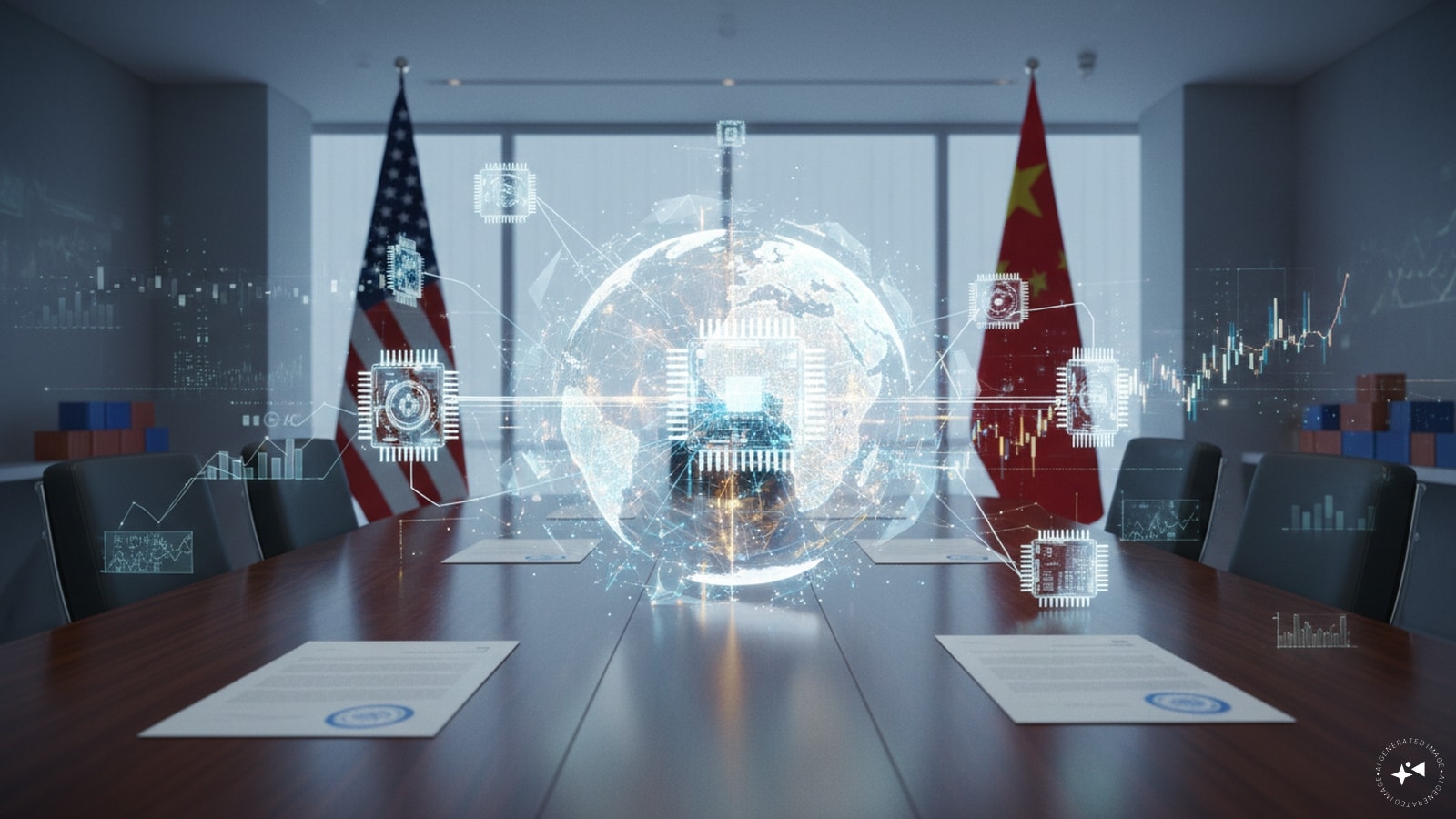
Everybody treats a Trump-Xi summit on artificial intelligence like a nineteenth-century arms treaty. Pundits imagine two leaders sitting across a polished table, trading access to advanced semiconductors for promises on military restraint. That framing misses the point entirely.
Global leadership in AI won't be decided by a handshake in a palace or a joint communiqué drafted by career diplomats. It's being decided right now in power grids, open-source developer forums, and export compliance offices from San Jose to Shenzhen. When Donald Trump and Xi Jinping meet to discuss artificial intelligence, they aren't negotiating a truce. They're trying to define the rules of an asymmetric race where neither side actually controls all the pieces. For a closer look into similar topics, we suggest: this related article.
If you've spent time around semiconductor supply chains or enterprise AI deployment over the past few years, you know how messy the reality on the ground actually is. Policy papers love clean binaries—American innovation versus Chinese scale, open models versus state control. In practice, those lines blur constantly.
Why Defining Global Leadership in AI at a Trump-Xi Summit Is So Complicated
Most coverage of US-China tech diplomacy assumes both leaders want the exact same thing: total dominance over frontier models. That's only half true. To get more background on the matter, extensive analysis can also be found at Ars Technica.
Washington wants to maintain a multi-year compute and model capability lead while preventing frontier systems from bolstering the People's Liberation Army. Beijing, facing years of tightening export controls under both the first Trump administration and the Biden administration, wants self-sufficiency in critical hardware and global adoption of its own open-weight ecosystems. Those goals collide at almost every chokepoint, yet they also create weird pockets of mutual dependence.
Consider the hardware reality. The United States still dominates the design of high-end AI accelerators through companies like Nvidia and AMD, alongside critical electronic design automation software from Synopsys and Cadence. Meanwhile, the physical manufacturing relies heavily on Taiwan's TSMC and Dutch lithography giant ASML. China, unable to legally buy top-tier EUV lithography machines or unrestricted H100 and Blackwell chips, poured tens of billions of dollars into domestic alternatives through its National Integrated Circuit Industry Investment Fund, often called the "Big Fund."
Huawei's Ascend 910B and subsequent iterations proved that Chinese engineers could build competitive AI training clusters using older deep ultraviolet (DUV) lithography and clever packaging, even if yields remain lower and power consumption runs higher. So when Trump and Xi sit down, Trump isn't holding a monopoly card anymore. He's holding a lead-time card. And lead times shrink fast when an entire industrial base treats survival as a national mandate.
The Compute Myth vs. The Energy Bottleneck
Ask a Silicon Valley founder what determines AI leadership, and they'll usually say FLOPs—floating-point operations per second. Ask an infrastructure engineer, and they'll laugh and point to a substation transformer.
Training and running frontier AI models requires staggering amounts of baseload electricity. According to data from the International Energy Agency, global data center electricity demand is on track to more than double between 2022 and 2026, driven largely by AI workloads. In the United States, hyperscalers like Microsoft, Google, and Amazon are scrambling to lock down nuclear power purchase agreements and bypass multi-year grid interconnection queues.
China doesn't have that permitting bottleneck. Over the past decade, Beijing built out massive ultra-high-voltage transmission lines and added more solar, wind, hydro, and nuclear capacity than the rest of the world combined. In western provinces like Guizhou, Inner Mongolia, and Gansu, state-backed data center hubs sit directly next to abundant, cheap electricity.
This creates an awkward dynamic for any Trump-Xi negotiation. Trump campaigned heavily on "energy dominance" and slashing permitting red tape to power American AI data centers. Xi already has the grid infrastructure built. You can't sanction megawatts.
The Three Real Flashpoints on the Negotiating Table
When you strip away the diplomatic posturing, any substantive AI discussion between Trump and Xi comes down to three concrete issues. None of them have easy fixes.
1. Semiconductor Export Controls and Transshipment Loopholes
Export controls are blunt instruments. Since October 2022, the Bureau of Industry and Security (BIS) at the U.S. Department of Commerce has repeatedly tightened rules on advanced logic chips and manufacturing equipment headed to China. Every time Washington lowers the performance threshold, Nvidia designs a compliant, slightly throttled chip for the Chinese market, and BIS eventually comes back to close that loophole too.
Meanwhile, gray-market smuggling and cloud access workarounds have thrived. Chinese researchers and startups have rented compute from data centers in Southeast Asia and the Middle East, or purchased small batches of restricted GPUs routed through shell companies.
At a summit, Xi's primary ask is predictable: ease export controls on commercial chips and semiconductor manufacturing equipment, or at least stop pressuring allies in the Netherlands, Japan, and South Korea to tighten maintenance restrictions on older DUV machines.
Trump's calculus is trickier. He views tariffs and export restrictions as leverage for broader trade deals—soybean purchases, fentanyl precursors, intellectual property enforcement, or TikTok's ownership structure. Hawkish advisors in Washington argue that trading away chip controls for agricultural purchases would be catastrophic for national security. Business leaders, including chip executives who lose billions in Chinese revenue, quietly argue that strict bans simply accelerate Huawei's domestic market share.
Honestly, both sides have a point. If you cut off a customer completely, you guarantee they build a competitor. If you sell them the best gear, you arm a strategic rival. There's no neat middle ground.
2. Open-Weight Models and Global AI Standards
Here's something most political commentators completely miss: China is winning hearts and minds in the global developer community through open-weight AI models.
While OpenAI, Anthropic, and Google keep their strongest frontier models proprietary behind APIs, Chinese labs like DeepSeek, Alibaba's Qwen team, and 01.AI have released remarkably capable open-weight models under permissive licenses. Developers in Europe, Latin America, Southeast Asia, and even inside American startups regularly download and fine-tune Qwen or DeepSeek models because they're cheap, transparent, and don't lock you into a single vendor's pricing.
Think about what that means for global leadership. Leadership isn't just having the smartest model locked inside a classified government facility in Virginia. It's setting the default software stack that millions of engineers build on every day.
If a bank in Jakarta or a logistics company in São Paulo builds its internal tools on top of an open-weight Chinese model, Beijing gains soft power, ecosystem influence, and subtle alignment advantages—even if the model runs on American GPUs. At a summit, Trump and Xi aren't going to ban open-source weights. You can't put math back in a bottle once the weights are on Hugging Face. Instead, the fight shifts to international standards bodies like the ISO and the UN, where Beijing actively lobbies to shape global AI governance frameworks in ways that favor state sovereignty over Western-style individual rights.
3. Military AI and Nuclear Command Guardrails
This is the one area where both leaders actually share a survival instinct.
In November 2023, Joe Biden and Xi Jinping agreed to launch bilateral talks on AI risks, which eventually led to a notable pledge in late 2024: both nations affirmed the need to maintain human control over the decision to use nuclear weapons, rather than delegating launch authority to autonomous AI systems.
Keeping that guardrail alive—and expanding it to autonomous drone swarms, cyber warfare, and biological design tools—is low-hanging fruit for a Trump-Xi summit. Neither leader wants an accidental escalation triggered by a hallucinating sensor fusion algorithm in the South China Sea or the Taiwan Strait.
The catch? Verification. You can inspect a nuclear silo from a satellite. You can't inspect weights on a server farm from orbit. Without intrusive inspection regimes that neither Beijing nor Washington would ever accept, bilateral safety pledges rely almost entirely on mutual self-interest rather than hard verification.
What Companies and Investors Keep Getting Wrong
Watching Washington and Beijing spar over AI makes a lot of executives freeze up or bet on the wrong horse. Over the past two years, I've seen three recurring mistakes across tech and policy circles.
First, people assume decoupling means total separation. It doesn't. Even as hardware supply chains split into "red" and "blue" stacks, global consumer markets remain intertwined. Apple still relies heavily on Chinese manufacturing and Chinese consumers while trying to roll out Apple Intelligence. Tesla builds cars in Shanghai while training Full Self-Driving neural networks on massive compute clusters in Texas. Any summit outcome won't reverse decoupling, nor will it achieve total separation. Expect "managed friction"—a messy, expensive middle state where compliance teams grow faster than engineering teams.
Second, analysts routinely underestimate algorithmic efficiency gains. When export controls hit, Western observers assumed China's AI progress would hit a brick wall due to a lack of top-end Nvidia clusters. Instead, scarcity forced Chinese labs to obsess over mixture-of-experts (MoE) architectures, quantization, and reinforcement learning techniques that squeezed near-frontier performance out of far fewer GPUs. DeepSeek's releases shocked Wall Street precisely because they proved raw compute isn't the only path to capability.
Third, people forget about data and real-world deployment. The U.S. leads in foundational research and enterprise software monetization. China leads in rapid physical deployment—autonomous robotaxis operating at scale in Wuhan through Baidu's Apollo Go, automated ports in Shanghai, and AI-driven factory robotics across Guangdong. Leadership looks very different depending on whether you measure software margins or physical industrial throughput.
How to Read the Signals Coming Out of the Summit
When headlines start pouring out of a Trump-Xi meeting, ignore the grand rhetoric about "historic cooperation" or "win-win frameworks." Look at the specific, boring details instead.
Watch what happens to the Entity List and BIS export rules in the 60 days following the summit. If the Commerce Department pauses planned updates to chip restrictions or grants new licenses for mid-tier accelerators, that signals Trump is using tech access as a bargaining chip for broader economic concessions. If new sanctions drop immediately after the photo ops, the hawkish national security wing in Washington won the internal debate.
Pay attention to tariffs on clean energy and hardware components. AI leadership isn't just about GPUs; it's about server racks, cooling systems, copper wiring, and battery storage. Broad tariffs on Chinese industrial inputs raise the capital expenditure required to build data centers in Ohio and Texas.
Look closely at bilateral working groups. Are the two sides only talking about abstract "AI existential safety," or are they discussing technical standards, intellectual property enforcement, and cross-border data flows? Talk about existential risk is cheap diplomatic theater. Talk about cross-border data flows and cloud access actually moves money.
Practical Moves If Your Business Touches AI or Global Supply Chains
You don't need a seat at the negotiating table to protect your organization from geopolitical whiplash. Whether you're building AI products, managing enterprise IT, or allocating capital, treat US-China AI rivalry as a permanent operating condition rather than a temporary storm.
Audit your model and vendor dependencies immediately. Know exactly where your inference runs, which foundational models sit underneath your wrappers, and whether your compliance rules allow using open-weight models originating from Chinese labs. Many U.S. defense contractors and regulated financial institutions already ban Chinese-origin weights even when self-hosted on American servers.
Build multi-model routing into your software architecture. Hardcoding your product to a single proprietary API—or a single cloud provider's custom silicon—leaves you exposed to pricing shocks, regulatory blocks, and supply shortages. Abstracting your inference layer lets you swap between proprietary American models and compliant open-weight alternatives in hours rather than months.
Track power and hardware lead times rather than press releases. If you're planning significant compute expansion, lock in capacity early and pay close attention to local utility constraints and tariff exposure on data center equipment. Diplomats will argue over who leads the world in AI for the rest of the decade, but the winners will be the operators who actually secured the power, the chips, and the distribution to ship working products.