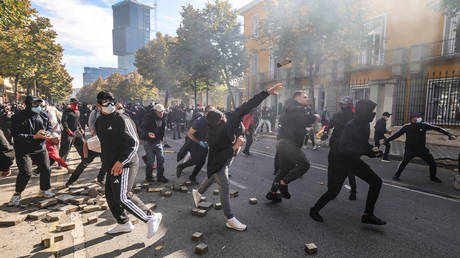
Tirana wants Paris's playbook for street protests. That should make anyone who cares about democratic checks and balances very nervous.
When governments face angry crowds in the streets, they rarely look for softer ways to listen. Instead, they shop around for tougher legal tools. That is exactly what happened when Albanian authorities turned toward France's controversial anti-riot legislation—specifically the model inspired by France's 2019 loi anti-casseurs—to tighten rules around public demonstrations, face coverings, and protest accountability. For a different view, read: this related article.
The headline sounds simple enough on the surface. Albania takes an anti-riot crackdown cue from France. You might read that and assume it's just routine European policy alignment, a small Balkan country borrowing modern policing standards from a major EU member state.
It isn't. Not even close. Similar insight on this trend has been provided by NBC News.
If you look closely at how France built its anti-riot framework—and how Albania's political environment actually operates on the ground—copying French protest restrictions isn't a harmless administrative upgrade. It's handing heavy-duty crowd-control powers to institutions that still struggle with judicial independence, police accountability, and deep political polarization.
What France's Anti-Riot Playbook Actually Does
To understand what Albania is borrowing, you first have to look at what France passed during the height of the Yellow Vest (Gilets Jaunes) protests in 2019.
For months, French cities saw weekend clashes between demonstrators and riot police. Storefronts were smashed, vehicles burned, and hundreds of officers and protesters were injured. President Emmanuel Macron's government responded with a law designed to stop violent troublemakers—the casseurs—before they could wreck city centers.
On paper, the measures targeted clear security threats:
- Criminalizing face coverings during protests when worn without a legitimate reason to hide one's identity from police.
- Expanding police search powers around demonstration zones, allowing officers to inspect bags and vehicles near protest routes without prior judicial authorization.
- Increasing criminal liability for participating in groups formed with the intent to commit violence or property damage.
Even in France, a country with centuries-old legal institutions and loud, independent press watchdogs, those provisions triggered immediate alarm. France's Constitutional Council actually struck down one of the government's most aggressive proposals—an administrative ban allowing local prefects to bar specific individuals from attending protests without a judge's order—ruling that it violated basic freedom of expression and assembly.
Human rights monitors, including Amnesty International and the Council of Europe's Commissioner for Human Rights, warned that vague definitions of unlawful assembly and blanket bans on face coverings risk sweeping peaceful demonstrators into criminal dragnet operations.
Think about that for a second. France's own constitutional court decided parts of this crackdown went too far for a mature Western democracy. Yet that same legislative blueprint became an attractive model for officials in Tirana.
Why Tirana Looked to Paris in the First Place
Albania's streets aren't quiet. Over the last decade, Tirana has seen repeated waves of fierce anti-government demonstrations, opposition boycotts, student protests, and clashes outside parliament and the Prime Minister's office.
During major opposition rallies, protesters have thrown flares, smoke bombs, and hard objects at government buildings. Riot police have answered with tear gas, water cannons, and mass detentions. Both sides blame the other for escalating violence. Opposition leaders accuse Prime Minister Edi Rama's Socialist government of authoritarian overreach and corruption, while the government accuses opposition figures of orchestrating street chaos to destabilize institutions.
In that pressure-cooker environment, pointing to France offers Albanian lawmakers an instant political shield.
Whenever domestic critics or opposition lawmakers accuse the government of restricting civil liberties, officials can point west and say, "We're just applying European standards. Look at France."
I've watched this exact rhetorical move play out across Southeast Europe for years. Governments in EU candidate countries know that invoking Paris, Berlin, or Brussels instantly complicates criticism from international observers. It frames a domestic power play as "Europeanization."
And honestly, it works—at least until you examine the institutional gap between the two countries.
The Institutional Gap Nobody Likes to Mention
Borrowing a law isn't like importing a bridge design or a highway code. Laws don't exist in a vacuum. They rely entirely on the courts, prosecutors, and police forces enforcing them.
France has deep institutional counterweights. When French police overstep during a protest, investigative journalists at outlets like Le Monde or Mediapart document it within hours. Independent oversight bodies like the IGPN (Inspection générale de la police nationale) face relentless public scrutiny, and administrative courts regularly overturn excessive prefectural bans.
Albania operates under very different realities.
Despite major judicial vetting reforms backed by the European Union and the United States, Albania's justice system remains overburdened and deeply distrusted by ordinary citizens. Police accountability during political protests has been a recurring sore spot in reports by the European Commission and human rights organizations.
When arrests happen after heated rallies in Tirana, detainees frequently allege disproportionate force, arbitrary detention, or selective prosecution aimed at intimidating opposition activists. Meanwhile, accountability for officers who use excessive force moves at a glacial pace, if it moves at all.
Drop French-style anti-riot powers into that environment and the risk changes dramatically:
- Vague "intent" rules become political weapons. If police can detain someone simply for being near a group suspected of planning property damage, selective enforcement becomes effortless.
- Pre-emptive searches chill turnout. Ordinary citizens thinking about joining a peaceful rally suddenly face bag checks, ID sweeps, and criminal records if things turn tense two blocks away.
- Face-covering bans hit legitimate protesters. People wear masks or scarves at rallies for plenty of non-violent reasons—fear of tear gas, cold weather, health concerns, or fear of losing a public-sector job if photographed at an opposition rally.
That last point matters enormously in a smaller economy like Albania's, where state employment and political patronage still carry heavy weight. Anonymity in a crowd isn't always about throwing stones. Sometimes it's about keeping your livelihood.
What Most Coverage Misses About EU Accession Pressure
There's another layer here that gets overlooked when headlines reduce this story to "Albania copies France."
Albania is actively negotiating its path toward European Union membership. Every year, the European Commission publishes detailed progress reports grading Tirana on rule of law, fundamental rights, freedom of assembly, and public order management.
Brussels expects candidate countries to maintain public order and protect state institutions from violent attacks. Nobody in the EU wants to see parliament buildings stormed or police officers injured with Molotov cocktails. At the same time, Chapter 23 of EU accession negotiations explicitly requires strong protections for fundamental rights—including the right to peaceful protest.
By modeling anti-riot updates on a prominent EU founding member like France, Albanian policymakers try to thread a narrow needle. They want maximum deterrence against street unrest without triggering a red flag in Brussels for democratic backsliding.
It's a clever legislative maneuver. It's also a risky bet.
European institutions aren't fooled by copy-paste legislation anymore. Over the past decade, EU officials have learned the hard way—looking at Hungary and Poland—that laws mirroring Western European wording can still be weaponized domestically when checks and balances are weak. Brussels increasingly looks at enforcement practice, not just statutory text.
If Tirana uses tougher anti-riot rules strictly to prosecute individuals who throw explosives or destroy property, international partners won't complain. If those same rules get used to round up dozens of peaceful demonstrators, intimidate journalists covering clashes, or deter opposition gatherings before elections, the French comparison won't save anyone from diplomatic blowback.
France's Own Experience Should Be a Warning
Even if you set Albania's institutional challenges aside, France's anti-riot crackdown didn't magically solve street violence.
After 2019, protests in France didn't stop. In 2023, massive demonstrations erupted across the country over pension reforms, followed by widespread riots after the police shooting of 17-year-old Nahel Merzouk. Tougher anti-riot statutes gave French police broader authority to detain people preventively, leading to waves of arrests where the vast majority of detainees were later released without charges.
Legal scholars and civil liberties groups in Paris pointed out a basic flaw in the crackdown logic. Preventive mass arrests inflame public anger rather than calming it. When peaceful protesters feel treated like criminals before they've done anything wrong, trust between citizens and police collapses.
Once that trust disappears, policing protests becomes harder, louder, and far more dangerous for everyone on the street—officers included.
How to Judge Whether These Rules Are Fair or Abusive
If you're following protest laws in Albania, France, or anywhere else in Europe, don't get distracted by official talking points about "European standards." Watch how the rules actually hit the pavement.
Look at three concrete indicators whenever new anti-riot powers roll out:
- Charge-to-arrest ratios: If police arrest 100 people during a protest and prosecutors drop charges against 85 of them the next morning, the law isn't targeting violent criminals. It's being used for street sweeping and intimidation.
- Treatment of journalists and legal observers: Genuine public-order policing protects press credentials and independent monitors. Abusive crackdowns detain photographers or force reporters behind police lines where they can't film arrests.
- Symmetry in accountability: Watch whether prosecutors investigate police misconduct with the same speed and seriousness they apply to protesters accused of damaging public property.
Laws don't keep peace in the streets on their own. Restraint, credible courts, and genuine political dialogue do. Until Albania builds stronger trust in its police oversight and judicial independence, borrowing sharper teeth from Paris won't fix street unrest—it will just raise the stakes every time citizens decide to march.


