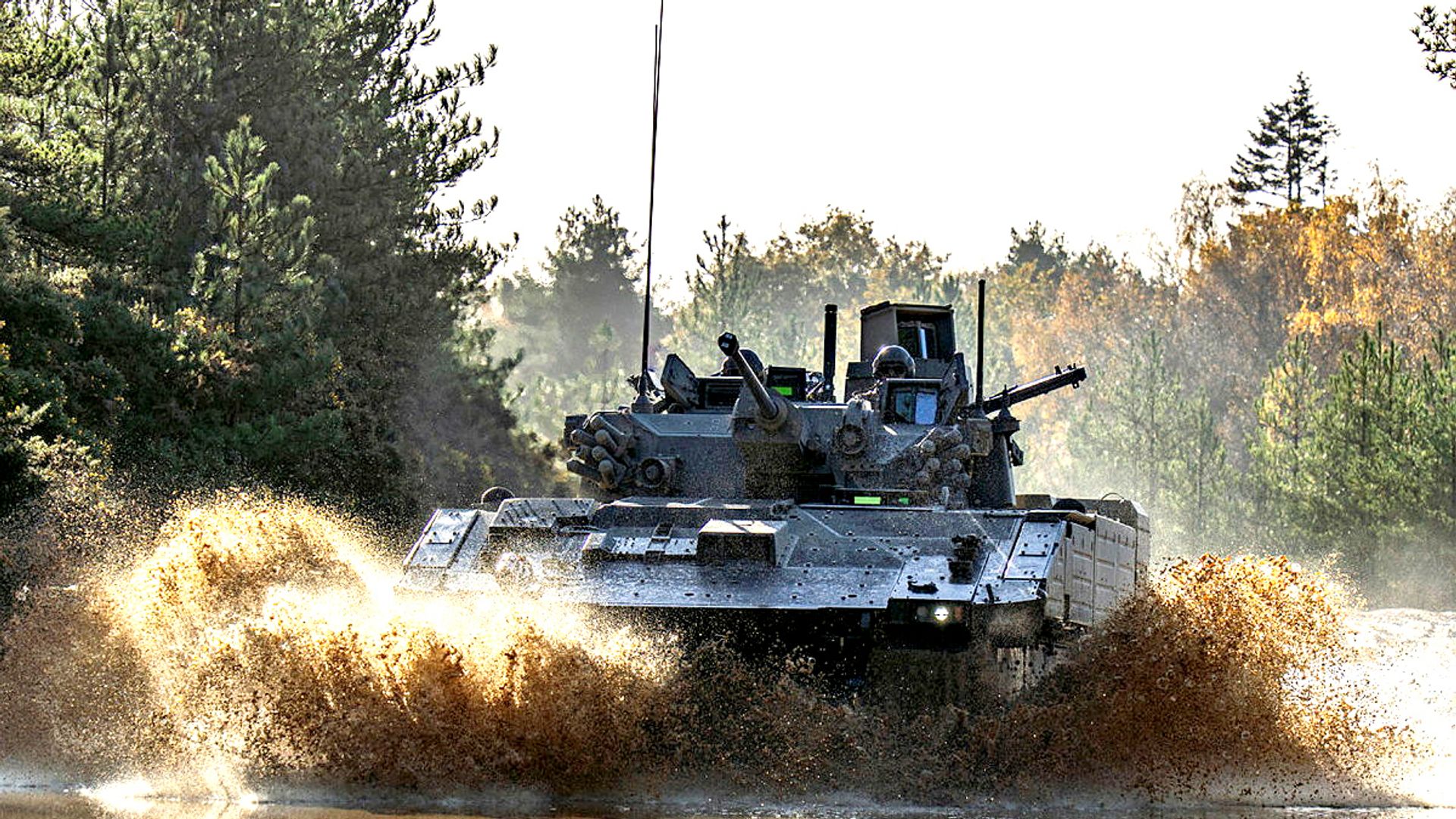
The British Army’s Ajax armored vehicle program represents a foundational case study in the systemic failure of "concurrency"—the attempt to overlap development and production phases in high-complexity hardware systems. While political discourse often centers on "cautious proceedings," the engineering reality is a fundamental mismatch between 21st-century digital sensor suites and 20th-century chassis kinetics. The program's stagnation is not a result of simple mismanagement, but of a failure to account for the physical feedback loops inherent in high-frequency vibration and acoustic resonance.
The Three Vectors of Mechanical Failure
The reported issues of excessive vibration and noise within the Ajax hulls are not superficial defects; they are systemic indicators of a failed integration of the General Dynamics Land Systems (GDLS) ASCOD chassis with British-specific requirements. These failures can be categorized into three distinct vectors:
1. Acoustic Energy Concentration
The Ajax was designed to be a "digital tank," featuring an unprecedented array of sensors and communication equipment. However, the internal geometry of the turret and hull acted as an accidental acoustic chamber. When the vehicle operates at speed, the mechanical energy from the power pack and the drivetrain converts into high-decibel internal noise. This is not merely a comfort issue. The acoustic pressure levels reached a threshold where they induced permanent hearing damage (tinnitus) in test crews, indicating that the energy dissipation strategy of the chassis was insufficient for the mass and power of the final build.
2. High-Frequency Vibration and Component Fatigue
Vibration in tracked vehicles is a function of the track-link pitch and the suspension’s dampening coefficient. In the case of Ajax, the vibration was so severe that it caused unpredictable failures in onboard electronics and stabilized weapon systems.
- The Harmonic Bottleneck: Every physical component has a natural resonant frequency. If the vehicle’s operating vibrations match these frequencies, the amplitude of the vibration increases exponentially.
- The Stabilization Deficit: The 40mm Cased Telescoped Cannon requires extreme precision. High-frequency hull vibration introduces "noise" into the stabilization algorithms, making it impossible to maintain fire-on-the-move accuracy without stressing the motors beyond their thermal limits.
3. Structural Weight Spirals
The original ASCOD chassis was designed for a significantly lower weight class. To meet British requirements for Protection (Level 4/5 STANAG), the Ajax grew to 42 tonnes. This mass increase altered the center of gravity and shifted the vehicle's "roll center," requiring a stiffer suspension. Stiffer suspensions transmit more ground energy directly into the hull, creating the very vibration issues that now haunt the program.
The Cost Function of Delayed Deployment
The decision to "proceed cautiously" is a tactical necessity, but it carries a compounding strategic cost. Procurement logic suggests that every year a platform remains in the trial phase, the "Unit Capability Cost" increases while the "Operational Relevance" decreases.
The Capability Gap Calculus
The British Army currently relies on the Warrior IFV, a vehicle designed in the late 1970s. The delay in Ajax creates a capability gap that cannot be bridged by software updates. The Warrior lacks the digital backbone required for Multi-Domain Integration (MDI). Without Ajax, the Army’s "Deep Reconnaissance Strike Brigade Combat Teams" exist only on paper. The hardware is the sensor; without the sensor, the network is blind.
Obsolescence at Entry
The Ajax project began in 2010. In the intervening 16 years, the nature of peer-to-peer conflict has shifted toward loitering munitions and First-Person View (FPV) drone saturation. A vehicle optimized for 2010 battlefield threats faces a high probability of being "obsolete on arrival" (OOA) if its electronic warfare and Active Protection Systems (APS) are not modular enough to adapt to these new threats. The rigid procurement cycles of the Ministry of Defence (MoD) make this modularity difficult to achieve.
The Concurrency Trap in Defense Procurement
The primary failure of the Ajax program was the decision to sign a production contract before the prototype had achieved "Final Design Acceptance." This is the Concurrency Trap. By the time the vibration issues were identified as systemic, dozens of hulls had already been manufactured.
The Cost of Retroactive Engineering
Fixing a vibration issue in a finished vehicle is an order of magnitude more expensive than fixing it in a CAD model or a technology demonstrator. It requires:
- Dampening Inserts: Adding mass to specific areas to shift resonant frequencies, which further taxes the engine and cooling systems.
- Structural Stiffening: Rewelding or reinforcing joints in existing hulls, which introduces heat-affected zones (HAZ) that may compromise the integrity of the armor.
- Software Filtering: Attempting to use algorithms to "cancel out" the physical vibration in the sensor feed, which introduces latency—a fatal flaw in high-speed engagement.
Technical Feasibility of the Minister's "Caution"
When a minister states that trials will proceed cautiously, they are referring to a rigorous "Noise and Vibration" (N&V) mitigation plan. This plan involves three specific engineering hurdles that General Dynamics must clear:
1. Seat and Headset Decoupling
The primary interface between the human and the machine—the seat—is being redesigned to include active or passive isolation. This decouples the crew from the hull’s vibration. While this protects the soldier, it does nothing to protect the vehicle’s sensitive electronics or the turret's mechanical accuracy. It is a mitigation of a symptom, not a cure for the disease.
2. Drivetrain Re-alignment
The power pack and transmission mounts are being re-engineered to absorb more kinetic energy. This involves changing the elastomer compounds in the mounts. If these compounds are too soft, they degrade quickly under field conditions; if they are too hard, they transmit vibration. Finding the "Goldilocks" dampening coefficient is the current technical bottleneck.
3. Track Link Geometry
The Army is testing different track designs to reduce the "clatter" frequency. By changing the pitch of the track links, the frequency of the vibration can be shifted outside the resonant range of the internal electronics. However, changing the track design has second-order effects on fuel consumption, top speed, and trench-crossing capability.
The Strategic Path Forward
The Ajax program is too expensive to fail but currently too flawed to succeed in its original vision. The "cautious proceeding" is a euphemism for a massive engineering rework.
To salvage the program, the MoD must pivot from a "Platform-First" mentality to a "Subsystem-First" mentality. This involves:
- Decoupling the Sensor Suite: Validating the digital architecture of the Ajax on other platforms or static rigs to ensure the software and ISTAR (Intelligence, Surveillance, Target Acquisition, and Reconnaissance) capabilities are ready, even if the hull is not.
- Accepting the Mass Penalty: Acknowledging that the vibration fixes will add weight, potentially pushing the vehicle toward 45 tonnes. This requires a reassessment of the bridge-crossing (MLC) and transportability constraints across Europe.
- Fixed-Price Contract Enforcement: Ensuring that the financial burden of the rework remains with the contractor. The current £5.5 billion contract is a "firm-price" agreement, meaning the taxpayer is theoretically shielded from the cost of these fixes, but the "Time Cost" remains an unhedged risk.
The ultimate viability of Ajax depends on whether the 2025-2026 trials prove that the N&V mitigations are permanent. If the vibration returns after 1,000 kilometers of cross-country driving, it will signal that the ASCOD chassis has reached its physical limit. At that point, the strategic recommendation must be a pivot to a "Boxer-derivative" reconnaissance vehicle or a total redesign of the hull, regardless of the political fallout. The friction of reality cannot be legislated or briefed away.