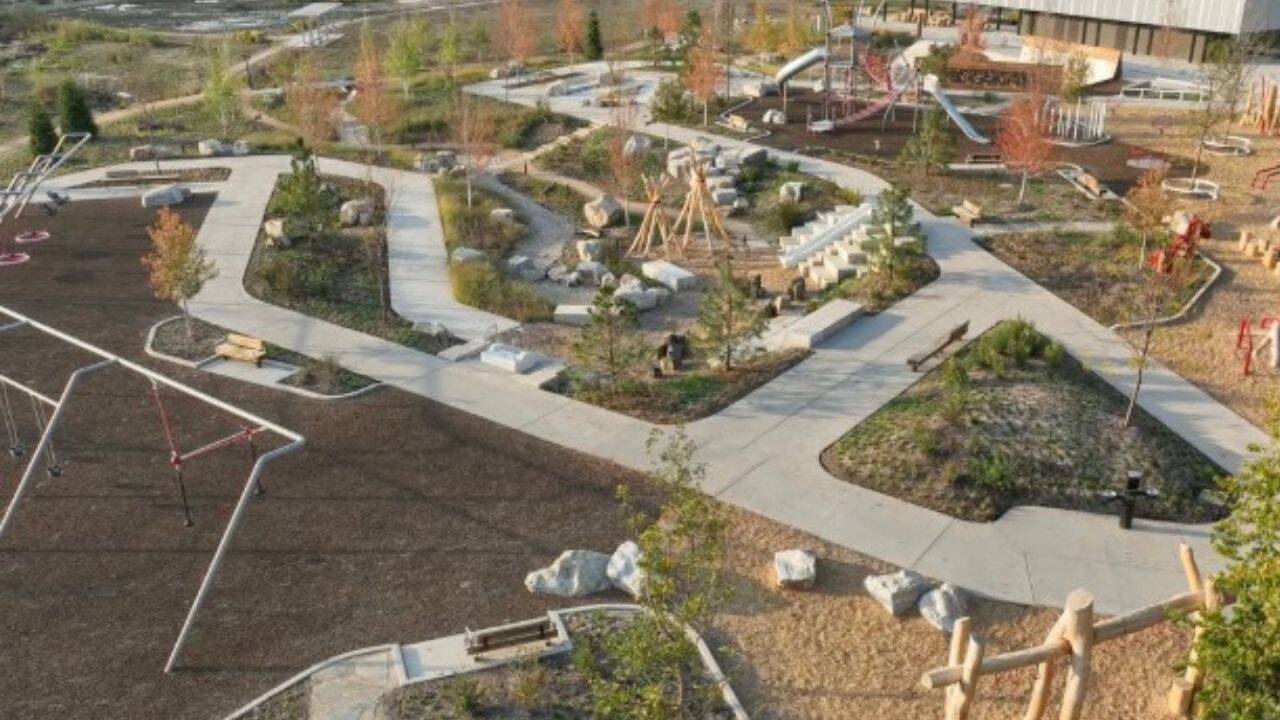
Converting a 50-acre dormant horse-racing facility in Idaho into a $42 million public park demonstrates a fundamental shift in municipal asset management: the transition from speculative, single-use entertainment venues to high-utility public infrastructure. When the track ceased operations in 2015, it left behind an underperforming land parcel burdened by specialized, depreciating structures and high carrying costs. Rather than allowing urban blight to depress surrounding property values or selling the acreage to low-density private developers, public stakeholders deployed capital to capture long-term civic and economic returns through adaptive reuse.
To evaluate the financial and operational logic of this redevelopment, one must strip away surface-level civic pride and examine the underlying real estate mechanics. The $42 million capital outlay—equating to $840,000 per acre—represents a deliberate restructuring of land yield.
The Structural Obsolescence of Legacy Racetracks
Live pari-mutuel horse racing in secondary North American markets suffered a systemic collapse throughout the 2000s and 2010s. The closure of this Idaho facility in 2015 was not an isolated operational failure; it was the predictable outcome of three converging economic pressures:
- Revenue Cannibalization: The proliferation of digital wagering, tribal gaming, and state lotteries eroded on-track attendance. Without high-volume foot traffic, auxiliary revenue streams—concessions, parking, and program sales—collapsed below the break-even threshold required to maintain the physical plant.
- Asymmetric Maintenance Liabilities: A 50-acre equestrian complex requires specialized, high-cost upkeep. Grandstands, barns, drainage systems for dirt or turf ovals, and expansive asphalt parking lots depreciate rapidly while offering zero utility during non-race days.
- Opportunity Cost of Urban Infill: As Idaho municipalities experienced rapid population growth and suburban expansion between 2015 and 2026, a 50-acre dead zone shifted from a peripheral curiosity to a prime infill bottleneck. Holding 50 acres of blighted land in a growing metropolitan area creates a negative externality, suppressing tax assessments on adjacent commercial and residential parcels.
Leaving the site dormant for a decade created a classic real estate stalemate. Private developers faced prohibitive demolition and environmental remediation costs—specifically dealing with decades of concentrated equine waste, fuel storage from maintenance equipment, and outdated asbestos-laden grandstand materials—before a single foundation could be poured.
Deconstructing the $42 Million Capital Allocation
At $840,000 per acre, a $42 million public investment requires rigorous justification. In municipal finance, this expenditure is not measured by direct cash-on-cash return via ticket sales, but through Tax Increment Financing (TIF) mechanisms, avoided infrastructure costs, and public health dividends.
1. Demolition and Site Remediation
A significant fraction of any brownfield or greyfield redevelopment goes underground before vertical construction begins. Removing legacy grandstand steel, breaking up acres of cracked asphalt, and regrading a banked oval track to establish natural water drainage absorbs substantial capital. Replacing impervious asphalt with permeable turf and bioswales directly reduces the municipality's stormwater management burden, lowering long-term utility maintenance expenses.
2. Multi-Use Civic Infrastructure vs. Single-Purpose Venues
The core failure of the 2015 racetrack model was low utilization—the asset sat empty for the vast majority of the calendar year. A modern 50-acre municipal park reverses this utilization curve through programmatic diversity:
- Passive Recreation Zones: Walking trails, open lawns, and shade structures serve daily local foot traffic at near-zero marginal cost per user.
- Active Athletic Facilities: Sports fields, courts, or skateparks generate scheduled, high-density usage across youth leagues and adult recreation, creating predictable weekend foot traffic that spills over into nearby retail corridors.
- Event Infrastructure: Amphitheaters or festival lawns allow the city to host seasonal concerts and markets, capturing tourism and hospitality tax revenue without the fixed overhead of maintaining a permanent stadium.
3. The Adjacent Property Value Multiplier
Urban economics consistently demonstrates the "proximate principle"—the documented phenomenon where high-quality public parks increase the market value of surrounding real estate within a 500-to-1,500-foot radius. By eliminating a 50-acre eyesore and installing a $42 million civic amenity, the municipality catalyzes private capital investment along the park's perimeter. As adjacent landowners redevelop aging commercial strips into higher-density residential or mixed-use projects, the resulting surge in property tax assessments services the municipal debt or replenishes the capital funds used to build the park.
Operational Realities and Execution Risks
While the strategic logic of converting a dead racetrack into a public park is sound, the transition introduces distinct operational liabilities that municipal managers must actively contain.
The Operating Expense (OpEx) Trap
Capital expenditure (CapEx) is politically popular; ribbon-cuttings generate immediate public approval. Operating expenditure is where municipal projects fail. A 50-acre park requires continuous irrigation, turf management, security patrols, restroom sanitation, and liability insurance. In Idaho's semi-arid climate, water allocation and drought-tolerant landscaping design are critical variables. If the park relies heavily on high-water bluegrass turf rather than native xeriscaping, summer irrigation costs will create a permanent drag on the city's parks and recreation budget.
Homelessness and Public Safety Management
Large urban parks without active programming and clear sightlines frequently become encampment sites, which rapidly degrades public perception and suppresses family utilization. Preventing this outcome requires Crime Prevention Through Environmental Design (CPTED)—eliminating blind spots, installing high-efficiency LED lighting, and ensuring continuous programmed activity from early morning through evening hours.
Historical Identity vs. Functional Utility
When redeveloping legacy sites, planners often face pressure to preserve historic structures, such as a dilapidated ticket booth or a section of the original grandstand. Unless those structures can be safely and economically integrated into a revenue-generating function—such as a café, equipment rental hub, or pavilion—preservation becomes an emotional tax on the project budget. Functional utility must override nostalgia.
Blueprint for Replicating Greyfield Civic Conversions
Municipalities sitting on dormant racetracks, fairgrounds, or dead shopping malls of similar scale (40 to 60 acres) should execute the following four-step acquisition and redevelopment sequence:
- Conduct a Phase II Environmental Site Assessment Early: Never finalize land valuation or construction budgets until soil borings confirm the exact cost of remediating legacy agricultural, automotive, or industrial runoff.
- decouple Land Acquisition from Build-Out:* Secure the acreage using land-banking funds or municipal bonds while land values are depressed by blight, then phase construction over three to five years to match cash flow and avoid supply-chain inflation spikes.
- Mandate Revenue-Generating Anchors: Designate 10% to 15% of the park's footprint for leaseable commercial concessions, private sports dome partnerships, or ticketed event spaces to offset annual groundskeeping OpEx.
- Upzone the Perimeter Simultaneously: Before breaking ground on the park, rezone the surrounding 1,000-foot buffer for high-density residential and mixed-use commercial development so the city captures the full tax increment generated by its own infrastructure investment.
The $42 million transformation of this 50-acre Idaho site succeeds if—and only if—the municipality treats the park not as a static patch of grass, but as an active economic engine engineered to maximize daily throughput and catalyze private development along its borders.