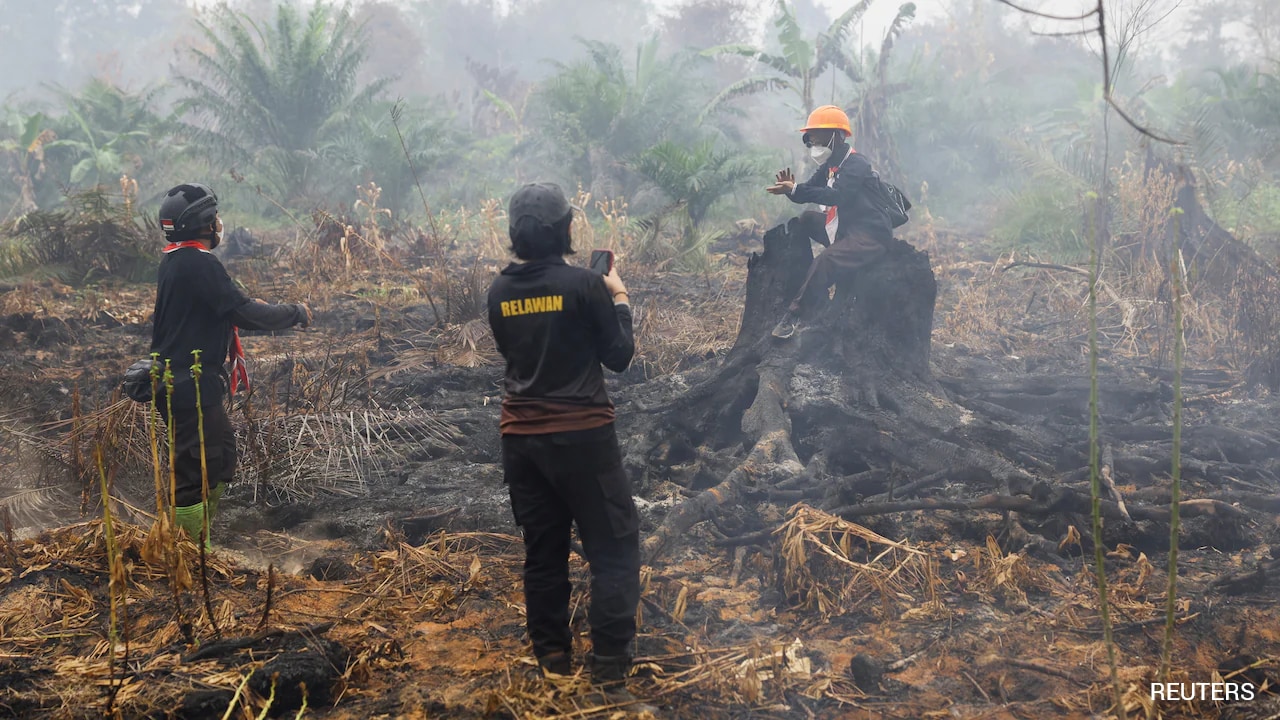
When tropical peatlands burn in Indonesia, the ecological recovery window is not measured in years or decades, but across three to four centuries. While surface vegetation can green over within a single rainy season, destroying the underlying peat dome eliminates millennia of accumulated organic carbon and alters the local hydrology so severely that the original swamp forest ecosystem takes roughly 350 years to regenerate. That timeline assumes the land is left entirely undisturbed—a condition rarely met in the world’s largest palm oil and pulpwood frontier.
Most coverage of Indonesia’s annual fire haze treats the crisis like a bad wildfire season in California or Australia. That is a fundamental misunderstanding of the chemistry and geology at play. You are not looking at a forest fire. You are looking at a slow-motion geological combustion event where the ground itself is the fuel. Don't forget to check out our previous coverage on this related article.
The Anatomy of an Underground Fire
To understand why recovery takes centuries, you have to look beneath the roots. Indonesian peatlands, concentrated heavily in Sumatra, Kalimantan, and Papua, are vast waterlogged basins filled with partially decayed plant matter. Over thousands of years, dead leaves, branches, and tree trunks fell into stagnant, oxygen-poor water. Because microbes could not break the material down quickly without oxygen, it compressed into dense, spongy layers of pure organic carbon, sometimes reaching depths of twenty meters.
In its natural state, a tropical peat swamp is virtually fireproof. It acts like a massive wet sponge, holding up to ninety percent water by volume. To read more about the history here, TIME offers an excellent summary.
Enter industrial drainage. To plant oil palm or acacia trees for paper pulp, companies and smallholders dig networks of canals to lower the water table. Water drains out into nearby rivers, exposing the ancient organic matter to air for the first time in millennia. The top layer dries into a brittle, tinder-dry crust. Once a spark hits—whether from an agricultural land-clearing burn that jumps its boundary or a discarded cigarette—the fire does not just race across the canopy. It burrows downward.
These subterranean fires smolder at lower temperatures than open flames, creeping laterally beneath the surface for months. Rainwater runs off the baked, hydrophobic top crust instead of soaking down to extinguish the embers. Even heavy monsoon downpours frequently fail to put out a deep peat fire; they merely dampen the surface while carbon continues to oxidize underneath, venting thick, toxic clouds of particulate matter and greenhouse gases into the atmosphere.
Why 350 Years Is an Optimistic Estimate
When environmental scientists model the 350-year recovery trajectory, they are tracking two distinct processes: biological succession and peat accretion.
Replanting trees is the easy part. Pioneer species—fast-growing ferns, grasses, and hardy scrub—colonize scarred earth within months. Within twenty to thirty years, a secondary forest canopy can re-establish itself, giving the illusion of recovery from the air. Satellite imagery often looks reassuringly green long before the ecosystem actually functions again.
Rebuilding the peat dome is another matter entirely. Tropical peat accumulates at an average rate of just one to two millimeters per year. A single severe fire event routinely burns away thirty to fifty centimeters of soil. Doing the basic arithmetic reveals the problem: half a meter of lost ground represents 250 to 500 years of biological accumulation erased in a matter of weeks.
Worse, fire changes the physical geometry of the landscape. When peat burns, the ground level drops—a process known as subsidence. Suddenly, the burned scar sits lower than the surrounding terrain. When the monsoon arrives, these sunken basins flood deeply and remain underwater for months at a time. Native swamp forest seedlings, which evolved to handle seasonal fluctuations rather than permanent deep submersion, drown. Instead of regenerating into a diverse, carbon-sequestering forest, the burned land often locks into an arrested state of degraded fern scrubland or open seasonal lakes.
The Carbon Accounting Trap
The atmospheric consequences of this slow recovery cycle distort global climate math. Indonesia holds roughly a third of the world’s tropical peatlands, storing an estimated 57 billion metric tons of carbon. When these domes burn, they release ancient carbon that was locked out of the atmospheric cycle long before human civilization existed.
During the catastrophic El Niño-driven fires of 2015, daily carbon emissions from Indonesian fires briefly exceeded the daily fossil fuel emissions of the entire United States economy.
Even if Indonesia halted every hectare of peatland deforestation tomorrow, the legacy emissions would continue for generations. Drained peat decomposes continuously through microbial oxidation, even without fire. Burning simply accelerates centuries of decay into a single dry season. Because the recovery rate of one millimeter per year is orders of magnitude slower than the rate of loss, every major fire year creates a permanent net deficit in the global carbon budget on any human policymaking timescale.
Follow the Canals, Not Just the Smoke
Blaming the fires solely on dry weather or El Niño cycles misses the structural driver. Drought provides the match, but infrastructure provides the fuel.
A satellite overlay of fire hotspots across Central Kalimantan or Riau Province maps almost neatly onto canal grids. The economic incentives driving this drainage are straightforward and stubborn. Global demand for cheap vegetable oil, soap, biofuels, and packaging cardboard continues to climb. Indonesia supplies more than half of the world’s palm oil, an industry employing millions and generating tens of billions of dollars in export revenue.
To illustrate how this plays out on the ground, consider a hypothetical smallholder farmer operating on the edge of a degraded concession. Clearing two hectares of scrubland by hand with machetes and chainsaws costs hundreds of dollars in labor and weeks of backbreaking work. Lighting a controlled burn on a dry afternoon costs nothing and leaves behind a layer of nutrient-rich ash that temporarily fertilizes the acidic peat soil. Even though Indonesia has strict laws banning the use of fire for land clearing, enforcement across millions of hectares of remote swamp remains nearly impossible.
At the corporate level, the dynamic is more complex. Major palm oil and pulp conglomerates have adopted strict "No Deforestation, No Peat, No Exploitation" policies under pressure from international buyers. Many now maintain sophisticated fire-fighting brigades, watchtowers, and drone surveillance systems. Yet fires still ignite inside or along the borders of their concessions. Why? Because once a drainage canal network is cut into a peat dome, hydrology does not respect property lines. A canal dug by an industrial plantation drains water from neighboring community lands three kilometers away, turning someone else's forest into a fire hazard.
The Limits of Rewetting and Restoration
Following the 2015 haze disaster, which sickened half a million people and drew furious diplomatic protests from neighboring Singapore and Malaysia, Jakarta established the Peatland Restoration Agency (BRG, later expanded to include mangroves as BRGM). The mandate was ambitious: restore more than two million hectares of degraded peatland through a three-pronged strategy known as the 3Rs: rewetting, revegetation, and revitalization of local livelihoods.
The engineering behind rewetting is conceptually simple. Teams build wooden, earthen, or compacted-peat dams—known as canal blocks—across drainage ditches to trap rainwater and raise the water table back to the surface. When the peat stays wet, it stops burning and stops oxidizing.
In practice, restoration has hit severe physical and political friction.
- Hydrological irreversibility: Peat that has been drained and burned repeatedly undergoes a chemical shift, losing its ability to absorb water like a sponge. Even after canals are blocked, water levels fluctuate wildly, drying out dangerously during prolonged droughts.
- Social resistance: Blocking a canal does not just flood the forest; it cuts off the primary transport highway used by local farmers to haul crops to market by boat, while simultaneously flooding agricultural plots planted by communities who depend on drained soil for cash crops like oil palm or rubber.
- Maintenance failures: Wooden canal blocks rot within a few years in the acidic, tropical heat. Without permanent funding and local buy-in, dams wash out during heavy rains, and the drainage resumes.
Satellite monitoring shows that while fire incidents have dropped significantly compared to the worst peaks of 1997 and 2015—aided in part by a string of wetter La Niña years and tighter corporate policing—hundreds of thousands of hectares still burn during every moderate dry season. The underlying landscape remains primed for disaster whenever the next severe El Niño stalls the monsoon rains.
What Actually Survives the Burn
Ecological recovery is not uniform across the archipelago, and treating all burned peatland as a total loss overlooks emerging models of adaptation.
Where peat fires are shallow and the water table is rapidly restored, native species like shorea balangeran—a hardy, flood-tolerant timber tree—can survive and form the backbone of a new swamp forest within decades. Researchers working in Kalimantan have found that assisted natural regeneration, where conservationists clear aggressive ferns around surviving native saplings rather than planting expensive nursery trees in neat rows, yields significantly higher survival rates at a fraction of the cost.
Meanwhile, a growing movement around paludiculture—wet agriculture—attempts to solve the economic trap without draining the soil. Instead of forcing dry-land crops like oil palm onto swamp ecosystems, agronomists are working with villages to cultivate native wetland species that thrive in saturated ground. Sago palms, illipe nuts, jelutung trees (which produce natural latex), and native freshwater fish farming offer viable income streams that keep the water table high and the carbon locked underground.
Yet paludiculture remains tiny compared to the industrial scale of palm oil. Supply chains, processing mills, and global commodity markets are built around the status quo. Until wet-peat commodities command comparable market access and financing, farmers and companies will continue fighting the natural hydrology of the islands.
A tropical peat swamp is an archive of deep time, built millimeter by millimeter while empires rose and fell. You can drain it in a season and burn it in a week, leaving behind a collapsed basin that no living person—and none of their great-grandchildren—will ever see restored to what it once was.