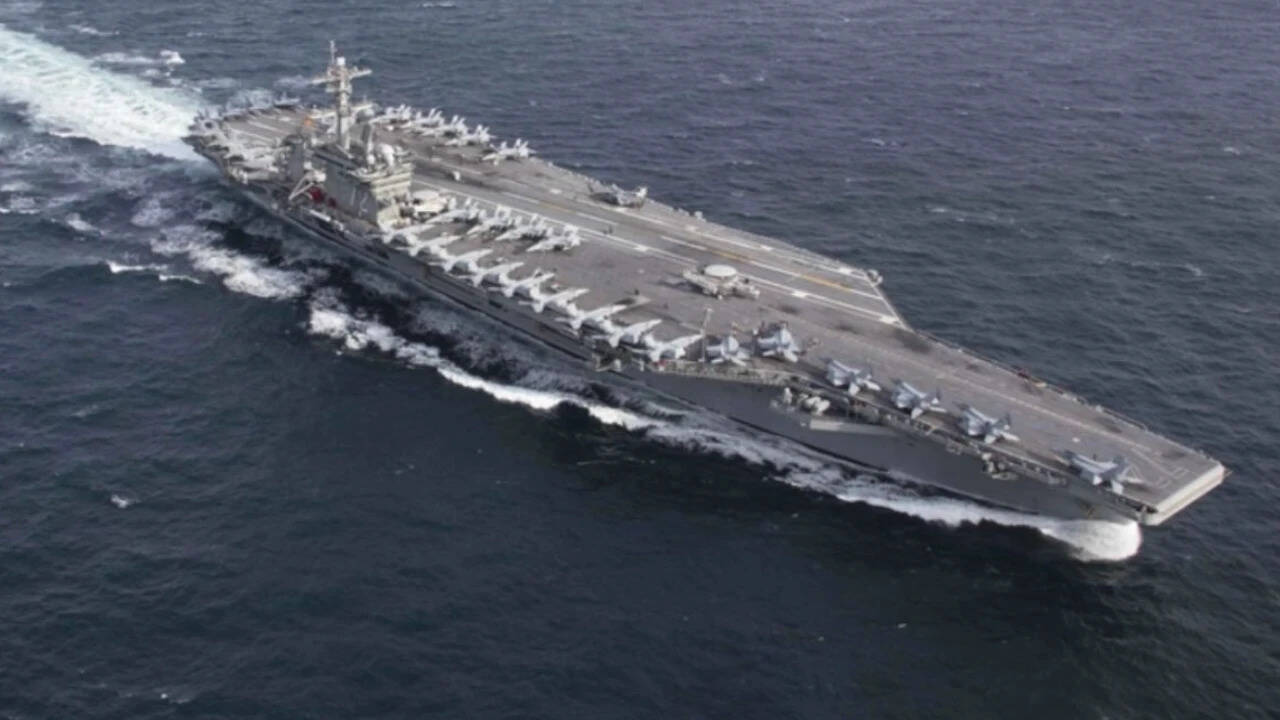
Every mainstream outlet covering the USS Abraham Lincoln carrier strike group return is running the exact same lazy narrative. Two hundred sixty-six days at sea. Extended rotations. Burnout headlines. Hand-wringing pundits asking if the Navy is pushing sailors too hard amid mounting scrutiny over fleet welfare.
They are asking the wrong question entirely. For a more detailed analysis into this area, we recommend: this related article.
The debate is not whether an extended deployment strains human capital. Of course it does. Living in floating steel tubes for over eight months breaks routines, frays nerves, and taxes families. But framing a 266-day cruise merely as an indictment of sailor welfare misses the structural crisis hiding in plain sight. The real story is not that a supercarrier stayed deployed for nearly nine months. The real story is that the United States Navy has so few operational hulls and so many simultaneous global flashpoints that a 266-day deployment has become the baseline arithmetic of survival.
When you hear people wringing their hands over deployment length, listen closely to what they leave out. They ignore the brutal math of fleet architecture, the erosion of industrial shipyard capacity, and the absurd expectation that a shrinking force can police an expanding map without burning out its people. For broader information on this development, in-depth coverage is available at TIME.
Let us dismantle the comfortable fiction that this is just a human resources problem.
The Myth of the Standard Rotation
For decades, the Pentagon operated on a predictable rhythm. The Optimized Fleet Response Plan promised a neat choreography of maintenance, training, basic phase, advanced phase, and deployment. Six to seven months out, home for the rest. It looked great on PowerPoint slides in Washington.
It also collided with reality.
I have spent years watching defense budgets get swallowed by administrative bloat while shipyard backlogs stretch into years. When you have thirty-one amphibious ships and eleven aircraft carriers to cover a globe that demands constant presence in the Red Sea, the Indo-Pacific, and the Mediterranean, the math stops working.
The lazy consensus says: Fix the morale by shortening deployments.
That sounds compassionate. It is also dangerously naive. If you shorten deployments without expanding the fleet or fixing maintenance delays, you create massive operational gaps. You leave theater empty. You invite aggression. Adversaries do not check the deployment schedule of the USS Abraham Lincoln before testing regional boundaries. They exploit vacuum.
Let us look at what actually happens when a strike group stays out past the standard window.
- Maintenance deferred: The ship absorbs accelerated wear and tear, pushing its next scheduled shipyard availability deeper into a congested queue.
- Optempo creep: Every extended day at sea means the subsequent training and reset cycle gets compressed, setting up the next crew for an even harder squeeze.
- Skill atrophy: While operating continuously in high-threat environments keeps watchstanders sharp on immediate defense, it starves the crew of complex, high-end integration training against peer competitors.
Yet the civilian commentariat treats these deployments as administrative choices rather than desperate emergency measures.
The Human Cost vs. Strategic Reality
Nobody denies the human toll. Talk to a sailor who missed a child's birth, a graduation, or a simple weekend on land during a nine-month stretch, and you will hear genuine frustration. Retention suffers. Mental health strains are real.
But pretending that cutting deployments short solves the crisis is like turning off the check-engine light to fix a blown transmission.
The Navy does not extend deployments because leadership enjoys torturing crews. They extend them because the alternative is telling the White House that a vital maritime chokepoint has zero coverage. The fault line does not run through the wardroom of the carrier; it runs straight through decades of congressional budget games, procurement delays, and strategic indecision.
Consider the replacement cycle. When a carrier returns after 266 days, the shipyard overhaul waiting for it is already backlogged. Workers are scarce. Parts are delayed. The industrial base lacks the surge capacity to turn ships around on schedule. When the inputs to the system are broken, the output will always be overextended sailors.
Focusing exclusively on the length of the cruise treats the symptom while ignoring the disease.
What the Pundits Get Wrong About Deterrence
A common refrain in coverage of extended naval deployments is that constant presence is failing because it does not stop regional conflicts from boiling over. Critics point to the Red Sea, the Taiwan Strait, and Eastern Europe, arguing that keeping carriers at sea for record-breaking durations has not deterred adversaries.
This argument misunderstands how hard power works in the twenty-first century.
Deterrence is not a magic shield that stops bad actors from trying things. It is the margin of safety that prevents local skirmishes from metastasizing into total war. When the USS Abraham Lincoln stays on station for 266 days, it is putting a thumb on the scale against miscalculation. It is providing airborne early warning, missile defense, and immediate strike options in volatile zones.
If you pull those assets early to satisfy a strict calendar quota, you gamble with strategic stability.
Imagine a scenario where the Navy pulls every extended strike group back right on schedule, leaving key theaters unshielded to prioritize crew rest. Within weeks, shipping lanes close permanently, regional proxies launch unchecked assaults, and allies lose faith in American security guarantees. The resulting geopolitical shockwave would dwarf the internal strain on the fleet.
That does not mean we should accept perpetual 266-day deployments as normal. It means we must be honest about the trade-offs.
The Uncomfortable Solution
If you want shorter deployments and healthier sailors, you have two choices: build more ships or do fewer missions.
There is no third option. You cannot squeeze infinite operational output out of a finite fleet without burning the people who operate it.
Yet neither political party wants to face this truth. Expanding the fleet requires massive, sustained capital investment in shipbuilding infrastructure, workforce training, and supply chains—investments that take a decade to bear fruit. Simultaneously downsizing global commitments requires a radical, bipartisan rethink of American grand strategy that neither hawks nor isolationists are prepared to manage.
So we get what we have now. Pundits write predictable columns about sailor welfare. Politicians issue stern statements of concern. And the Navy quietly keeps ships at sea past their expiration dates because the alternative is admitting that American global reach has outrun its industrial foundation.
Stop treating the 266-day deployment as an isolated HR scandal. It is the visible symptom of a hollowed-out maritime strategy trying to hold together a fracturing world with duct tape and caffeine.
Until Congress funds a larger fleet and fixes the shipyards, expect more record-breaking deployments, more exhausted crews, and more empty hand-wringing from analysts who refuse to look at the math.