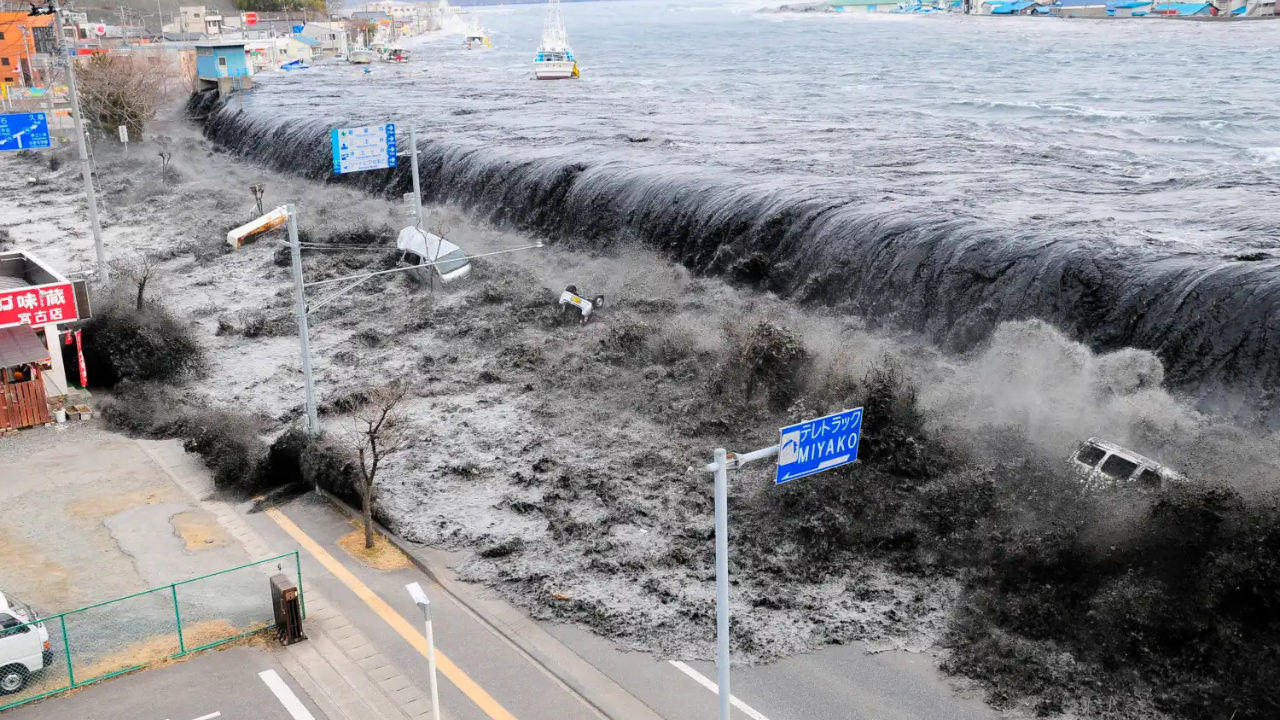
When the colossal magnitude 9.0 Tohoku-Oki earthquake ruptured off the coast of Japan on March 11, 2011, it didn’t just shake the ground. It violently redrew the map. The main shock instantly shoved parts of Honshu, Japan’s main island, up to 13 feet eastward into the Pacific Ocean.
But what happened next went unnoticed for over a decade.
Roughly 15 minutes after the initial terror subsided, GPS stations stretching from Hokkaido in the far north to Kyushu in the south registered a secondary, highly coordinated hiccup. Across a span of nearly 1,800 miles, the entire country shifted eastward again by up to six millimeters. It happened all at once. No felt tremors accompanied it. No local aftershock could explain it.
A team of geophysicists, led by Sunyoung Park at the University of Chicago, finally cracked the case. The culprit? A massive seismic echo that traveled straight to the center of the Earth and bounced back with enough muscle to nudge a nation.
The 3,600 Mile Round Trip
When a fault ruptures with the violence of a magnitude 9.0 event, it sends waves of energy radiating in every direction. Some of those waves roll along the surface, causing the visible destruction we see on the news. Others dive straight down into the planet.
The specific wave involved here is known to seismologists as an ScS wave.
- The "S" stands for a shear wave, which shakes the ground perpendicular to the direction the wave is moving.
- The "c" represents the core-mantle boundary.
These shear waves plunged nearly 2,900 kilometers (1,800 miles) through the solid rock of Earth's mantle. When they hit the boundary of the outer core—which is made of liquid iron and nickel—they hit a literal wall. Shear waves cannot travel through liquids. Instead of passing through, they bounced off the core-mantle boundary like a billiard ball hitting a cushion, racing back up to the surface.
This journey took roughly 15 minutes to complete.
Normally, these deep-traveling waves lose nearly all their energy to friction and heat during such a grueling commute. They usually return to the surface as faint whispers, detectable only by incredibly sensitive instruments. But Tohoku was a beast. The wave returned to the crust with enough lingering energy to physically alter tectonic plates near the surface.
A Country-Wide Nudge
When the returning ScS wave finally slammed back into the crust from below, it didn't just rattle the surface. It arrived almost simultaneously across the entire Japanese archipelago.
[Tohoku Epicenter] --(Seismic Energy)--> Down through Mantle (2,900 km)
                                                    │
                                            [Outer Core Boundary] (Reflection)
                                                    │
[Entire Japanese Coastline] <-- (Slight Tectonic Slip) <-- Back to Surface (15 mins)
The incoming energy acted as a synchronized, gentle push. Because the major tectonic plates around Japan were already under immense, unstable stress from the main earthquake, this returning wave was the straw that broke the camel's back. It triggered what geophysicists call a "slow slip" event across multiple plate boundaries.
This slip occurred at the intersection of four major plates: the Pacific, Okhotsk, Philippine Sea, and Eurasian plates. Over a window of 100 to 200 seconds, these plates slid slightly. Because it happened so slowly and over such a vast geographic area, no one felt a thing.
Yet, the sheer scale of this slip was staggering. It released energy equivalent to a magnitude 7.5 earthquake, but without the destructive, high-frequency shaking of a typical surface quake. It is officially the broadest seismic slip event ever recorded.
Why It Took Over a Decade to Discover
You might wonder why it took scientists 15 years to figure this out.
First, the immediate aftermath of a magnitude 9.0 earthquake is chaotic. The seismic records were incredibly "noisy," filled with thousands of local aftershocks, landslides, and settling crust.
Second, our earthquake detection systems are specifically tuned to listen for high-frequency, sudden movements—the kind of sharp shaking that collapses buildings. A slow, quiet slip that quietly moves an entire country by six millimeters over three minutes is incredibly easy to miss. It required years of painstaking processing to clean the GPS data, filter out the background noise, and isolate the permanent, silent displacement.
Rewriting the Seismic Hazard Playbook
This discovery completely changes how we think about seismic hazard zones. Historically, seismologists assumed that once the main shock waves of a massive quake passed, the immediate threat of triggering new plate movements was limited to local aftershocks.
Now we know that the Earth can essentially store an earthquake's energy, shoot it down to the core, and use it to strike again from below 15 minutes later—potentially miles away from the original epicenter.
For countries situated on major fault lines, like Japan or those along the Pacific Rim, this introduces a previously unrecognized hazard. If a major fault is already teetering on the edge of failure, a returning core-reflected wave from an earthquake hundreds of miles away could theoretically trigger a second major rupture.
Understanding these deep-earth echoes gives geophysicists a more complete picture of tectonic stress. While we can't stop the earth from moving, knowing that the planet's core can act as a giant seismic mirror helps us better calculate the true risk of multi-fault ruptures in the minutes following a major disaster.
This breakdown of the Tohoku earthquake's seismic path shows how the deep earth directly influences surface movement.