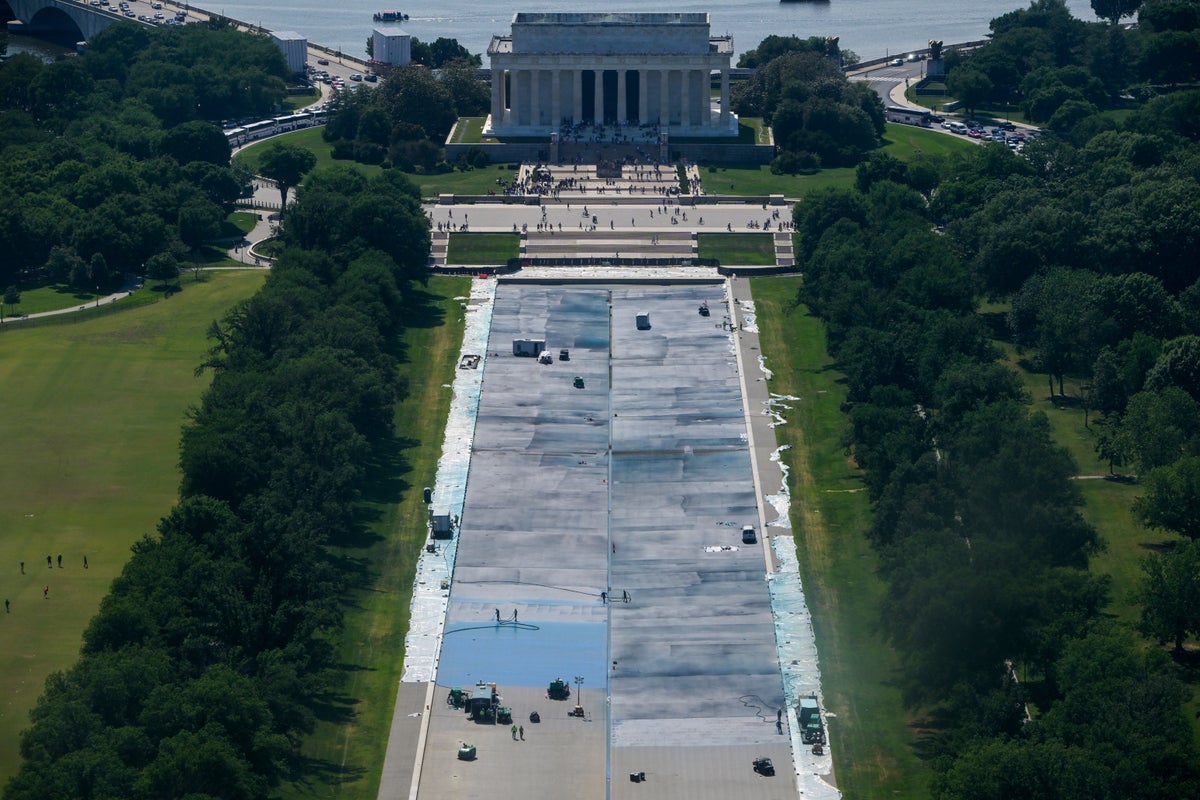
By early May 2026, the scorched-earth approach to federal bureaucracy reached the edge of the Lincoln Memorial. President Donald Trump, bypassing the traditional multi-year federal procurement cycles, has fast-tracked a radical aesthetic overhaul of the Lincoln Memorial Reflecting Pool. The project replaces the historic, often-algae-ridden granite basin with a high-performance, industrial-grade "American Flag Blue" coating.
The primary driver for this shift is a classic Trumpian trade-off: speed and visual "perfection" over historical preservation and high-cost structural masonry. While the National Park Service (NPS) originally estimated that a full structural repair of the leaking 1922 basin would cost roughly $300 million and take three years, the current administration has opted for a $2 million "swimming pool" style resurfacing. The goal was to have a sparkling, vibrant blue vista ready for the "America 250" celebrations by July 4, 2026.
The Engineering of an Aesthetic Pivot
For decades, the Reflecting Pool has been a maintenance nightmare. Built on a tidal flat, the structure suffers from differential soil settlement that has cracked the concrete and granite lining. In 2012, a $34 million restoration attempted to fix these leaks and installed a new filtration system, yet the water remained susceptible to sediment and biological growth.
The 2026 renovation takes a fundamentally different technical path. Instead of trying to heal the 104-year-old granite through traditional stone-setting—a process that involves painstakingly removing, cleaning, and resetting thousands of blocks—the current project treats the monument as a high-utilization aquatic facility.
From Monument to Swimming Pool
The process utilized "industrial-grade" pool toppings, a move that has stunned architectural historians. Traditionalists argue that the "blue" aesthetic destroys the intended mirror effect, which relies on a dark, deep bottom to reflect the sky and the Washington Monument. By making the bottom bright blue, the water shifts from a "reflecting" surface to a "display" surface.
The technical execution involved:
- Power Scrubbing: A deep mechanical cleaning of the existing 1922 granite.
- Grouting: Filling the pervasive leaks that the President famously described as "leaking like a sieve."
- Chemical Bonding: Applying a blue-tinted epoxy or polymer coating directly over the historic stone.
The Cost of Speed
The "why" behind this move is purely transactional. The administration’s disdain for the "three-year, $300 million" federal estimate isn't just rhetoric; it’s a critique of the federal government's inability to maintain its own infrastructure without astronomical price tags. By bringing in private swimming pool contractors—individuals the President has utilized for his personal real estate portfolio—the project was completed in a fraction of the time.
However, the "how" raises significant questions about long-term viability. Industrial coatings on top of settling granite are rarely a permanent fix. The thermal expansion of the granite versus the rigid polymer coating often leads to delamination. In a climate like Washington D.C., where winters freeze and summers bake, the $2 million fix may require annual touch-ups to prevent the blue surface from peeling away in unsightly sheets.
A New Vision for the National Mall
This renovation is not an isolated event. It is part of a broader "beautification" initiative that includes the demolition of the White House East Wing for a new ballroom and the proposed painting of the Eisenhower Executive Office Building white. The underlying philosophy is that the capital should look "clean and new" rather than "historic and weathered."
Critics argue that the Reflecting Pool was never meant to look like a Caribbean resort. The original architect, Henry Bacon, chose materials that would age and blend with the neoclassical surroundings. By forcing a vibrant "American Flag Blue" into the center of the Mall, the administration has fundamentally altered the visual gravity of the most visited site in the United States.
Whether this is seen as a triumph of common-sense business efficiency or a garish defacement of a national treasure depends entirely on one's perspective of what a monument should be. For now, the motorcades have already tested the surface, driving across the dry, blue-coated basin to prove its durability. The real test begins when the water returns and the 250th-anniversary crowds arrive.
Fix the leak, paint it blue, and move on to the next monument. That is the new standard for federal maintenance in 2026.